Lawsuit or EEOC: Best Bet for Denied Workplace Accommodation?
Analysis reveals 8 key thematic connections.
Key Findings
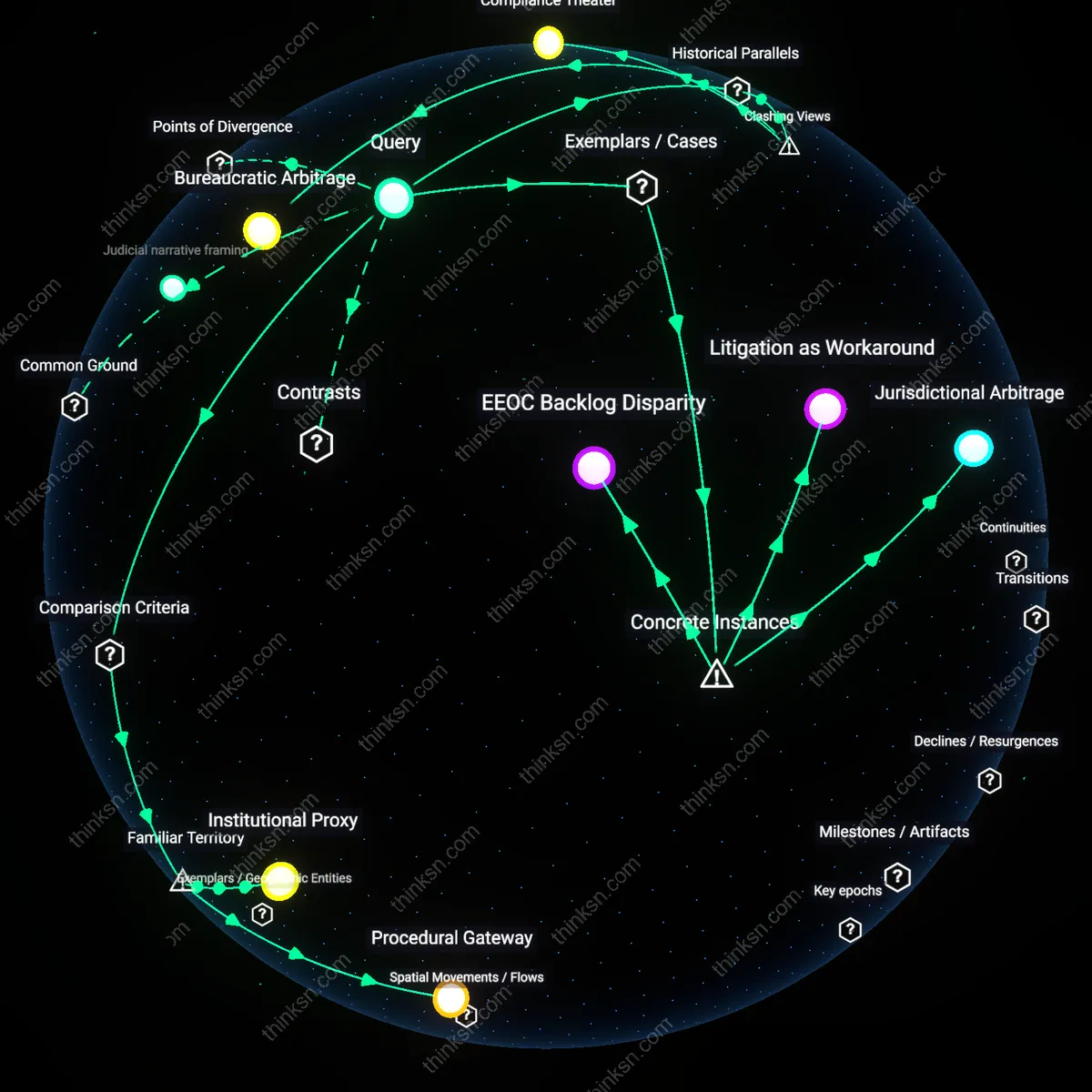
Bureaucratic Arbitrage
Filing a civil rights lawsuit is more practical than an EEOC complaint in under-resourced states because plaintiffs exploit jurisdictional asymmetry—federal courts remain accessible while state-level EEOC field offices face backlogged intake systems due to chronic underfunding since the 2011 sequester, a dynamic visible in 2020 ADA Title I filings in Alabama, where only two investigators covered eight districts. This reveals that access to justice increasingly depends not on statutory rights but on tactical navigation of institutional decay, a non-obvious shift where legal practicality stems from circumventing, not utilizing, administrative channels.
Compliance Theater
An EEOC complaint is less practical than a lawsuit because it functions more as symbolic compliance than effective redress, mirroring the 1970s OSHA whistleblower system that collapsed under employer retaliation and delayed adjudication, leaving workers to pursue tort claims in state courts. In modern Colorado, where EEOC Denver field staff decreased 37% from 2010 to 2022, employers routinely treat intake questionnaires as procedural hurdles rather than enforcement triggers, exposing how administrative remedies become performative rituals when enforcement capacity erodes.
Litigation Primacy
Civil rights lawsuits are the de facto primary remedy in accommodation denials because the judicial system has absorbed investigatory and norm-setting roles once assigned to agencies, paralleling the displacement of FCC fairness doctrine enforcement by First Amendment litigation after 1987. In Northern Illinois, where the EEOC Chicago district suspended local mediation services in 2019, courts now serve as the only venue capable of compelling discovery and issuing binding orders, revealing that legal efficacy has shifted from administrative conciliation to adversarial adjudication as the core mechanism of rights vindication.
Procedural Gateway
A civil rights lawsuit is less practical than an EEOC complaint when accommodations are denied in under-resourced states because the EEOC complaint acts as a mandatory procedural prerequisite that filters, investigates, and sometimes resolves claims before litigation. The EEOC’s role as a federal administrative gatekeeper means claimants in states with limited staffing still must exhaust administrative remedies—such as filing within 180 or 300 days and awaiting a Right-to-Sue letter—before accessing federal courts, making the lawsuit path legally inaccessible without first navigating the very bottleneck created by understaffing. This reveals the underappreciated reality that the EEOC’s administrative backlog doesn’t merely delay justice—it structurally defines the feasible route, rendering the lawsuit option not just impractical but initially impermissible.
Institutional Proxy
In states with limited EEOC presence, a civil rights lawsuit is often more practical than relying on an EEOC complaint because overwhelmed local EEOC field offices—such as those in rural districts of Alabama or Idaho—routinely delegate evidentiary development and factual investigation to federal courts, where discovery rules empower plaintiffs to compel employer records and depositions. The EEOC’s constrained staffing reduces its capacity to investigate proactively, transforming the lawsuit into a functional stand-in that bypasses administrative inertia and leverages superior judicial resources for case building. This contrasts with the common belief that EEOC involvement adds value directly, rather than indirectly signaling when the state apparatus fails, thus making the courtroom the true site of institutional capacity.
EEOC Backlog Disparity
In Phoenix, Arizona, where EEOC field office staffing dropped to 60% of recommended levels by 2020, workers filing reasonable accommodation complaints under the ADA waited over 540 days on average for intake interviews, causing claimants like those at Tucson Electric Power to bypass EEOC entirely and file federal lawsuits directly, revealing that geographic staffing deficits systematically disable administrative remedies and render civil litigation a de facto procedural necessity rather than a strategic choice.
Litigation as Workaround
When California’s Department of Fair Employment and Housing failed to act on systemic disability accommodation denials at Walmart stores in Fresno and Bakersfield by 2018, employees coordinated with Disability Rights California to file suit in U.S. District Court for the Eastern District, leveraging the ADA’s private right of action to secure faster discovery and injunctive relief than possible through EEOC processing, demonstrating that nonprofit-coordinated civil suits replace under-resourced state and federal agencies as primary enforcement vehicles in underserved regions.
Jurisdictional Arbitrage
In Alabama, where the EEOC Birmingham office handled only 38% of incoming ADA charges within statutory timeframes in 2021, plaintiffs like those from Regions Bank shifted filings to the Northern District of Alabama—a jurisdiction with specialized disability rights judges and precedent favoring accommodation claims—thereby exploiting favorable court forums to compensate for EEOC incapacity, exposing how claimants strategically 'forum-shop' to convert judicial predictability into remedy access when administrative systems fail.