Is Frequent Colonoscopy Worth the Time for IBD Patients?
Analysis reveals 11 key thematic connections.
Key Findings
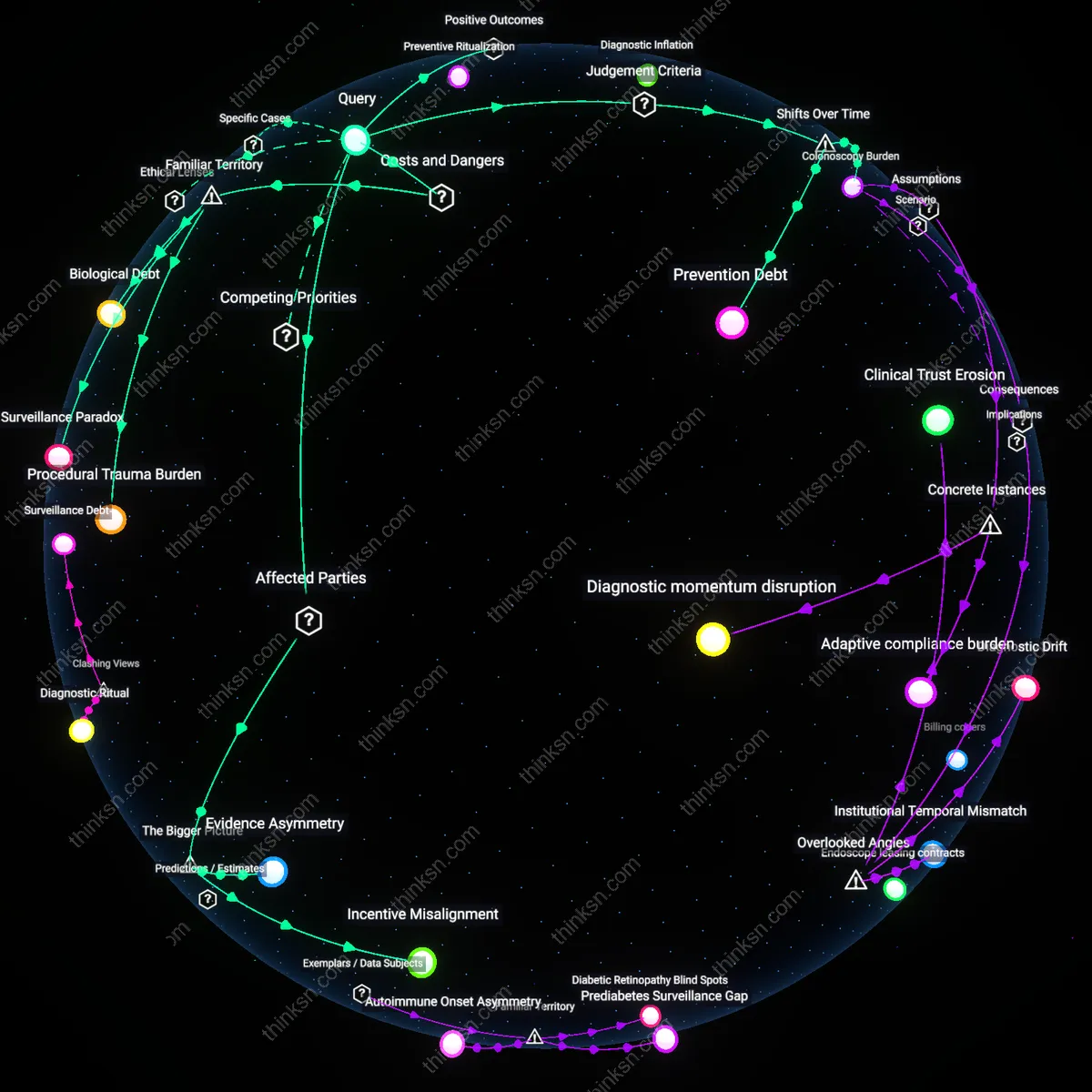
Diagnostic Debt
Individuals with chronic inflammatory bowel disease bear escalating surveillance burdens because healthcare systems offload long-term cancer risk management onto patients through repetitive colonoscopies, a mechanism driven by liability-averse clinical guidelines and fragmented care coordination; this creates a hidden cost where patients accumulate procedural fatigue without clear personal benefit, revealing how systemic risk aversion in gastroenterology converts uncertain population-level prevention goals into individualized, recurring obligations.
Incentive Misalignment
Patients with inflammatory bowel disease face disproportionate colonoscopy demands because provider reimbursement structures and institutional performance metrics prioritize procedure volume over patient-centered risk calibration, enabling a system in which endoscopy units benefit organizationally from high surveillance rates while patients absorb the physical, emotional, and opportunity costs; this dynamic exposes how fee-for-service infrastructures undermine shared decision-making in preventive care for chronic conditions.
Evidence Asymmetry
The uncertainty in colonoscopy benefits for IBD patients persists because clinical guidelines rely on extrapolated data from sporadic colorectal cancer studies rather than longitudinal IBD-specific carcinogenesis models, leaving individuals to navigate screening decisions using incomplete risk stratification tools shaped more by regulatory precedent than tailored evidence; this gap reflects how research funding priorities favor high-incidence cancers, systematically marginalizing the data needed for precise preventive strategies in chronic inflammatory conditions.
Colonoscopy Burden
Individuals with chronic inflammatory bowel disease should weigh colonoscopy frequency by the principle of proportional autonomy, which balances personal agency against clinical guidelines shaped by evolving surveillance protocols. This judgment relies on the moral principle of autonomy, recalibrated by medical authority to account for risk stratification rather than one-size-fits-all prevention, and becomes meaningful through the shift from uniform screening mandates in the 1990s to today’s risk-adapted guidelines influenced by biomarker validation and patient-reported outcomes. The mechanism—risk-tiered recommendations based on duration and extent of colitis, flat low-grade dysplasia, or cumulative biopsy burden—reveals that autonomy now operates not as unfettered choice but as negotiated compliance within a surveillance regime that emerged after the 2008 multi-society colorectal cancer consensus updated dysplasia management. What is non-obvious is that patient autonomy has not increased in absolute terms but been redistributed through clinical algorithms that assign differential surveillance intensity, making the burden of compliance itself a marker of risk category.
Prevention Debt
Patients must assess colonoscopy burden against cancer detection benefits by applying the economic principle of efficiency, specifically cost-effectiveness across a lifetime trajectory of care, where early and frequent interventions accumulate hidden personal and systemic costs. This efficiency calculus emerged from a historical shift between the 1980s and 2005, when colonoscopy transitioned from an infrequently used diagnostic tool to the dominant mode of colorectal cancer prevention in high-risk populations, driven by Medicare reimbursement changes and gastroenterology professionalization. The system operates through insurance-covered surveillance intervals (every 1–3 years) that externalize individual time, pain, and procedural risk while internalizing long-term savings from avoided cancer treatments—revealing a prevention debt wherein present burdens are justified by uncertain future offsets. The underappreciated dynamic is that economic efficiency here depends on patient endurance subsidizing population-level risk reduction, a trade-off normalized only after the rise of managed care governance in the 1990s made cost-averted metrics central to clinical guidelines.
Preventive Ritualization
Individuals with chronic inflammatory bowel disease gain psychological resilience and a sense of agency by treating colonoscopies as structured, predictable rituals rather than medical gambles, which transforms anxiety into disciplined self-management through the regular timing and routinization of surveillance within specialized gastroenterology clinics. This shift elevates adherence not because patients better understand cancer risk reduction, but because the procedure acquires stabilizing social and temporal meaning—akin to religious or civic rites—anchoring identity amid chronic illness. The non-obvious insight is that perceived medical benefit may be less motivating than the psychological need for order, challenging the assumption that risk-benefit calculations drive compliance.
Diagnostic Inflation
Frequent colonoscopies generate actionable findings that are clinically ambiguous—such as indeterminate dysplasia or low-grade inflammation changes—which are disproportionately interpreted as precancerous, leading to escalated interventions that create the illusion of life-saving detection while often responding to lesions that would never progress. This dynamic, sustained by liability-averse gastroenterologists and patient advocacy norms in U.S. academic medical centers, inflates the perceived utility of surveillance by counting non-lethal abnormalities as 'prevented cancers.' The underappreciated consequence is that the system rewards intervention over patience, subverting the original goal of early detection by manufacturing urgency where none biologically exists.
Biological Citizenship
Patients leverage colonoscopy participation to claim recognition and access within healthcare systems, transforming each procedure into a credential that validates their identity as responsible, proactive disease managers deserving of treatment priority, medication access, and inclusion in clinical trials. In public health systems like the UK’s NHS or veteran networks in the U.S., consistent surveillance adherence becomes a performative requirement for remaining 'visible' and eligible for care advancements. The counterintuitive reality is that colonoscopies often serve less as cancer prevention tools than as bureaucratic tokens in a system where medical belonging must be continually earned, exposing the moral economy underlying clinical surveillance.
Procedural Trauma Burden
Individuals should decline additional colonoscopies when prior procedures have induced clinically significant anxiety or physical injury because repeated endoscopic interventions in inflamed or scarred bowel tissue increase risks of perforation, bleeding, and hospitalization, particularly in patients with active Crohn’s disease or ulcerative colitis—systems like routine surveillance protocols often overlook personalized physiological deterioration, rendering population-level guidelines potentially harmful at the individual level; this is underappreciated because public discourse frames colonoscopy as uniformly safe, eliding the cumulative toll of invasive monitoring in fragile gastrointestinal tracts.
Surveillance Paradox
Patients should resist automatic enrollment in lifelong colonoscopy cycles because the very act of frequent monitoring can generate new pathologies—such as dysplasia induced by repeated bowel preps or interval cancers accelerated by inflammation from instrument trauma—mechanisms embedded in gastroenterology infrastructure that assume surveillance is neutral, when in fact the tools of detection may alter disease trajectories; this is rarely acknowledged despite being visible in longitudinal IBD cohorts, because the dominant cultural script equates vigilance with safety, obscuring iatrogenic feedback loops.
Biological Debt
Patients must limit colonoscopies when their disease history includes colectomy or immunosuppression because each additional procedure extracts a metabolic toll—through gut microbiome disruption, systemic immune activation, and mucosal healing interference—that compromises long-term resilience, a mechanism sustained by clinical routines that treat the bowel as a static inspection site rather than a dynamic physiological system; this erosion is invisible in standard outcome metrics, yet aligns with common patient reports of declining stamina post-procedure, which are dismissed as anecdotal despite their recurrence across IBD communities.