Do Priority Dates in Immigration Favor Some Nationalities Over Others?
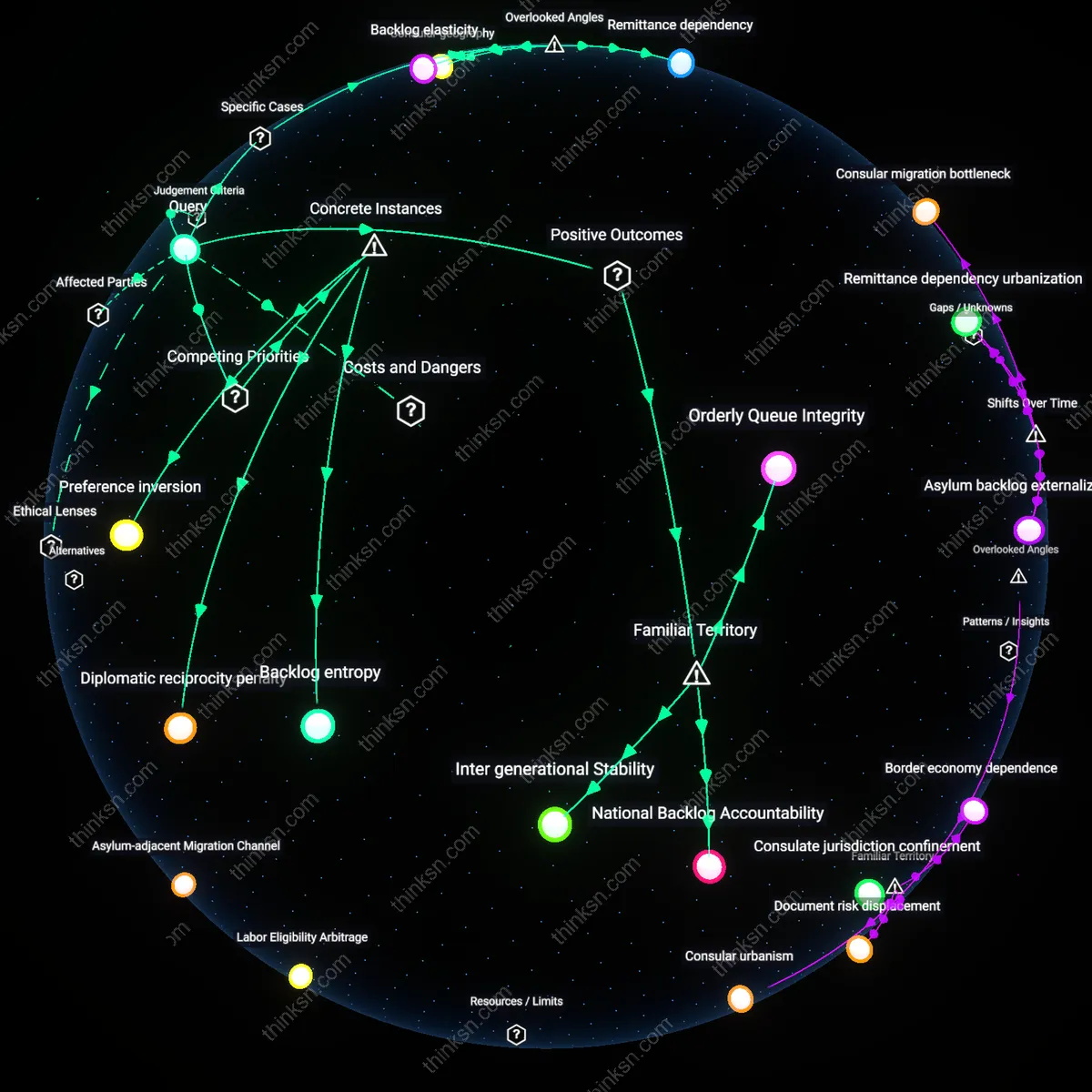
Analysis reveals 10 key thematic connections.
Key Findings
Geographic Arbitrage
The priority date system creates perverse incentives for immigration strategizing based on familial geography rather than kinship closeness, privileging those who can reposition across borders to access faster-moving queues. When a U.S. citizen sponsors a sibling from a low-demand country versus one from India, the difference in processing time exceeds 15 years, despite identical legal standing—this disparity fuels strategic use of third-country residence or temporary migration to reset eligibility pathways. The system thus rewards mobility and access to alternative residency, transforming family reunification into a stratified process where logistical flexibility outweighs familial need. The unacknowledged dynamic is that visa access is increasingly mediated by transnational maneuvering, not moral claims of kinship.
Orderly Queue Integrity
The priority date system fairly allocates visas by enforcing chronological order, which prevents arbitrary favoritism and ensures equitable treatment among family-sponsored applicants within the same nationality. This mechanism anchors visa distribution to a transparent timestamp—each applicant’s place in line is determined by petition receipt date, administered through the U.S. Citizenship and Immigration Services (USCIS) and tracked via the Department of State’s monthly visa bulletin. While widely perceived as a neutral administrative feature, its deeper significance lies in upholding public trust in immigration as a rule-based process, especially for immigrant communities who depend on predictability across years or decades—making fairness manifest not through speed but through procedural consistency.
National Backlog Accountability
The priority date system creates systemic disadvantages for nationals of high-demand countries like Mexico and the Philippines by rigidly enforcing per-country caps that interact with fixed annual visa numbers, producing multi-decade waits unseen in lower-demand nations. This bottleneck effect operates through Congressionally mandated limits—7% per country for family-sponsored preferences—amplifying the impact of cumulative demand imbalances tracked in the State Department’s visa availability charts. Though commonly blamed on 'long lines,' the underappreciated reality is that the system inadvertently penalizes nationality itself, making fairness contingent not on familial ties but on demographic scale and migration history—a structural inequity baked into the arithmetic of allocation.
Inter generational Stability
The priority date system enhances family unity over time by enabling derivative benefits and age-out protections that preserve kinship structures across extended waiting periods, particularly under provisions like CSPA (Child Status Protection Act). This stability emerges through USCIS adjudication of petitions where adult U.S. citizens sponsor parents or siblings, creating interlocking chains of eligibility that maintain household coherence despite delays. While public discourse often frames backlogs as failures, the unacknowledged utility is that these time-bound transitions allow children to age into adult sponsorship eligibility, transforming prolonged waits into phased family integration—thus converting bureaucratic delay into a form of social continuity.
Backlog entropy
The priority date system entrenches delays for Indian family-sponsored immigrants due to per-country caps interacting with high demand, as seen in the 2023 Visa Bulletin where Category F2A applicants from India faced wait times exceeding eight years—longer than applicants from most other nations. This backlog compounds non-linearly because even modest annual oversubscription creates multi-year queues that persist across decades, exposing how numerical fairness in allocation produces systemic inequity in outcome. The mechanism—fixed caps combined with first-come, first-served processing—fails to adjust for demographic pressure, making time itself a structurally discriminatory variable. What is underappreciated is that the system’s procedural neutrality amplifies rather than mitigates inequality when demand heterogeneity is ignored over time.
Diplomatic reciprocity penalty
Mexican nationals seeking family reunification through the F3 category (married sons/daughters of U.S. citizens) face disproportionately long waits—not due to volume alone, but because U.S. immigration policy indirectly penalizes asymmetrical migration patterns rooted in historical labor inclusion, as evidenced by the Bracero Program’s legacy (1942–1964). That program encouraged circular migration without legal pathways to permanence, creating intergenerational sponsorship chains that now strain the priority date system, while no equivalent pressure exists for countries without such embedded labor interdependence. The system treats this outcome as a neutral queue, but it is actually a deferred cost of prior policy choices that prioritized economic utility over legal integration. The non-obvious insight is that past diplomatic and labor agreements become embedded as latency in present-day family visa processing.
Preference inversion
Filipino immigrants in the F4 category (siblings of adult U.S. citizens) experience wait times exceeding 25 years, longer than any other nationality, due to sustained demand outpacing the 65,000 annual cap and per-country limits, creating a de facto reversal of the family-based hierarchy that values immediate relatives over extended kin. The Philippine case reveals how a policy designed to prioritize nuclear families collapses into equivalence across preference levels when queue length negates categorical distinctions. This inversion persists because Congress has not adjusted category ceilings since the 1990 Immigration Act, rendering the ranking system symbolic rather than functional. What is overlooked is that temporal delay can erase legislative intent, making the visa hierarchy a ritual rather than an operational structure.
Backlog elasticity
The priority date system disproportionately disadvantages applicants from high-demand countries like Mexico and the Philippines by freezing visa availability for decades, not due to statutory caps alone but because demand volatility is structurally absorbed by wait times rather than supply adjustments. The mechanism operates through the family-sponsored preference categories—especially F2A and F4—where Filipino spouses or siblings of U.S. citizens face wait times exceeding 20 years despite minimal annual per-country cap violations, revealing that the system’s inability to scale processing in response to accumulated demand creates a form of temporal inequity. This backlog elasticity—where delays expand to contain overflow instead of triggering proportional administrative or legislative correction—masks the true cost of policy inertia and shifts fairness from allocation rules to time-based attrition, a dimension rarely modeled in immigration equity assessments.
Consular geography
Applicants from countries such as Egypt or Pakistan experience compounded disadvantage under the priority date system not primarily due to visa demand but because consular processing bottlenecks in under-resourced embarks like Cairo or Islamabad delay final adjudication even after priority dates become current. These posts operate with fixed staffing and security-clearance throughput regardless of visa category surges, creating a hidden geographic toll where the same priority date yields different realization times based on embassy capacity rather than statutory entitlement. This spatial compression—where the final step of immigration is gated by diplomatic infrastructure rather than immigration law—reveals a territorial asymmetry in visa equity that bypasses legal analysis but determines actual access, a factor absent from most critiques focused on quotas or preferences.
Remittance dependency
In nations like Jamaica or the Dominican Republic, the priority date system indirectly reinforces economic precarity by tethering family reunification to prolonged separation that sustains remittance-dependent local economies, thus creating passive state-level disincentives to push for faster processing. Extended wait times—often 10–15 years in F2B or F3 categories—embed migrant financial contributions into community survival strategies, making accelerated visa issuance a potential economic disruption rather than an unalloyed good. This remittance dependency introduces a feedback loop where the developmental impact of delayed migration alters the political calculus of origin governments, who may tacitly accept systemic delays as a form of external fiscal support, a dynamic invisible in U.S.-centric policy debates that assume all stakeholders uniformly seek speedier adjudication.