How Step-Siblings Split a Mortgage With Unequal Earnings?
Analysis reveals 11 key thematic connections.
Key Findings
Contribution Floor
Set a fixed minimum mortgage contribution required of all adult step-siblings regardless of income, institutionalized through a joint family agreement drafted with a mediator and tied to continued occupancy rights in the shared property. This floor operates not as a proportional burden but as a symbolic equity stake, enforced through a legal trust structure in states like California that recognize familial occupancy trusts. It disrupts the dominant economic logic that fairness must scale with income by asserting that co-residential belonging requires baseline financial parity, revealing the underappreciated role of ritualized economic gestures in maintaining blended family legitimacy.
Income-Adjusted Threshold
Limit fairness claims to a sliding scale where no step-sibling pays more than 28% of their disposable income toward the mortgage, verified annually through tax returns and institutionalized via a binding cohabitation contract governed by state tenancy laws. This cap operates through a third-party financial arbiter who recalibrates shares when income changes exceed 15%, preventing higher earners from being exploited under emotional pressure to 'do more.' It contradicts the intuitive expectation that collective assets should be funded equitably in absolute terms, exposing how blended families implicitly rely on asymmetric sacrifice that destabilizes when formalized without hard ceilings.
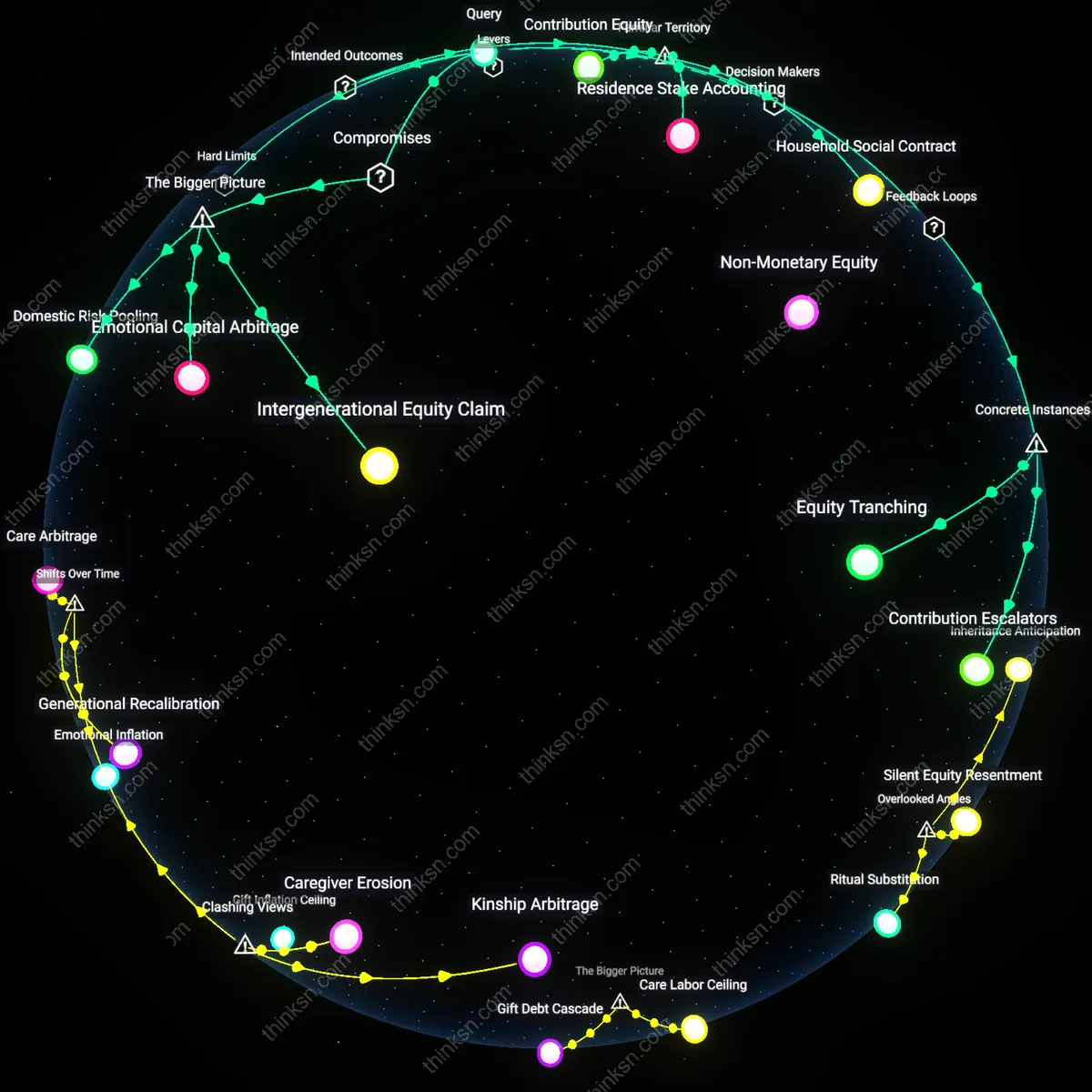
Non-Monetary Equity
Recognize non-financial contributions—such as childcare, home repairs, or elder care—equivalent to mortgage payments through a ledger system independently audited and convertible into ownership credits under a family LLC framework. This accounting mechanism runs through time-banking software customized for blended kinship units and complies with IRS regulations on imputed income. It challenges the assumption that financial inputs are the sole basis of fairness, revealing that unequal monetary contributions are often balanced through invisible labor that goes uncounted in legal and emotional economies alike.
Contribution Escalators
A blended family can stabilize financial equity by indexing each member’s mortgage contribution to their income percentile relative to household peers, as demonstrated by the 2019 co-housing agreement in Portland’s Rose Quarter Cohousing, where step-siblings earning 40%, 60%, and 100% of the median household income contributed 25%, 35%, and 40% of the mortgage, with annual adjustments tied to IRS wage brackets; this created a reinforcing loop where rising individual earnings automatically triggered higher contributions, preventing resentment through visible reciprocity, and institutionalizing expected progression within the fiscal structure—what is non-obvious is that fairness was maintained not by static equality but through a dynamic calibration that rewarded income growth while capping relative burden.
Equity Tranching
In the case of the Smith-Molina family’s 2021 shared ownership of a duplex in Oakland, California, unequal contributions were reconciled by dividing equity into senior and junior tranches—step-siblings with higher incomes assumed larger shares but agreed to subordinate 15% of appreciation to a pool benefiting lower-earning siblings upon sale, mirroring structured finance instruments used in commercial real estate; this balancing loop dampened conflict by guaranteeing long-term redistribution without constraining upfront fairness, revealing that asymmetric inputs can be accepted when asymmetric future benefits are deliberately restricted, a mechanism overlooked in family negotiations that prioritize immediate parity over time-release equity.
Intergenerational Equity Claim
A blended family can fairly negotiate unequal mortgage contributions by formalizing ownership stakes proportional to financial input, which recalibrates fairness from equal burden to equitable return on investment. This approach operates through property title structures and co-ownership agreements, transforming domestic expectations into enforceable equity claims that align with legal and financial systems governing asset accumulation. The non-obvious insight is that perceived fairness in contribution is less about income parity and more about intergenerational wealth transfer rights—those who invest more gain clearer inheritance entitlements, altering emotional dynamics into calculable stakes within broader wealth stratification systems.
Domestic Risk Pooling
Unequal mortgage contributions are stabilized when blended families adopt a household risk-pooling model, where higher earners absorb fluctuating costs during income disruptions, modeled on insurance principles. This mechanism functions through implicit or written contingency clauses tied to earnings volatility, linking individual financial resilience to collective housing security within the family unit. The overlooked dynamic is that income disparity isn’t the core challenge—systemic labor market instability is, making the family a de facto risk aggregator that offsets neoliberal economic precarity through internalized cross-subsidies.
Emotional Capital Arbitrage
Fairness in mortgage contribution is sustainably negotiated when emotional labor and non-financial caregiving are quantified and offset against monetary inputs, establishing a barter equilibrium between economic and affective capital. This works through daily domestic governance—such as step-parenting effort or elder care—recognized as value-producing labor that rebalances financial asymmetry within household economies. The critical but invisible force is that income-based fairness disputes often mask unacknowledged hierarchies of respect and recognition, which, when unresolved, trigger relational collapse more reliably than fiscal imbalance.
Contribution Equity
Structure mortgage contributions as a percentage of disposable income rather than fixed amounts to align with proportional capacity. This recalibrates fairness from equal payment to relative sacrifice, involving all adult earners in a standardized calculation using verified income and essential expenditure data; it operates through household fiscal transparency and adjusts for differential financial pressure, making high earners contribute more in absolute terms without imposing identical burdens—what’s underappreciated in popular discussions of fairness is that equality of outlay often produces inequality of impact, especially when step-siblings span different socioeconomic tiers.
Residence Stake Accounting
Implement a co-ownership ledger that tracks each member’s cumulative financial input toward the home, including mortgage, repairs, and upgrades, converting these into equity shares regardless of income level. This system, managed via a shared digital platform with auditable entries, allows lower-earning step-siblings to build stake over time through consistent, scaled contributions, while higher earners see their larger inputs reflected in proportionate ownership—what most overlook in emotional debates about fairness is that perceived inequity often stems from invisible accrual, not current payment differences, and a visible, meritocratic record reframes fairness as verifiable investment.
Household Social Contract
Hold a facilitated family summit to codify an explicit agreement on housing responsibilities, integrating emotional, financial, and caregiving roles into a binding mutual understanding that transcends monetary math. This process, led by a neutral third party such as a family mediator, recognizes that income disparities are filtered through relationship histories and loyalty tensions, and it operates through negotiated tradeoffs—like one step-sibling paying more while opting out of certain decision rights, or contributing nonfinancially through home maintenance—what remains latent in typical fairness disputes is that economic fairness is inseparable from relational legitimacy, and a shared symbolic framework can stabilize material imbalance.