How Does Wealth Influence Pre-Trial Detention Decisions?
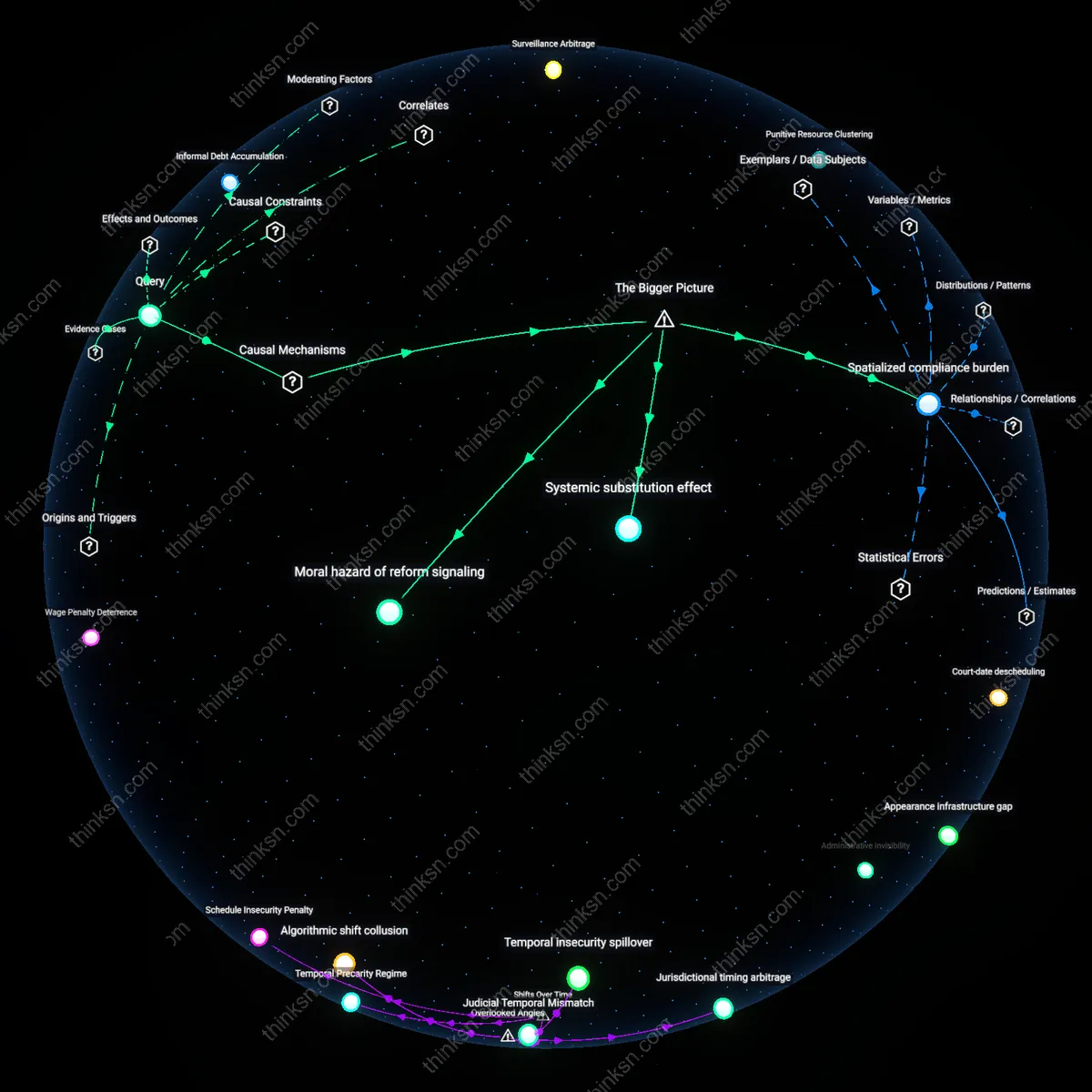
Analysis reveals 9 key thematic connections.
Key Findings
Fiscal Federalism
Local court practices amplify geographic disparities in pre-trial detention because counties with lower economic capacity rely on fine-driven justice systems that incentivize detaining indigent defendants; this mechanism is sustained by state-level fiscal decentralization that ties court funding to local revenues, creating a structural dependency on punitive revenue generation in poorer jurisdictions. The deeper systemic driver is not judicial bias but the devolution of financial responsibility to local governments, which transforms court operations into instruments of fiscal survival in economically distressed areas. This reveals how macroeconomic governance structures—specifically, the assignment of fiscal authority—mediate the implementation of criminal justice policy, making fiscal federalism an underappreciated determinant of detention outcomes.
Magistracy Autonomy
Pre-trial detention disparities arise because local judges in low-income jurisdictions wield unchecked discretion in setting bail, often aligning with law enforcement norms that equate detention with public safety, particularly where judicial appointments are politicized or shaped by local electoral pressures. This autonomy becomes a mechanism of inequality when economic scarcity limits the availability of public defense and community-based alternatives, effectively institutionalizing detention as the default. The non-obvious insight is that judicial independence—typically seen as a democratic safeguard—can exacerbate inequity in under-resourced settings when it operates without countervailing oversight or standardized benchmarks, turning local courtrooms into nodes of spatialized punishment regimes.
Poverty Legibility
Economic status shapes pre-trial detention outcomes because local courts in resource-constrained jurisdictions use detention as a risk management tool when they lack the administrative capacity to verify defendants’ community ties or employment status, effectively treating poverty as a proxy for flight risk. This practice persists because underfunded pre-trial services cannot conduct individualized assessments, forcing reliance on observable markers like housing instability or unemployment—signs of economic marginalization that become legally consequential through operational expediency. The overlooked dynamic is how institutional incapacity converts socioeconomic vulnerability into legal jeopardy, rendering poverty not just a background condition but a procedural signal within judicial decision-making circuits.
Judicial Signaling
Pre-trial detention disparities are driven not by economic inequality itself, but by judges in high-volume dockets using detention as a procedural signal to manage courtroom efficiency, disproportionately applying it in jurisdictions where indigent defendants are processed in assembly-line arraignments. Court supervisors in urban centers like Harris County, Texas, tolerate higher detention rates because non-financial bonds or quick dispositions act as performative markers of control, enabling judges to clear dockets while appearing tough on crime—this mechanism renders economic status a secondary variable to judicial workplace culture. The non-obvious insight is that reforming bail schedules does little unless it alters how judges perceive their role in managing court workflow, exposing that detention functions less as a response to risk than as bureaucratic theater.
Prosecutorial Arbitrage
Local court practices amplify geographic disparities in pre-trial detention not through overt bias, but because prosecutors in resource-constrained rural counties weaponize detention eligibility to extract guilty pleas from low-income defendants who cannot afford even modest bonds, effectively arbitraging the time value of liberty. In jurisdictions like eastern Kentucky, where public defender capacity is minimal and plea bargaining dominates, prosecutors file detention motions not based on flight risk but on the likelihood that indigent defendants will accept deals to exit jail within days, turning economic vulnerability into prosecutorial leverage. This reveals that economic status interacts with court practice not through formal rules but through informal temporal pressure, challenging the assumption that urban-rural disparities stem from judicial philosophy rather than structural bargaining asymmetries.
Data Obfuscation
Geographic disparities in pre-trial detention are sustained not by explicit class discrimination but by local courts systematically failing to collect or report standardized data on defendant income, bond amounts, and release outcomes, allowing economically stratified practices to persist under the guise of procedural neutrality. In counties across Alabama’s Black Belt, clerks do not integrate financial assessments into pre-trial services, making it impossible to audit whether indigent defendants are held at higher rates—this administrative omission functions as a de facto policy that shields disparities from scrutiny. The overlooked reality is that the absence of data is not passive neglect but an active mechanism preserving inequity, reframing transparency as a contested political act rather than a technical oversight.
Cash Bail Dependence
Higher economic status reduces pre-trial detention because wealthier defendants can afford cash bail in local jurisdictions where courts rely on it as a condition of release. In counties with cash bail regimes—common in southern and midwestern U.S. states—defendants’ ability to pay directly determines whether they remain jailed pre-trial, making local court practices a gatekeeper to economic privilege. This dependence is often assumed in public discourse around jail overcrowding and class bias, yet the non-obvious reality is that even minor charges trigger detention when cash bail is mandated and unaffordable, exposing how routine fiscal logic entrenches incarceration for the poor.
Public Defender Capacity
Lower economic status increases likelihood of pre-trial detention in areas where underfunded public defender offices cannot negotiate timely hearings or bail reductions in overburdened urban courts. In jurisdictions like New Orleans or Detroit, where public defenders manage hundreds of cases annually, delays in legal advocacy allow prosecutorial and judicial norms favoring detention to go unchallenged, particularly for indigent defendants. While people commonly link poverty to worse legal outcomes, the underappreciated point is that systemic under-resourcing of defense counsel—distinct from policing or sentencing—actively sustains geographic disparities by weakening a key check on detention decisions.
Risk Tool Standardization
Local court practices that adopt standardized risk assessment tools reduce the influence of economic status on pre-trial detention by formally decoupling release decisions from bail payments, as seen in New Jersey and Washington, D.C. These tools, now widespread in reform-minded jurisdictions, shift discretion from financial capacity to algorithmic forecasts of flight risk or danger, which are believed—however contestably—to neutralize class bias. The familiar narrative holds that replacing cash with risk metrics advances equity, but the non-obvious consequence is that such tools embed new forms of structural bias when trained on historically skewed data, ultimately reconfiguring rather than eliminating the role of socioeconomic background.