Is Securing Primary Residence Worth the Emotional Cost for Kids?
Analysis reveals 9 key thematic connections.
Key Findings
Developmental Priority
A parent should prioritize a child's emotional stability over financial benefits because early emotional environments biologically embed in neurodevelopment, as seen in the Bucharest Early Intervention Project, where institutionalized children exhibited lasting cognitive and emotional deficits despite later financial stability after foster care placement, revealing that neural plasticity windows constrain remediation; this demonstrates that financial advantages cannot retroactively repair disrupted attachment systems, a non-obvious truth obscured by assumptions of material compensation sufficiency.
Structural Incentive
A parent should recognize that financial incentives in custody disputes often distort caregiving authenticity, evidenced by the implementation of child support enforcement policies in the United States during the 1980s–90s, where monetized custody outcomes led some parents to prolong litigation for economic gain rather than disengage for emotional protection, illustrating how state-administered payment systems can inadvertently incentivize conflict, a dynamic often overlooked in favor of presuming financial provision equates to care.
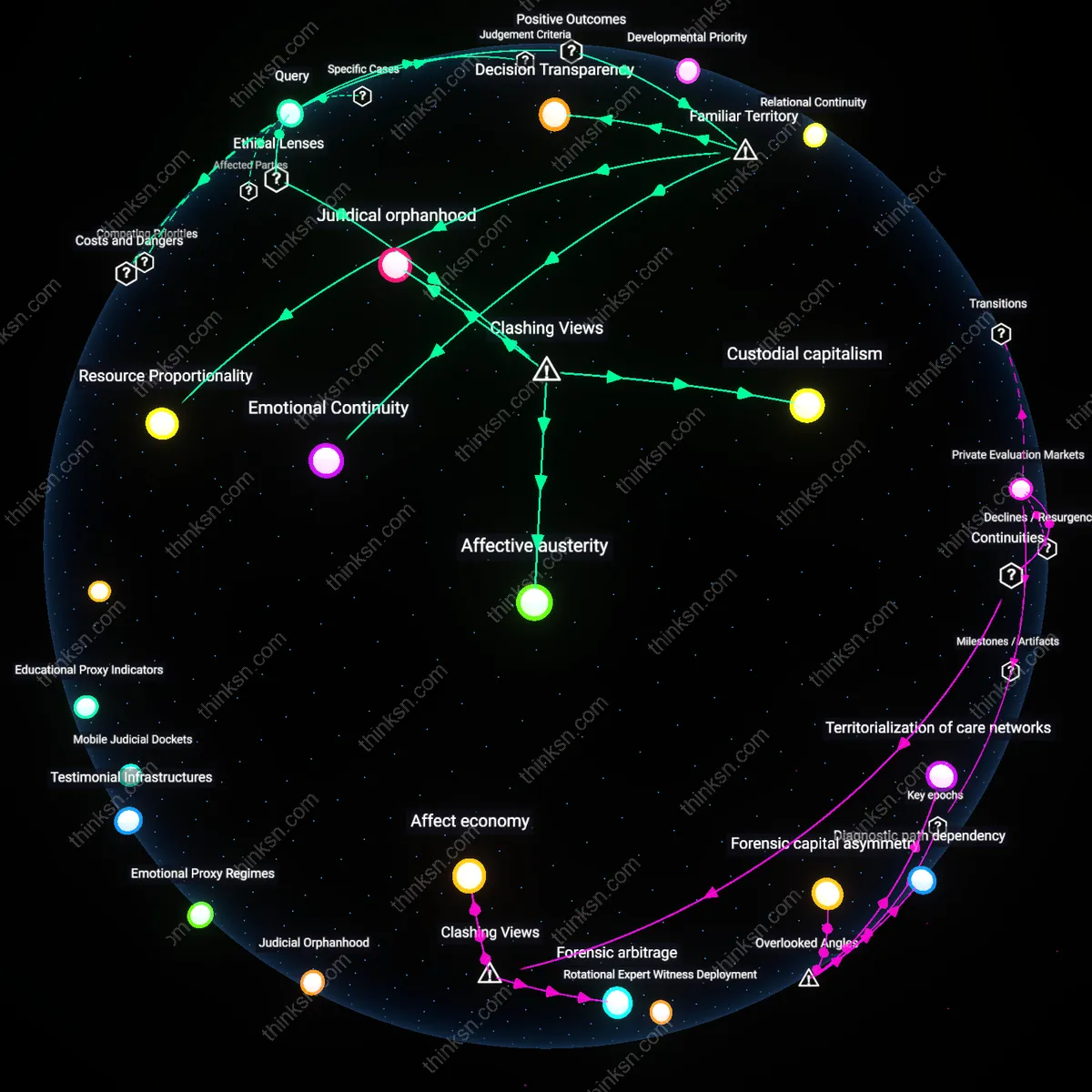
Relational Continuity
A parent should safeguard emotional stability by maintaining consistent caregiving relationships even at financial cost, as demonstrated by New Zealand’s Family Court integration of whānau decision-making, where extended family networks assumed custody under the principle of whanaungatanga (relationship permanence), often foregoing state benefits to preserve cultural and emotional bonds, revealing that indigenous governance models treat relational memory as foundational to identity—contrasting Western legal emphasis on individual economic capacity.
Emotional Continuity
Prioritize the child’s consistent access to trusted caregivers and established routines over financial gains. This maintains psychological safety through predictable attachment patterns, leveraging school, neighborhood, and familial networks the child already relies on; the underappreciated insight is that financial stability is often fungible across households, but rupturing familiar emotional scaffolding triggers long-term regulatory deficits in stress response systems.
Resource Proportionality
Match financial benefits to developmental needs rather than maximizing income transfer. Direct funds toward specific supports like therapy, extracurriculars, or educational access only when they demonstrably expand the child’s agency; the overlooked reality is that people conflate money with care, but disproportionate financial investments without emotional availability often inflate expectations while eroding relational trust.
Decision Transparency
Involve the child in age-appropriate custody discussions to reinforce autonomy and reduce helplessness. Structured input—such as court-appointed intermediaries or family councils—creates legitimacy in outcomes, even when financial trade-offs are made; what’s rarely acknowledged is that children prioritize being heard over material conditions, and procedural fairness itself becomes a stabilizing psychological anchor.
Custodial capitalism
Prioritize financial assets only when they directly fund therapeutic infrastructure proven to repair documented attachment disruptions, because courts in states like California increasingly admit empirically monitored mental health outcomes into custody determinations under the 'best interest of the child' doctrine, revealing that economic advantage without emotional rehabilitation mechanisms amplifies developmental risk—a challenge to the intuitive equation of wealth with stability.
Affective austerity
Reduce emotional well-being to a deferrable investment when the custodial parent demonstrates capacity to leverage economic gains into future psychological access, as seen in transnational custody cases where migrant parents in Gulf States accumulate capital to later afford elite trauma-informed schooling abroad, subverting the dominant Western therapeutic imperative by treating emotionality as a temporally negotiable resource within long-term kinship strategy.
Juridical orphanhood
Sever direct parental contact entirely if either caregiver instrumentalizes the child as a conduit for financial claims, as increasingly enforced in German family courts under §1666 BGB, where prolonged exposure to litigious economic negotiation triggers automatic psychological harm designations, exposing how legal systems are beginning to treat emotional stability as a condition incompatible with monetized custody bargaining.