Personal Risk vs Population Data in Cardiovascular Treatment?
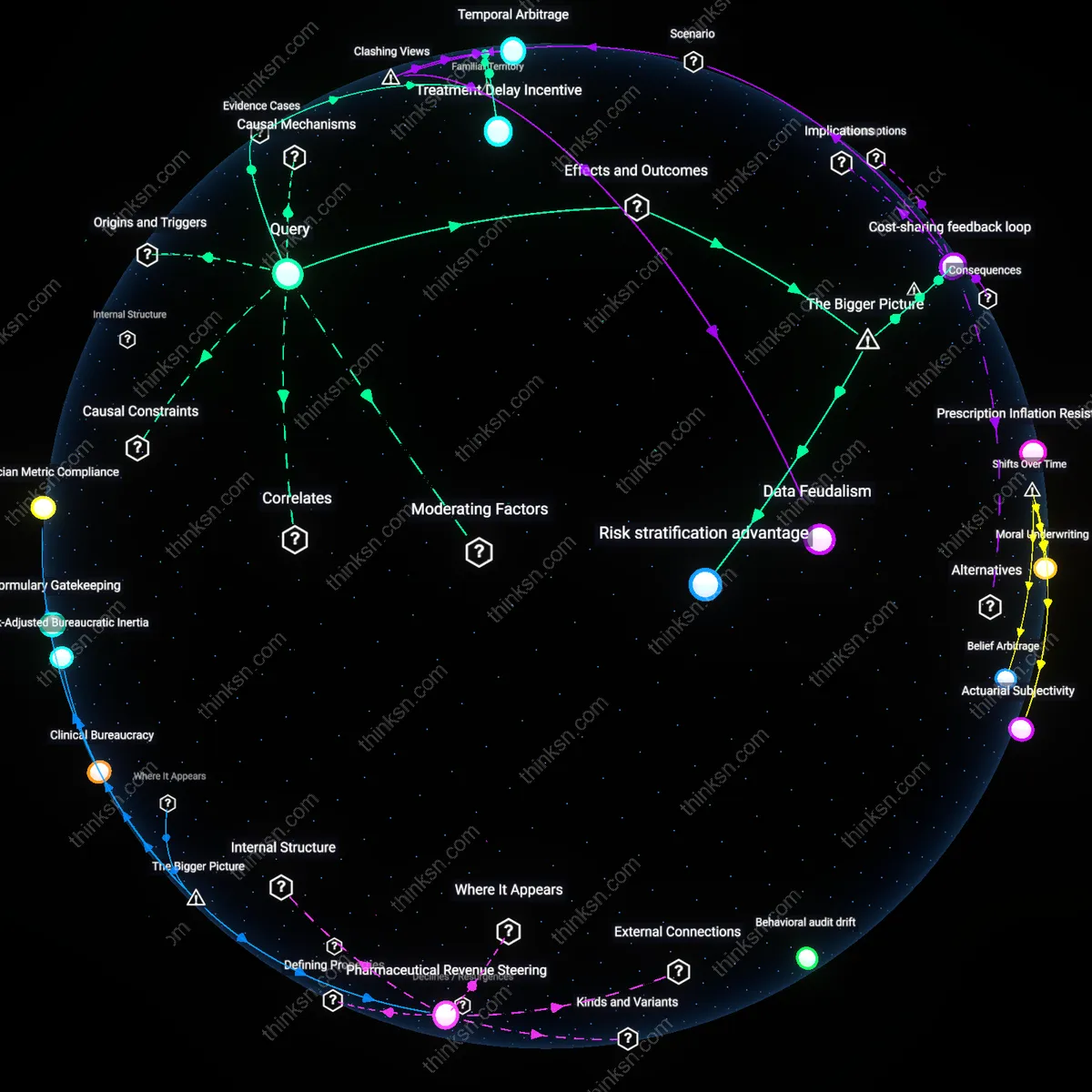
Analysis reveals 9 key thematic connections.
Key Findings
Clinical Discretion
Treatment decisions must defer to physicians’ judgment when patient-specific factors undermine population calculator validity. Doctors in primary care settings integrate longitudinal observations—such as inflammatory burden, family history nuances, or unmeasured lifestyle risks—that risk algorithms like ACC/AHA or QRISK omit because they rely on fixed variables from pooled cohorts. This discretion is essential not because physicians override data, but because their authority operates through proscribed standards of accountability within malpractice and peer-review systems, making it a legally and ethically codified exception to algorithmic governance. The non-obvious element is that this discretion is not arbitrary but embedded in institutional safeguards that treat individual patient trajectories as clinical evidence.
Risk Re-Calibration
When a patient's actual biomarker trajectory contradicts static risk calculator projections, recalibrating that individual’s risk using serial measurements—like coronary artery calcium scoring or LDL trends over time—becomes the necessary step. This mechanism, used in specialized lipid clinics and cardiology follow-ups, replaces single-timepoint population estimates with dynamic personal baselines, exploiting the divergence between stable population percentiles and shifting individual markers. What’s underappreciated is that recalibration doesn’t reject population data but repositions it as a starting hypothesis rather than a diagnostic endpoint, transforming risk from a classification into a process.
Guideline Adaptation
Treatment must follow formal risk-tier protocols unless contraindications are explicitly documented in national guideline annexes, such as those issued by the European Society of Cardiology or NICE. These structured exceptions—like familial hypercholesterolemia or chronic kidney disease—are pre-approved deviations that maintain adherence to standardized care while permitting individualization within sanctioned boundaries. The underappreciated reality is that these guidelines already encode flexibility through conditional pathways, meaning true conflict arises not from patient uniqueness per se, but from whether that uniqueness matches a codified exception within the existing decision tree.
Data Friction
Treatment decisions should integrate patient-specific risk markers that contradict population models by activating feedback from clinical outliers to recalibrate risk algorithms. When clinicians act on discrepant data—such as a patient with low calculated risk but severe coronary calcium—they generate counter-evidence that exposes model drift; this data friction, if systematically captured in registries like the American College of Cardiology’s PINNACLE database, creates a balancing loop that slows the overgeneralization of population tools. Most risk-discordance analyses focus on physician judgment or patient preferences, but the mechanical resistance of anomalous clinical observations—when fed back into algorithm development cycles—acts as a regulatory check on calibration drift, a dynamic typically erased in static 'accuracy' metrics.
Prescribing Scripts
Treatment decisions should be guided by identifying when a clinician’s reliance on population calculators overrides experiential red flags due to institutional pressure to adhere to guideline-based throughput. In high-volume cardiology clinics, the use of risk calculators becomes embedded in prescribing scripts—automated workflows that link calculators directly to electronic health record (EHR) decision alerts and medication templates—creating a reinforcing loop where adherence begets efficiency, which reinforces adherence. This script dependence marginalizes clinician intuition about individual anomalies, not due to cognitive bias but because deviating requires time-coded effort against productivity incentives; the overlooked dynamic is that the calculator’s influence is less epistemic than operational, embedded in time-economy structures of care delivery.
Silent Recalibration
Treatment should be informed by the unrecorded adjustments clinicians make when population risk scores conflict with patient presentation, particularly in marginalized populations where risk calculators underperform. For example, Black patients frequently present with higher coronary artery calcification at lower calculated risk scores, leading some cardiologists to silently escalate statin recommendations despite guideline discordance—adjustments rarely documented but preserved in informal peer networks. These covert corrections form an undocumented balancing loop that sustains clinical efficacy when formal systems fail, yet they remain invisible to quality improvement infrastructures; the residual concept is not clinician discretion but the systemic reliance on informal knowledge transfer to correct algorithmic bias, which evaporates if not institutionally stabilized.
Risk Reassignment
Prioritize individualized physiological markers over population-based algorithms by delegating calculators to triage roles, not decision thresholds, because tools like the ACC/AHA Pooled Cohort Equations systematically overestimate risk in low-income urban populations due to unmeasured social pathophysiology, revealing that standard calculators function best as exclusion filters rather than inclusion criteria, which inverts their clinical hierarchy and makes observed risk discordance a design feature, not an error.
Algorithmic Sovereignty
Clinicians should treat population calculators as policy instruments that embed epidemiological norms rather than clinical truths, since risk assessments like QRISK3 are calibrated to justify statin rollout under constrained NHS budgets, meaning they optimize for cost-effectiveness at the expense of individual overprediction, exposing that treatment decisions conflict not because of data error but because patient autonomy disrupts the economic calibration of public health algorithms.
Biological Debt
Use longitudinal biomarker trajectories—such as lipoprotein(a) trends or coronary artery calcium scoring—over cross-sectional risk scores because patients with chronic inflammatory conditions like lupus exhibit accelerated atherosclerosis unaccounted for in calculators trained on general populations, demonstrating that biological risk accrues differentially through non-linear exposure histories that static models cannot capture, rendering population averages structurally blind to embedded physiological insolvency.