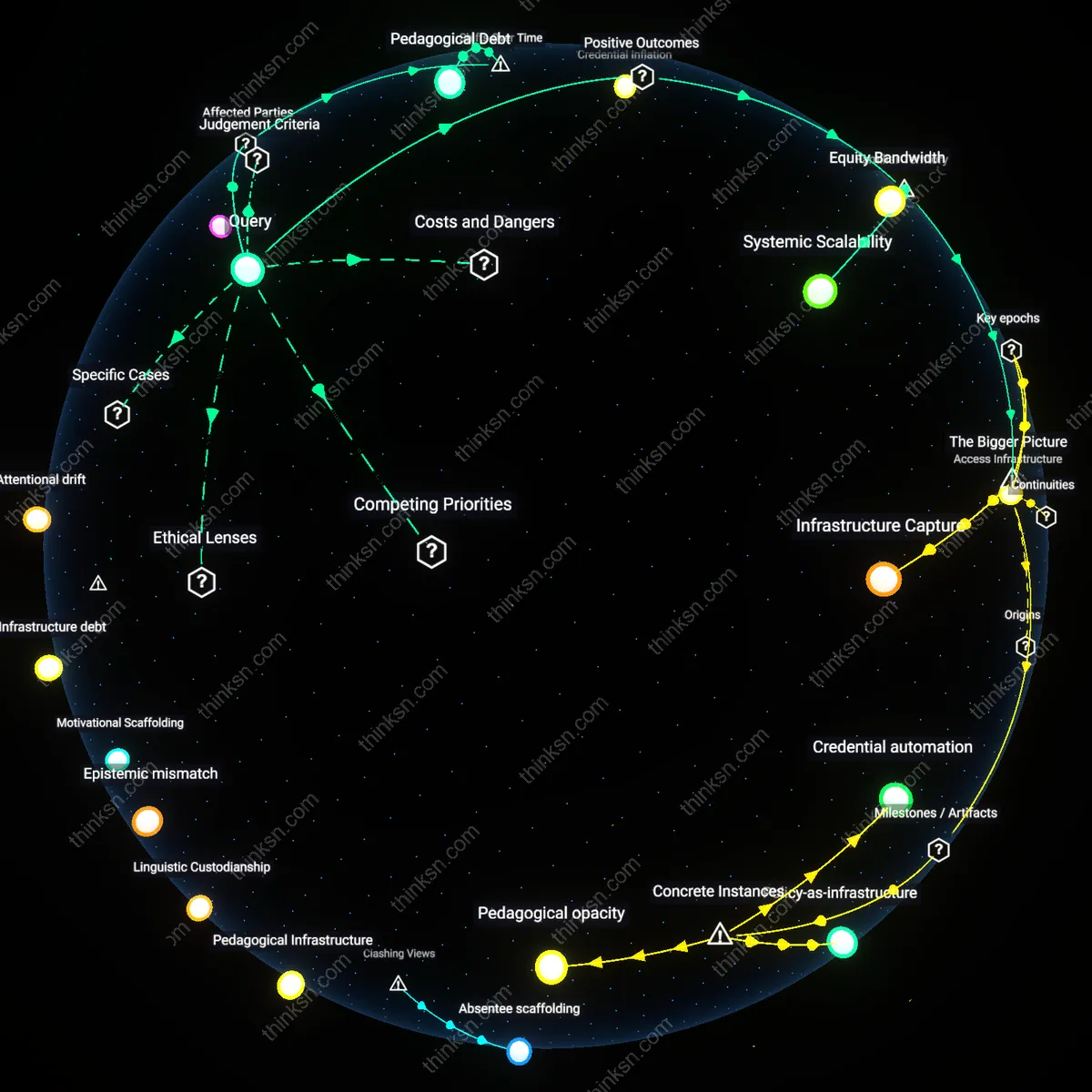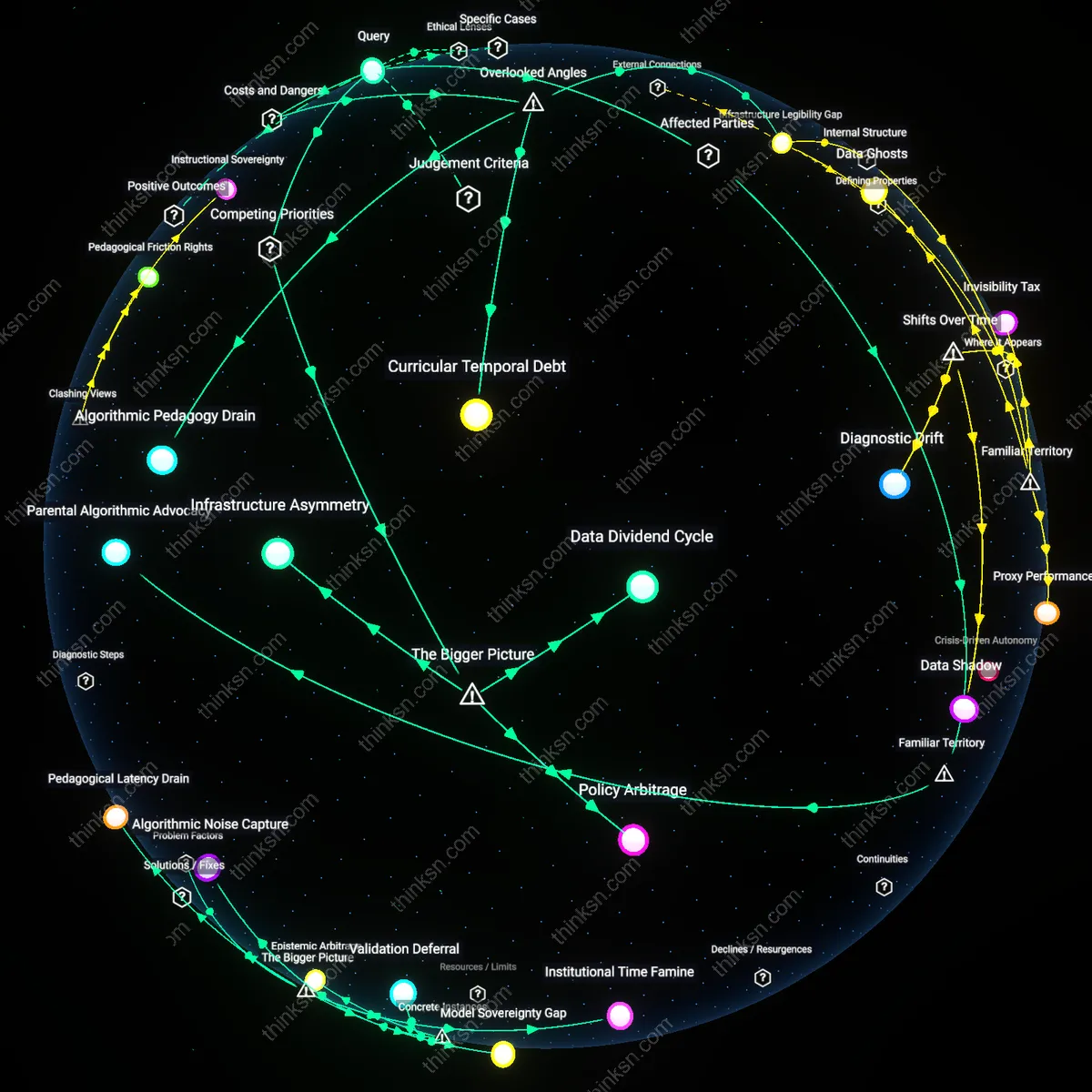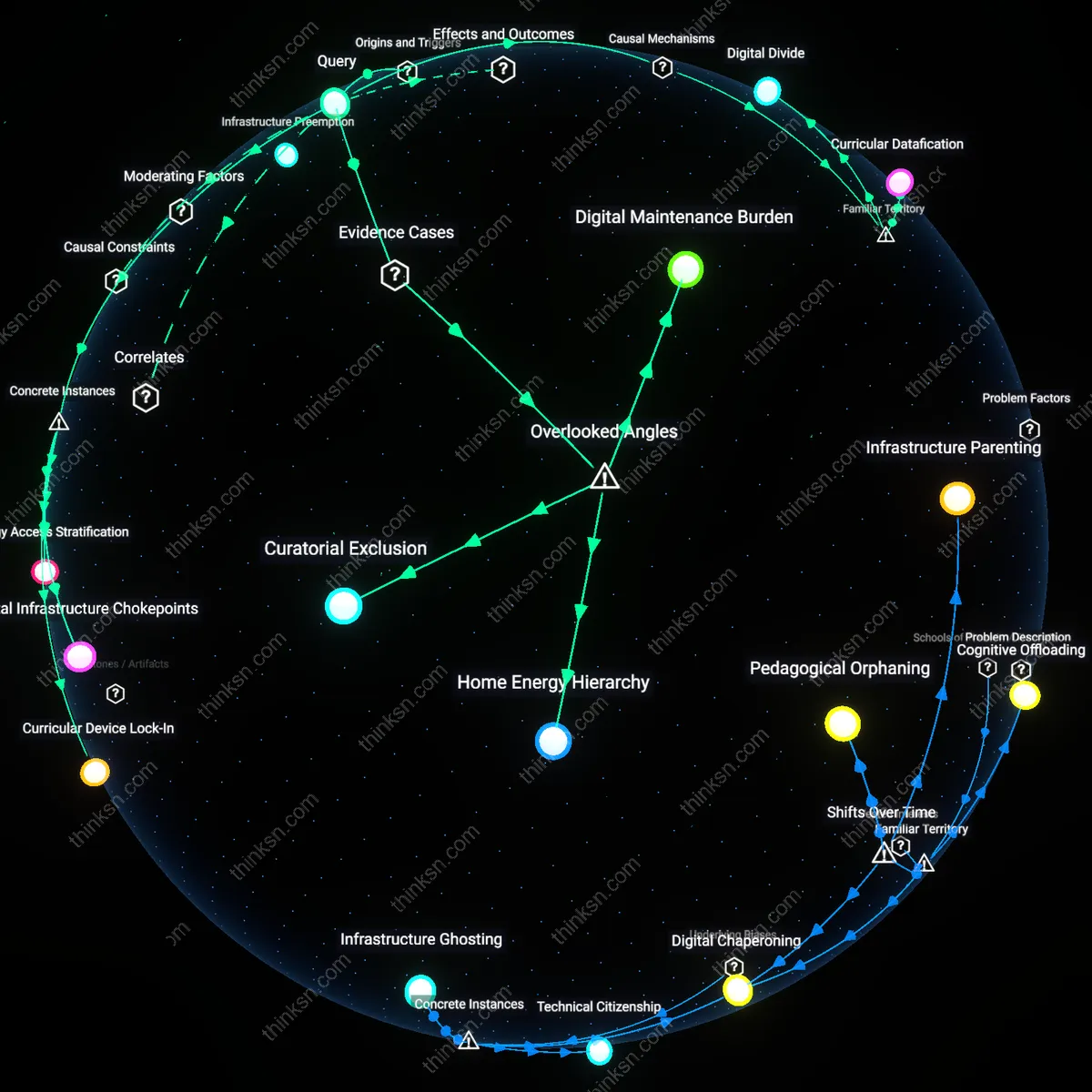
Screen or Book? The Tech Divide in Classrooms?
Analysis reveals 11 key thematic connections.
Key Findings
Infrastructure Preemption
Screen-based learning did not expose but actively erased the material reality of textbook access by redefining educational adequacy around digital delivery, privileging schools in high-bandwidth districts while rendering obsolete the well-established, low-cost distribution networks for printed materials in rural and underfunded regions. This shift was driven not by proven pedagogical superiority but by policy incentives tied to federal technology grants and public-private partnerships with ed-tech firms, which made screens the condition of funding rather than a tool among others. The non-obvious consequence is that the 'debate' itself functioned as a displacement tactic—framing inequality as a choice between modalities rather than as a failure to maintain foundational systems now abandoned.
Attention Capitalization
Screen-based learning environments funnel children’s attention into architectures designed to extract behavioral data for adaptive algorithms, making the classroom an extension of surveillance capitalism, whereas textbook use remains largely inert and non-instrumentalized by commercial interests. This transformation positions economically vulnerable students not just as under-resourced learners but as raw material for algorithmic profiling, where their digital footprints feed models that predict performance, behavior, and even 'engagement'—metrics increasingly used to allocate support. The obscured reality is that the digital divide is not solely about access but about differential exposure to data extraction, turning unequal tech access into a mechanism for long-term social sorting.
Digital Divide
Screen-based learning requires functional devices and home internet, which low-income families disproportionately lack compared to middle- and high-income households, making digital instruction immediately inaccessible for many. Schools in underfunded districts often cannot bridge this gap due to budget constraints, forcing reliance on paper packets or outdated materials, whereas wealthier districts seamlessly deploy tablets and high-speed connectivity. The obviousness of device ownership as a barrier masks the deeper institutional asymmetry in infrastructure maintenance and technical support that continuously reproduces inequity.
Parental Scaffolding
Parents with higher education and flexible jobs are more able to guide children through screen-based platforms, troubleshoot login issues, and manage digital schedules, giving their children an invisible advantage over peers whose caregivers work multiple jobs or lack digital literacy. This uneven capacity to provide cognitive and technical oversight during at-home learning amplifies disparities even when technology is physically present. The familiarity of 'parental involvement' as a success factor obscures how its digital-era form now demands new skills and time investments that are socioeconomically stratified.
Curricular Datafication
Screen-based platforms generate granular data on student engagement and performance, enabling real-time interventions in well-resourced schools, while textbook use leaves no such trace, leaving underfunded classrooms dependent on delayed, subjective assessments. Over time, this feedback asymmetry allows advantaged schools to refine instruction algorithmically, while others operate in informational darkness. Though people recognize technology as a tool for personalization, few consider how the mere act of learning through digital interfaces produces a secondary resource—actionable data—that itself becomes a cumulative advantage.
Digital Infrastructure Chokepoints
In Jakarta, Indonesia, the shift to screen-based learning during the 2020–2021 pandemic exposed how state reliance on commercial internet providers created access bottlenecks in low-income neighborhoods, where households could not afford data plans or faced repeated connectivity outages—this systemic dependency on privatized digital infrastructure amplifies educational inequality not through device ownership alone, but through the concentration of bandwidth control in unregulated corporate hands, revealing a hidden chokepoint in equitable technology access.
Curricular Device Lock-In
In the Los Angeles Unified School District’s 2013 iPad rollout, the mandated use of Apple devices integrated with Pearson’s digital curriculum created a technological dependency that disadvantaged schools unable to maintain or repair the devices, showing how curricular design can lock institutions into specific hardware ecosystems—this mechanism of pedagogical entanglement with proprietary platforms intensifies disparities when underfunded schools lack the technical or financial capacity to sustain the required technology.
Energy Access Stratification
In rural Malawi, where electricity reaches only 11% of households, the introduction of solar-powered tablets in primary schools through NGO-led programs revealed that even off-grid solutions deepen stratification when maintenance and replacement depend on external aid flows—this illustrates how energy poverty transforms screen-based learning into a contingent privilege, where educational access becomes mediated not just by device availability but by the fragile logistics of power supply and donor cycles.
Digital Maintenance Burden
School districts in rural Alabama reveal that screen-based learning exacerbates educational inequality not just through device access, but due to the unacknowledged labor of maintaining aging technology fleets under constrained IT capacities. Local school technicians, often solo staff managing hundreds of devices, spend disproportionate time diagnosing hardware lags, deploying patches, or recovering corrupted student profiles—time not spent on pedagogical integration—while textbook-dependent classrooms face no equivalent systemic maintenance demand. This hidden operational tax on under-resourced schools shifts attention from device ownership to ongoing technical stewardship, exposing a dependency on institutional bandwidth rarely measured in access equity models. The overlooked reality is that digital learning creates recurring logistical liabilities that poor districts can ill afford, making technology access a time-bound, fragile advantage rather than a stable resource.
Home Energy Hierarchy
In Puerto Rico’s post-hurricane education recovery, families with inconsistent electricity access prioritize charging mobile phones for communication and job coordination over children’s tablets used for remote schooling, revealing that screen-based learning competes with survival logistics within household energy budgets. When power is intermittent or prepaid, the ability to engage in digital learning depends not on device ownership but on energy allocation hierarchies where educational screens are routinely deprioritized—textbooks remain usable regardless of grid stability. This material dependency on energy equity reframes the technology gap as a secondary layer of a deeper utility stratification, exposing that digital pedagogy assumes a continuous, cost-free energy substrate that many homes lack. The unexamined variable is not device possession, but the socioeconomic embedding of electricity as a rationed domestic commodity.
Curatorial Exclusion
Kenyan national STEM curriculum rollouts relying on government-issued digital learning portals have systematically excluded offline-compatible content design, marginalizing students in arid regions like Turkana where internet reliability is low and data costs prohibitive—even when devices are distributed. Unlike textbooks, which are self-contained and navigable without connectivity, these platforms assume persistent, high-bandwidth access for video streaming and cloud-based assessments, making their content inaccessible during frequent outages. This curatorial bias toward always-on digital experiences embeds urban-centric infrastructure assumptions into educational materials, rendering them functionally inert in offline contexts despite superficial device parity. The hidden mechanism is not hardware distribution but the informational architecture of digital content, which silently enforces exclusion through design philosophy rather than explicit policy.