Do Truancy Interventions Prevent Violence or Shift Parental Blame?
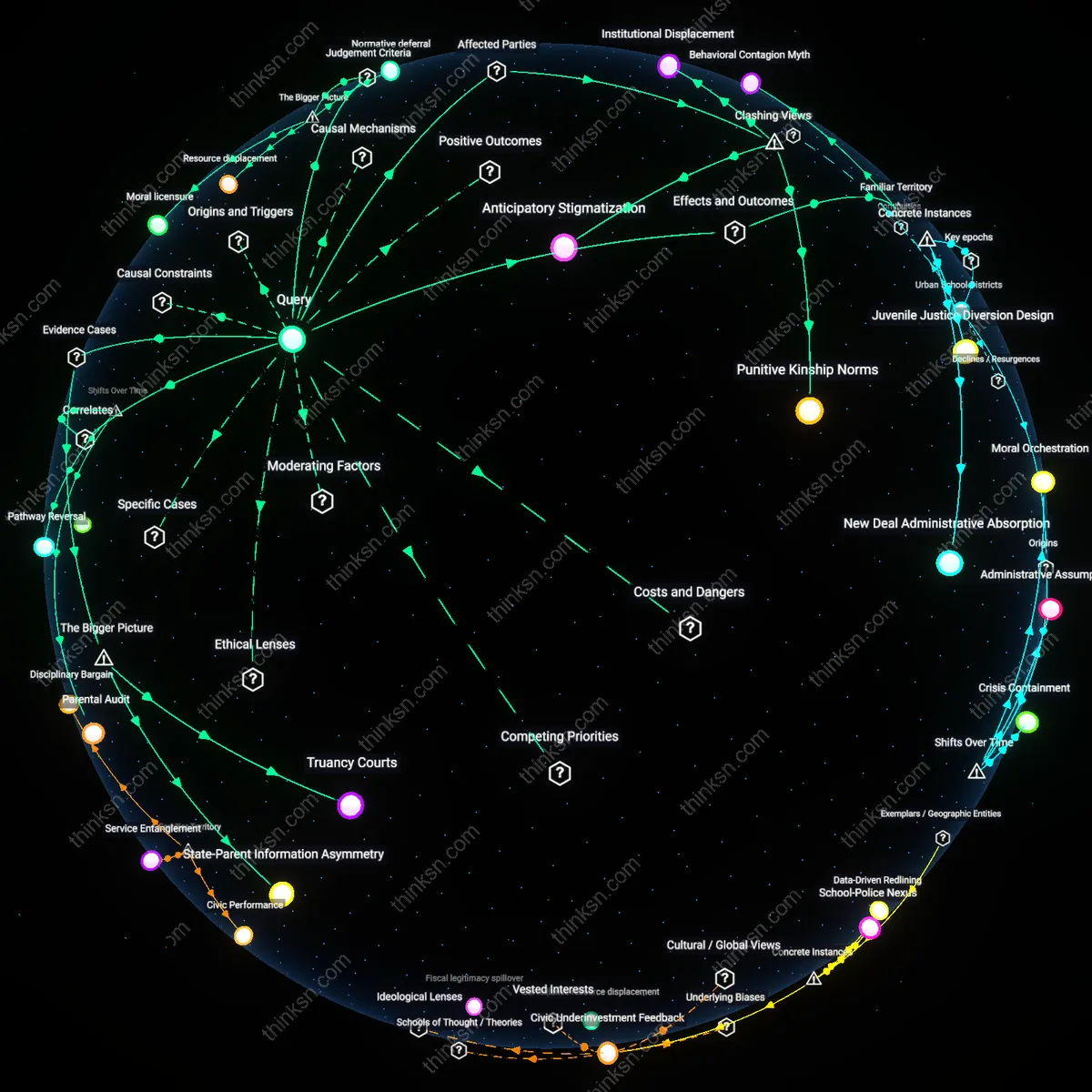
Analysis reveals 13 key thematic connections.
Key Findings
School-to-Prison Pipeline
Early intervention programs that target truant juveniles often channel misbehavior into punitive systems like juvenile probation or law enforcement monitoring, reinforcing the perception that discipline prevents crime while expanding surveillance of at-risk youth in urban school districts. This occurs through zero-tolerance policies and mandatory reporting rules that activate court referrals for repeated absences, disproportionately affecting low-income and minority families. The non-obvious consequence in familiar discourse is that what feels like protective vigilance—getting 'troublemakers' supervised—actually normalizes criminal justice entanglement for non-violent conduct, thereby increasing the likelihood of later violent system contact not because of inherent risk but because of institutional exposure.
Behavioral Contagion Myth
Community-led truancy initiatives in suburban and exurban districts often emphasize isolating 'bad influences'—certain peers or neighborhoods—under the assumption that removing deviant individuals prevents violence from spreading like an infection through youth networks. This belief activates neighborhood watches, school exclusion lists, and social worker home visits aimed at disrupting peer associations in towns from Phoenix to Raleigh. The unnoticed issue is that treating truancy as contagious behavior elevates personal choice and peer mimicry over material conditions, leading to spatial sorting and moral panics that obscure how disinvestment in recreation, mental health services, and after-school programs generates both truancy and violence independently—in effect, mistaking correlation for transmission.
Statistical Mirage
Early intervention for juvenile truancy correlates with reduced future violent offenses because both outcomes are moderated by neighborhood-level investment in social services, not truancy enforcement itself. School-based referrals to social workers increased after the 1994 Federal Violent Crime Control Act incentivized 'early identification' of at-risk youth, creating a data pattern where intervention and reduced crime co-occur geographically—especially in cities like Chicago and Baltimore—while masking that improved outcomes tracked federal funding cycles rather than behavioral corrections. The non-obvious insight is that truancy programs served as conduits for resource injection, not behavioral deterrence, making their statistical association with lower violence an artifact of timing and allocation, not causation.
Parental Audit
The linkage between truancy intervention and reduced violent crime emerged as a justification for expanding state surveillance of parenting practices only after the shift from industrial to service economies in the 1980s eroded working-class employment stability, particularly in Rust Belt communities. As schools became de facto childcare providers, absenteeism was redefined not as an educational issue but as a sign of familial dysfunction—triggering interventions that treated parents as accountable contractors in youth socialization. This transition turned truancy into a proxy metric for parental responsibility, revealing that the state’s interest in early intervention lessened over child behavior and intensified over governable family norms.
Pathway Reversal
Truancy was reconceptualized as a predictor of future violence only after longitudinal criminology models from the 1960s—such as the Cambridge Study in Delinquent Development—were reinterpreted in policy circles during the 1990s 'superpredator' panic to favor trajectory-based interventions. Prior to this, truancy was treated as a status offense isolated from criminal development; the shift treated it as the first observable node in a behavioral cascade. This reversal—where future violence now appears to cause earlier intervention rather than the reverse—produced a feedback loop in juvenile justice systems where preventing violence legitimates ever-earlier surveillance, retroactively assigning causal power to truancy programs that merely chronicle decline.
Truancy Courts
Court-mandated family interventions in Harris County, Texas, reduce future violent offenses among juveniles by requiring parents to attend truancy hearings and comply with attendance contracts, creating legal accountability that alters household incentives around school engagement. The truancy court system acts as a formalized feedback loop between schools, justice authorities, and families, where judicial oversight forces parental attention toward behavioral regulation. This reveals how non-educational institutions can become de facto enforcers of parental responsibility when schools lack coercive authority. The non-obvious insight is that the threat of parental prosecution—however rarely executed—activates compliance through institutional visibility rather than punishment severity.
State-Parent Information Asymmetry
In New Zealand’s integrated data system, welfare and education agencies flag chronic truancy to child protection services, triggering home assessments that shift parental responsibility from private moral failure to public risk management, thereby reducing future violence through earlier state detection of neglect. The causal leverage lies in institutional data-sharing that collapses the gap between absenteeism and familial dysfunction, allowing caseworkers to intervene before school disengagement hardens into criminal identity. The overlooked factor is that early intervention works less through direct services than by reclassifying parents as agents of public safety rather than private upbringing.
Institutional Displacement
Early intervention programs that divert truant juveniles from the justice system often shift accountability onto schools and social services, relieving parents of formal sanctions despite their documented role in monitoring school attendance; this transfer of duty occurs through municipal truancy boards in cities like Philadelphia and Denver, where funding incentives prioritize low law enforcement referrals over family accountability mechanisms. The non-obvious outcome is that reducing future violent crime becomes contingent not on strengthening parental responsibility, but on expanding bureaucratic oversight—reframing delinquency as a systemic rather than familial failure, which quietly decouples moral expectations from policy consequences.
Punitive Kinship Norms
Targeted truancy interventions increase familial surveillance by embedding child welfare personnel in urban school districts like Chicago Public Schools, where mandatory home visits and parenting workshops activate deeper scrutiny of low-income caregivers—particularly single mothers—while equivalent behaviors in affluent families rarely trigger such responses. This reveals that society enforces parental responsibility not through universal standards but through a selectively punitive lens, where early intervention functions less to prevent future violence and more to codify moral hierarchies, exposing family regulation as a proxy for managing class and racial anxieties rather than mitigating criminal trajectories.
Anticipatory Stigmatization
Referring truant youth to intervention programs such as New York’s Juvenile Justice Initiative often generates administrative records that pre-identify children as 'at-risk,' shaping teacher expectations, policing patterns, and social service monitoring well before any violent act occurs—particularly in Black and Latino communities in the Bronx and Harlem. Contrary to the assumption that early support reduces crime, this preemptive labelling can entrench youths in systems that amplify surveillance and constrain opportunity, revealing how societal appeals to parental responsibility function rhetorically to justify institutional overreach while deflecting from structural inequities that actually propagate violence.
Moral licensure
Early intervention for truant juveniles reduces future violent crime by activating state oversight that substitutes for absent parental accountability, thereby reinforcing a societal bargain in which deviant behavior triggers institutional moral authority—this mechanism functions through probation systems and family courts that condition leniency on compliance with behavioral mandates, revealing how legal leniency is covertly tied to the performance of rehabilitative responsibility rather than its actual efficacy; what is underappreciated is that state intervention can inadvertently license parents to abdicate responsibility, as the appearance of corrective action satisfies communal expectations without requiring sustained familial engagement.
Resource displacement
Early intervention for truant juveniles reduces future violent crime only when programs are embedded within communities that already possess robust social infrastructure, such as mental health services and employment pipelines—because outcomes depend not on the intervention itself but on its co-location with upstream economic supports, the system functions through municipal budget allocations that prioritize visible, short-term behavior modification over long-term developmental investment; this reveals the non-obvious reality that truancy programs in underfunded districts often redirect scarce resources from family-centered prevention to individualized risk management, worsening structural inequities under the guise of early action.
Normative deferral
Early intervention for truant juveniles reduces future violent crime only when it aligns with culturally recognized scripts of parental responsibility, such as school participation and behavioral compliance—because social workers, educators, and judges interpret delinquency through normative family models, interventions succeed when families can perform expected roles, functioning through institutional gatekeeping that grants access to services based on perceived alignment with dominant values; the underappreciated dynamic is that the system defers to cultural norms about parenting rather than addressing material constraints, making intervention effectiveness contingent on symbolic conformity, not behavioral change.