Does Academic Tracking Hinder Language Learners Progress?
Analysis reveals 9 key thematic connections.
Key Findings
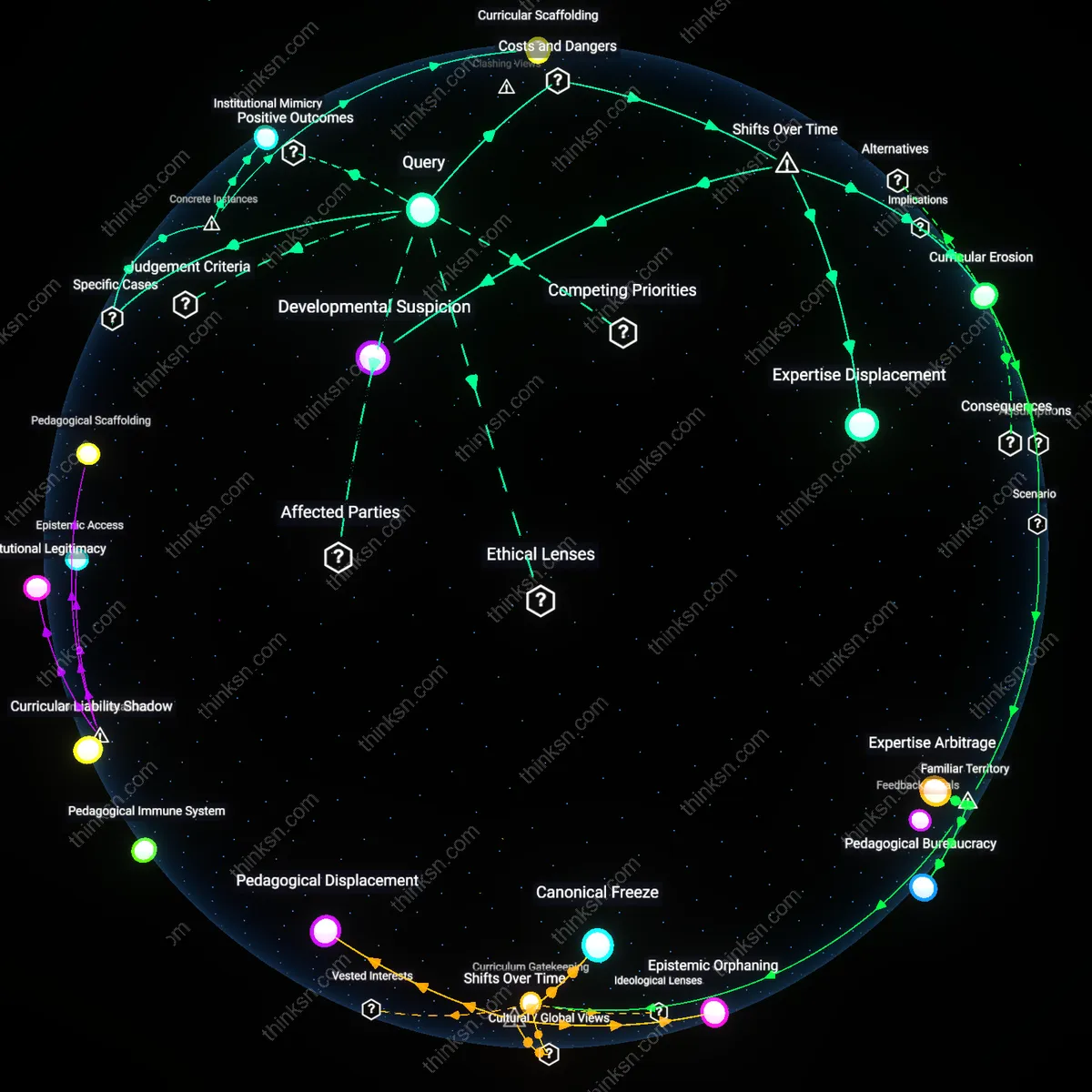
Curriculum Divestment
Academic tracking in middle schools since the 1980s has systematically withdrawn language development resources from non-tracked classrooms, redirecting them toward advanced tracks under the assumption that English learners benefit more from remedial isolation than integrated rigor. This shift intensified after federal accountability mandates in the early 2000s, which tied school funding to standardized test performance, pressuring administrators to reserve enriched instruction for students deemed 'on track'—a designation rarely afforded to language learners in flexible grouping pilot programs. As a result, even when flexible grouping was reintroduced in the 2010s as an equity reform, the prior divestment from heterogeneous teaching capacity meant that schools lacked both the materials and trained staff to make such models effective, rendering them symbolic rather than transformative. The non-obvious insight is that flexibility itself became a cover for sustaining underresourced tracks, not dismantling them.
Transitional Mirage
In the 1970s, bilingual education programs often used academic tracking as a temporary bridge—placing language learners in lower-tier classes with the explicit promise of transition to mainstream instruction after English acquisition. By the 1990s, however, due to policy shifts like California’s Proposition 227 and the reclassification of ‘transitional’ programs as permanent sorting mechanisms, language learners increasingly remained in tracked tracks throughout middle school, with flexible grouping reintroduced only in form, not function, as teachers re-sorted students internally based on latent proficiency markers. The critical temporal turning point was the mid-1990s, when funding incentives equated speed of reclassification with program success, thereby accelerating misplacement and minimizing mobility. The underappreciated reality is that flexibility, when unmoored from longitudinal support, merely simulates movement without altering power structures in curriculum access.
Diagnostic Drift
The rise of data-driven instruction in the 2000s recast academic tracking not as a fixed placement but as a dynamic, formative process, where language learners were continuously assessed and regrouped based on quarterly benchmarks—a practice labeled 'flexible' despite reinforcing cumulative disadvantage. In urban districts like Chicago and Los Angeles, the intended mechanism of fluid movement across groups eroded over time, as early diagnostic scores disproportionately influenced later placements, cementing initial inequities under the guise of responsiveness; by the late 2010s, algorithms used to assign students reproduced tracking patterns even when human teachers intended flexibility. This shift from static tracking to algorithmic sorting has masked structural inertia beneath a veneer of adaptability, revealing a temporal trajectory wherein diagnostic tools assume authority over developmental trajectories. The non-obvious insight is that flexible grouping, when embedded in high-stakes assessment cycles, amplifies rather than mitigates tracking effects over time.
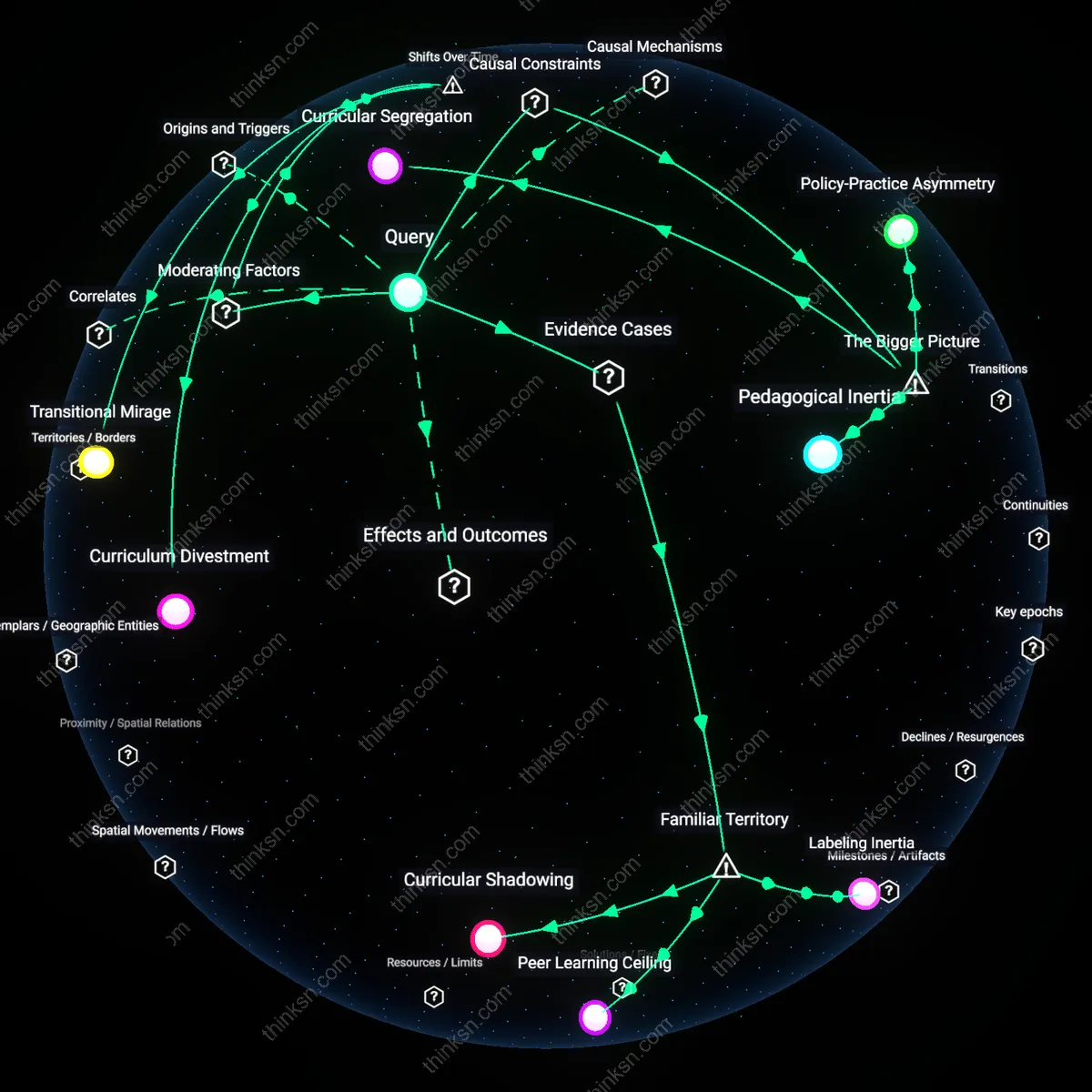
Curricular Segregation
Academic tracking in middle schools systematically limits language learners' access to grade-level content by placing them in lower-track classes with diminished cognitive demand. This occurs because placement decisions often rely on standardized test scores that conflate language proficiency with academic ability, causing educators to underestimate students’ conceptual understanding. The mechanism operates through district-level tracking policies that lack validation protocols for emergent bilinguals, reinforcing a feedback loop where language learners receive intellectually narrowed instruction that consolidates achievement gaps. The non-obvious implication is that tracking does not merely sort students but actively constructs academic disadvantage through curricular exclusion.
Pedagogical Inertia
Flexible grouping fails to reduce negative outcomes for language learners when teachers lack structured protocols to rotate students based on formative assessment data. Without mandated re-evaluation intervals and data-sharing routines across departments, flexible grouping becomes de facto tracking if initial placement assumptions persist. This dynamic is sustained by school leadership that treats grouping as a classroom management tool rather than an equity strategy, rendering flexibility symbolic rather than operational. The overlooked reality is that structural flexibility without instructional accountability reproduces the very inequities it aims to dissolve.
Policy-Practice Asymmetry
State-level mandates promoting flexible grouping have no impact on language learners’ opportunities when district budget allocations prioritize staffing for tracked remedial programs over interdisciplinary team teaching. Local funding decisions, shaped by historical precedent and union contracts, lock in resource distributions that make flexible grouping logistically unworkable. As a result, schools comply with policy rhetoric while maintaining rigid structures, revealing that policy change without fiscal realignment cannot alter instructional trajectories. The key insight is that reform intentions are blocked not by resistance, but by embedded fiscal routines that stabilize inequity.
Labeling Inertia
Academic tracking in middle schools locks language learners into lower performance trajectories because placement decisions made early are rarely revisited, as seen in tracked math pathways in Los Angeles Unified School District where English learners are disproportionately placed in remedial streams without reevaluation; this mechanism persists because educators rely on initial proficiency assessments that do not account for rapid linguistic growth, making the system resistant to change despite evidence of student progress—what’s underappreciated is that the inertia isn't due to student ability but to administrative routines that treat tracking as a one-time sorting event.
Peer Learning Ceiling
Tracking concentrates language learners in lower-tier classrooms where academic language models are scarce, as observed in Miami-Dade’s middle school remedial tracks where heterogeneous language exposure is replaced by uniform simplification of discourse; the critical mechanism here is that constrained peer interaction limits access to advanced vocabulary and syntactic complexity, which are normally acquired through immersion in more proficient peer groups—what’s overlooked is that even highly motivated learners cannot compensate for this environmental deficit through individual effort alone.
Curricular Shadowing
Flexible grouping in schools like those in Montgomery County’s elementary-to-middle school transition program reduces tracking harm by aligning student movement with language development rather than fixed ability, allowing language learners to access grade-level content in temporary, skill-based clusters; the key dynamic is that short-term, content-embedded groupings prevent the long-term curricular narrowing typical of rigid tracks—what’s rarely acknowledged is that flexibility only works when it is systematically tied to language acquisition milestones, not general academic performance, making the difference between meaningful access and symbolic inclusion.