Do Mediation Programs Protect Renters from Corporate Landlord Hikes?
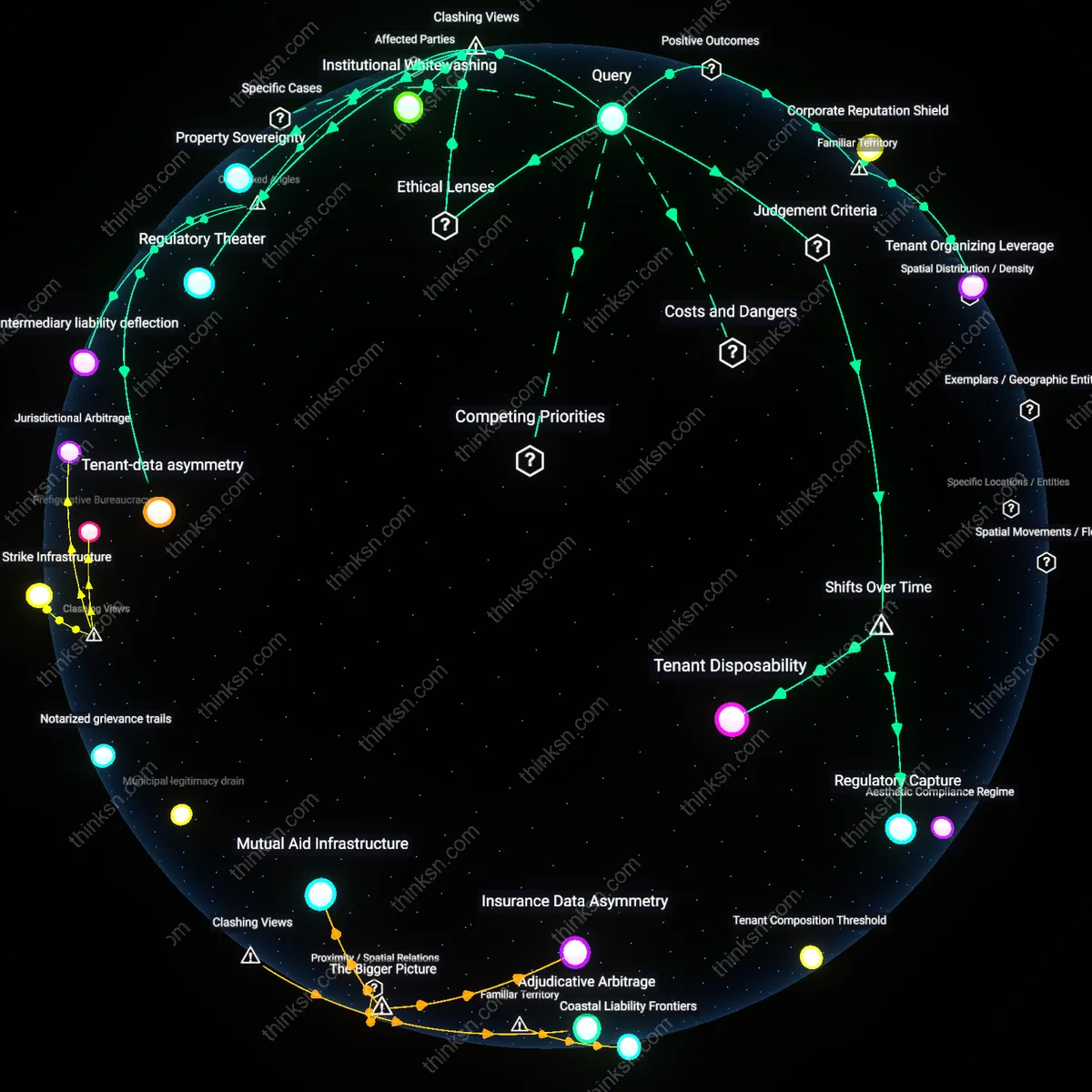
Analysis reveals 12 key thematic connections.
Key Findings
Tenant-data asymmetry
Housing-authority mediation fails to curb illegal rent hikes in corporate-dominated markets because it assumes equal access to leasing records, when in reality large property managers systematically withhold or fragment tenant payment histories and lease terms from both tenants and oversight bodies. This data opacity prevents authorities from verifying rent compliance, enables retroactive lease manipulation, and shifts evidentiary burden onto displaced residents—most of whom lack legal resources. The underappreciated mechanism is not landlord defiance per se, but the strategic privatization of data infrastructure that neutralizes mediation before disputes are even formalized, transforming information control into a tool of regulatory evasion.
Intermediary liability deflection
Housing-authority mediation is undermined in corporate landlord markets because third-party property management firms act as legal shock absorbers, absorbing complaints and delays without authority to modify leases or binding commitments, thus stalling enforcement while ownership entities remain insulated. These intermediaries exploit their procedural role to create temporal drift—mediation timelines expire, tenants relocate, and penalties become untraceable—while parent companies avoid direct liability. This deflection is rarely accounted for in policy evaluations, which treat landlords as monolithic actors rather than layered legal architectures designed to dissipate accountability through operational separation.
Municipal fiscal cooption
Mediation efforts are weakened in regions with high corporate landlord concentration because municipal housing authorities rely on property tax revenues from large real estate trusts, creating a structural disincentive to enforce rent regulations aggressively. When city budgets become dependent on stable or rising tax rolls tied to high-value rentals, mediation is quietly steered toward settlements that permit de facto rent increases under 'renovation' or 'redevelopment' pretexts. This fiscal entanglement transforms oversight bodies into reluctant enforcers, where regulatory outcomes are shaped less by tenant protection mandates than by municipal budget models that internalize corporate landlord interests as fiscal necessities.
Regulatory Capture
Housing-authority mediation has become increasingly ineffective at curbing illegal rent hikes since the 1980s because oversight bodies have gradually internalized corporate landlord logics through revolving personnel and policy feedback loops. As federal housing policy shifted from tenant protection to market facilitation post-Reagan, housing authorities began prioritizing landlord cooperation over enforcement, transforming mediation into a venue for legitimizing de facto rent increases rather than contesting them. This change was cemented by the devolution of public housing authority powers and the rise of public-private partnerships, which redefined compliance not as adherence to rent regulations but as maintenance of landlord participation in subsidized programs. The non-obvious implication is that mediation, originally designed as a corrective mechanism, now functions as an institutionalized delay tactic that obscures regulatory failures under the guise of negotiation.
Tenant Disposability
Mediation processes are structurally ineffective in corporate landlord markets because they reproduce a historical shift that began in the 2000s, when private equity firms entered the rental sector and redefined tenant relations as actuarial risk management rather than tenancy-as-right. In this shift, housing authorities now treat tenants not as rights-bearing parties but as temporary occupants whose claims must be balanced against landlord profitability and portfolio stability, which are treated as public goods. This recalibration, driven by investors like Blackstone and landlords such as Invitation Homes, treats rent hikes as negotiated outcomes rather than violations, embedding disposability into mediation frameworks through standardized evictions and roll-over leases. The overlooked consequence is that the machinery of mediation—intended to ensure fairness—now ratifies economic displacement by treating tenant retention, not rent compliance, as its primary success metric.
Compliance Theater
Housing-authority mediation fails to prevent illegal rent hikes in corporate-dominated markets because it has evolved since the 2010s into a performative regime designed less to enforce rent laws than to simulate regulatory action amid widespread deregulation. As cities like New York and Los Angeles faced political pressure to address housing inflation but lacked legislative power to restrict rents outright, mediation became a procedural stand-in for enforcement—generating records of 'resolution' while rarely imposing penalties or reversing increases. This shift from adjudication to documentation was accelerated by understaffed authorities and corporate landlords’ use of shell entities, rendering accountability administratively unwieldy. The underappreciated reality is that mediation now serves less to protect tenants than to absolve states of liability, transforming legal obligations into administratively manageable fictions.
Rent Stabilization Anchor
Housing-authority mediation effectively prevents illegal rent hikes by enforcing rent stabilization laws through formal dispute resolution with corporate landlords in cities like New York and Los Angeles, where established regulatory frameworks empower authorities to audit leases, impose fines, and mandate rollbacks, making non-compliance riskier than compliance; what’s underappreciated is that the mere presence of an active mediation body deters exploitative behavior not through frequent punishment but through predictable scrutiny, transforming mediation into a systemic check rather than an occasional remedy.
Corporate Reputation Shield
Mediation by housing authorities helps large corporate landlords avoid public backlash and regulatory red flags by resolving rent disputes quietly and adjusting pricing practices before litigation escalates, as seen in publicly traded real estate investment trusts (REITs) that prioritize brand image and investor confidence; the underappreciated dynamic is that mediation serves less as a tool for tenant justice and more as a risk-management conduit, allowing corporations to maintain legitimacy while making minimal concessions.
Tenant Organizing Leverage
Housing-authority mediation strengthens tenant collective action by providing a recognized platform where documented patterns of illegal hikes across corporate portfolios—such as those by Equity Residential or Greystar—can be exposed and aggregated, enabling block-by-block resistance backed by official records; what is rarely acknowledged in public discourse is that mediation doesn’t just resolve individual cases but generates actionable data that bolsters advocacy and informs class-action strategies, turning administrative procedure into a foundation for broader housing justice campaigns.
Regulatory Theater
Housing-authority mediation is ineffective at preventing illegal rent hikes because it prioritizes procedural compliance over material enforcement, allowing corporate landlords to exploit legal ambiguities and delay tactics that nullify tenant protections. This process functions not as a shield for tenants but as a legitimizing ritual that absolves authorities of deeper intervention, revealing how accountability can be performed rather than enacted—particularly in cities like New York, where HPD mediations routinely precede inevitable eviction filings by Equity Residential or Aimco. The non-obvious reality is that the mediation system is designed not to resolve conflict but to absorb dissent, transforming systemic exploitation into individualized disputes.
Property Sovereignty
Mediation fails to curb rent gouging because it operates within a neoliberal legal orthodoxy that treats property rights as quasi-inalienable, making any challenge to landlord pricing behavior inherently suspect under doctrines like regulatory takings articulated in Penn Central v. New York City. As a result, housing authorities in markets like San Francisco or Seattle approach rent mediation not as enforcement but as negotiation between unequal parties, where the corporate landlord’s profit imperative is treated as a legitimate interest co-equal with tenant habitability. This framing exposes the ethical concession that capital allocation decisions—especially by REITs such as Essex Apartment Corp—are functionally immune to moral scrutiny, so long as they follow color-of-law procedures.
Institutional Whitewashing
Available evidence from Los Angeles’ Rent Mediation Program shows that mediation outcomes are skewed by institutional capture, where former real estate lawyers staff housing authorities and recast rent hikes as 'market adjustments' rather than violations of anti-gouging statutes like AB 1482. Rather than mediating fairly, these actors normalize deviations from rent caps by invoking 'hardship exemptions' or inflated maintenance costs—tactics systematically deployed by corporate landlords such as Greystar. The dissonant finding is that mediation doesn’t reduce illegality; it routinizes it, laundering exploitative behavior through state-sanctioned processes that feign neutrality while reproducing power imbalances.