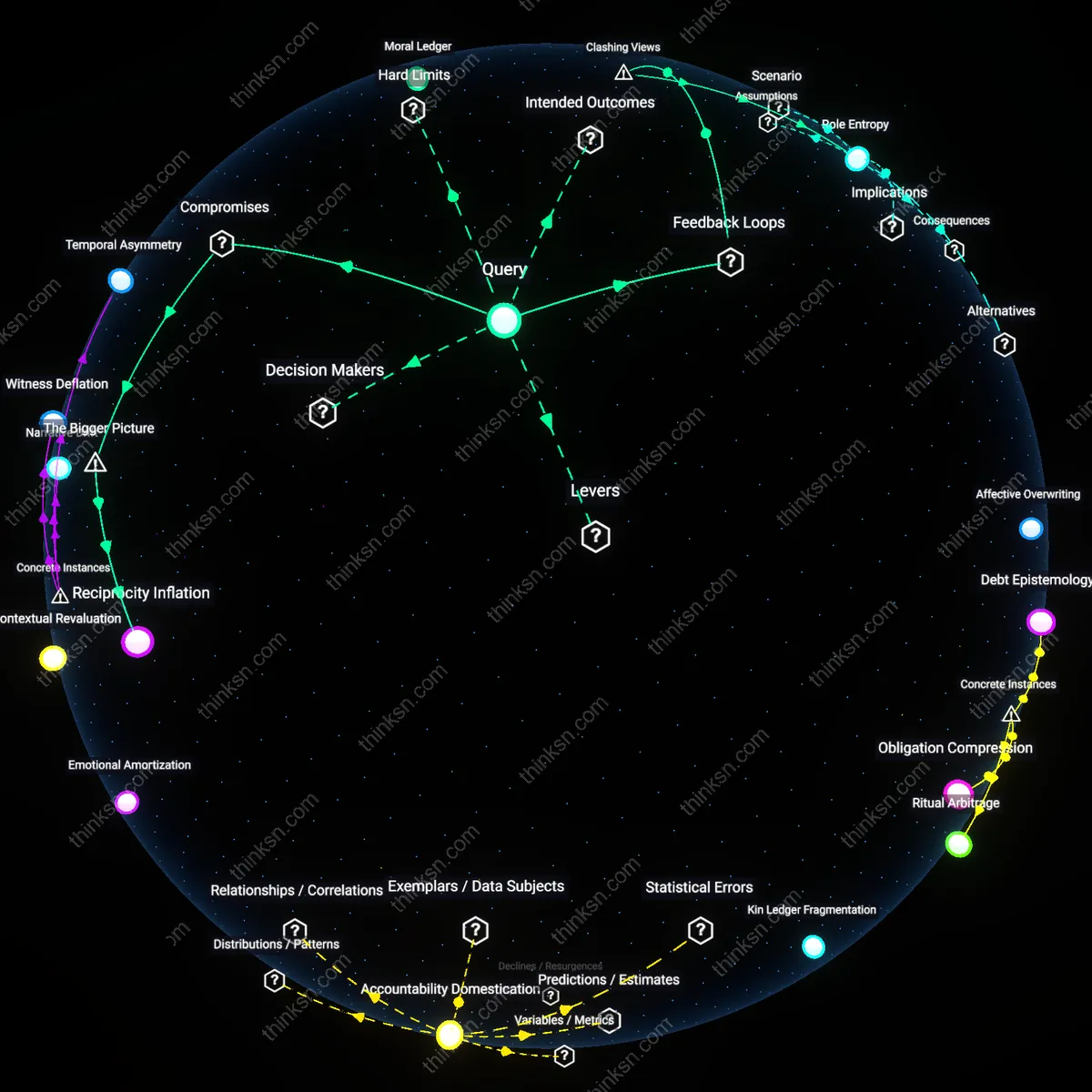
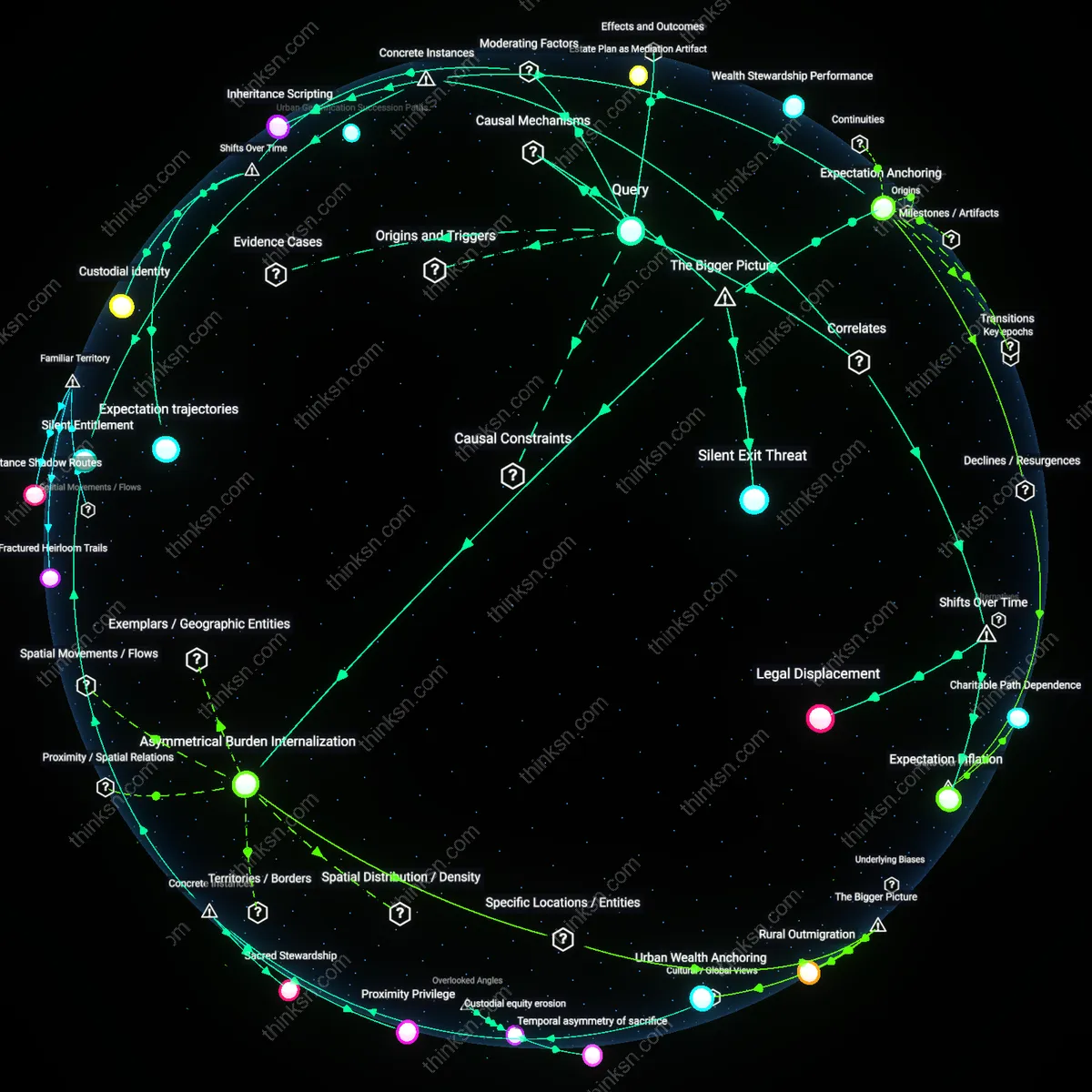
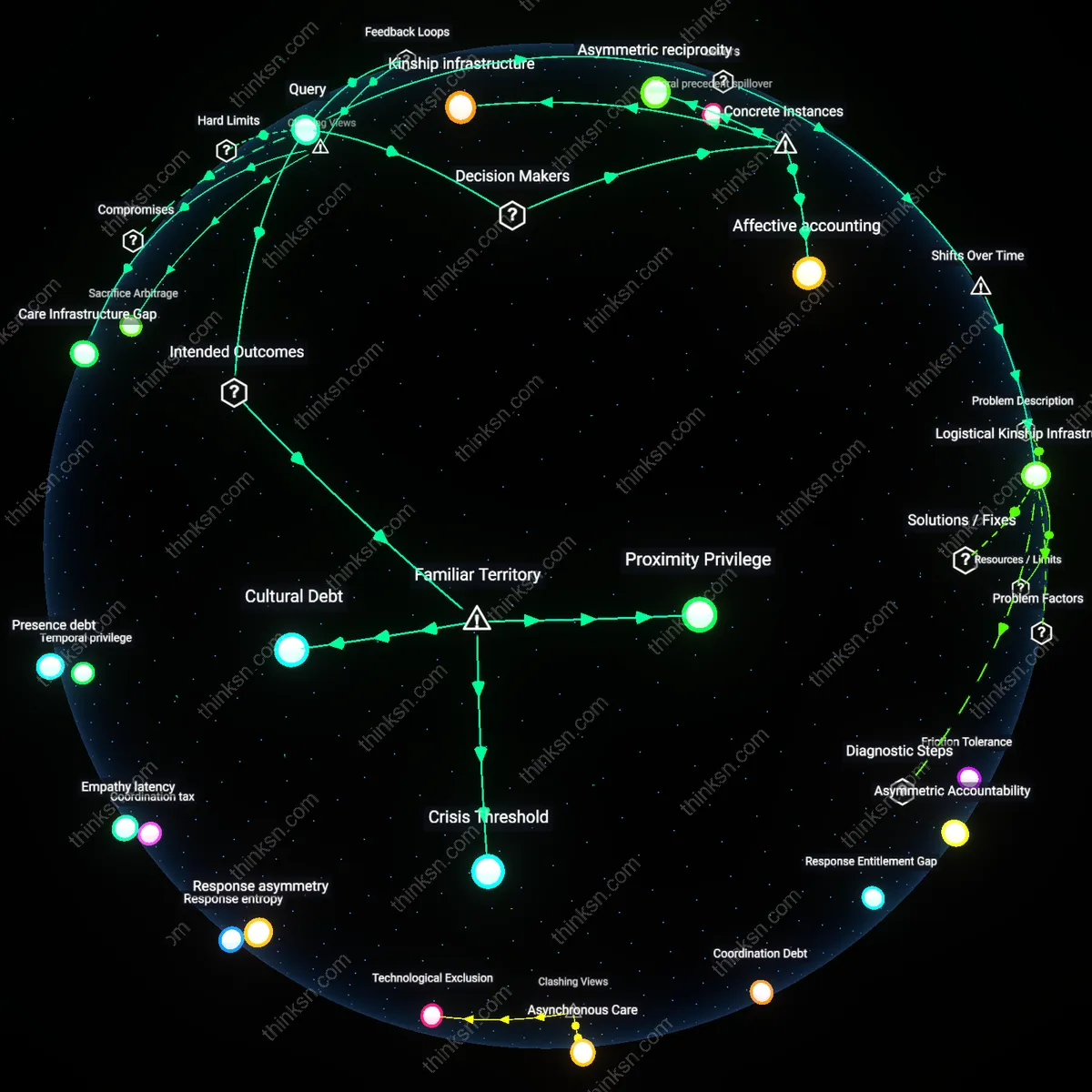
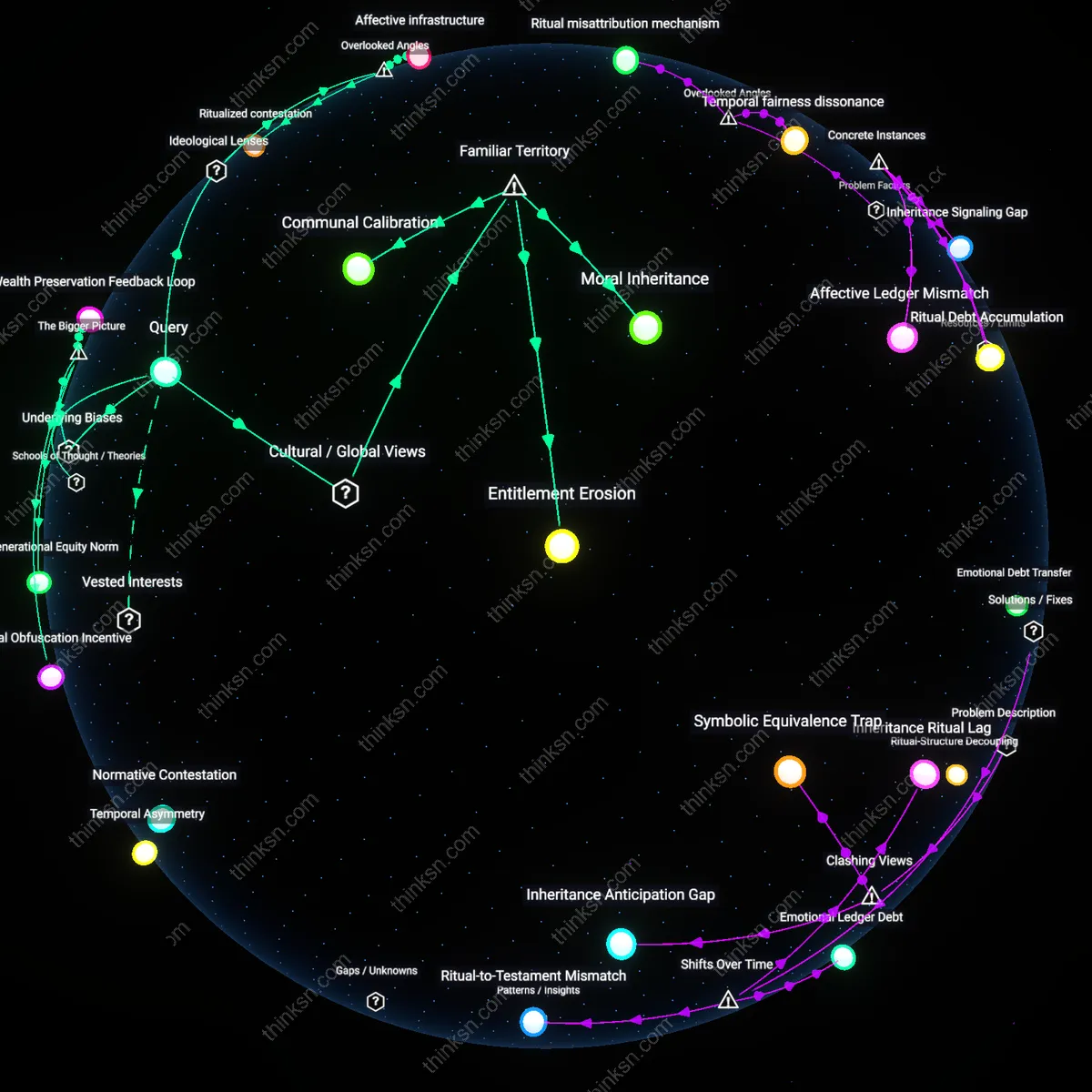
Accountability Domestication
The shift from extended family networks to nuclear households in mid-20th century North America concentrated financial tracking responsibilities within the private home, replacing communal memory and reciprocal obligation systems with bilateral spousal accounting. This transition emerged as suburbanization and wage labor severed kinship ties across distances, forcing couples to codify loans, favors, and domestic labor as internal debts managed through personal ledgers or implicit scorekeeping. What is underappreciated is that this privatization did not eliminate debt tracking but transformed it into a silent, emotionally charged domestic practice—where unspoken imbalances in chore contribution or gift giving became sources of marital tension rather than community mediation. The nuclear household thus became a micro-accounting unit, insulating intergenerational debt systems from scrutiny while internalizing their moral weight.
Kin Ledger Fragmentation
In 19th-century industrializing England, the migration from rural clan-based agrarian communities to urban nuclear tenements disrupted collective memory systems that once tracked interfamily debts across generations through oral tradition and ceremonial exchange. As families dispersed into wage-dependent households, the continuity of debt tracking collapsed—not because obligations vanished, but because no single member retained access to the full ledger of favors, inheritances, or dowry repayments once held communally. This fracture revealed that extended kinship networks operated as distributed memory systems, where accountability was maintained through overlapping witness and public ritual, and their dissolution produced fragmented, competing versions of who owed what. The residual effect was not just lost records but the structural impossibility of settling old debts, rendering many moral obligations temporally unmoored.
Temporal Compression
The shift to nuclear households accelerated the compression of intergenerational debt tracking into shorter time horizons, as reduced kinship oversight diminished long-standing expectations of deferred reciprocity. In extended families—such as those in 19th-century rural Yucatán or pre-industrial Japan—gifts, labor, and care were tracked across decades through communal memory and ritualized exchange, often enforced by elders; the nuclearization of households in urbanizing contexts like postwar Detroit or 1970s Seoul disrupted these timelines by removing custodians of memory and eliminating shared spaces for ritual reaffirmation. This temporal collapse is overlooked because most analyses focus on spatial fragmentation (household size) rather than the shrinking duration over which obligations remain active or acknowledged, fundamentally altering how reciprocity is timed and enforced.
Moral Arbitrage
Nuclear family formation enabled individuals to selectively invoke or suppress kinship roles to avoid or extract obligations, turning relational memory into a private ledger rather than a communal account. In extended networks—such as among Haudenosaunee longhouse communities or Ottoman Anatolian lineages—debt was validated through collective attestation, making denial socially costly; in contrast, post-1950s suburban nuclear settings like suburban Sydney or Frankfurt allowed individuals to reframe broken promises as 'private misunderstandings' rather than public breaches, exploiting the opacity of closed households. This moral arbitrage—where actors gain ethical leverage by shifting between isolated and extended modes of kinship depending on context—is rarely examined because standard models assume consistent identity and accountability, not strategic ambiguity in moral reporting.
Affective Overwriting
The privatization of domestic life in nuclear households replaced explicit record-keeping of debts with emotional narratives that reclassify obligations as acts of love, thereby erasing traces of reciprocity. In extended Yoruba lineage compounds or Han Chinese ancestral halls, material transfers were logged through oral proverbs, ritual seating order, or spirit tablet offerings that preserved entitlements across generations; with the rise of emotional companionate marriage in mid-20th-century London or Toronto homes, lending money to a sibling became framed as 'supporting family,' obscuring repayment expectations under the moral weight of affection. This affective overwriting is typically missed because scholars interpret emotionalization as deepening bonds, not as a mechanism for laundering or deleting transactional history from collective memory.
Debt Epistemology
In 1950s urban Shanghai, state-led housing reforms replaced multi-generational courtyard residences with small, state-allocated apartments, forcing families to abandon communal dining and rotating care duties, which had implicitly tracked obligations through participation; instead, nuclear households developed written ledgers to record loans and favors, transforming moral debt into auditable personal accounts—a shift not driven by distrust but by spatial rupture that severed daily rituals of reciprocity. This reveals how intimate economies rely on collective spatial practices, and their loss necessitates formalization, producing a new epistemology of debt grounded in individualized record-keeping rather than shared rhythm.
Obligation Compression
When Yugoslavia’s self-managed socialist enterprises declined in the 1980s, extended kin in rural Dalmatia re-routed informal credit through young wage-earning relatives in cities, designating single nuclear members as financial proxies; this compressed diffuse familial claims into a single point of accountability, making the urban worker the de facto auditor of ancestral promises, a role once distributed across elders. What is underappreciated is that this did not weaken kinship bonds but intensified pressure on the nuclear node, revealing how economic strain can concentrate intergenerational moral claims into minimal household units, collapsing temporal obligations into a single conduit.
Ritual Arbitrage
In 1980s Kerala, matrilineal Nair families, historically tracking jeevita kodutayal (lifetime contributions) through ritual feasts hosted by ancestral homes, saw these functions dwindle when nuclear households gained social prestige via remittance wealth from Gulf migration; families replaced temple donations with private savings plans, recasting obligation as investment to justify non-participation, thereby using ritual withdrawal as a quiet negotiation of debt. This case uncovers how ceremonial disengagement—often mistaken for cultural erosion—can function as a deliberate tactic to revalue intergenerational claims in private, market-compatible forms.
Debt Inscription Fragmentation
The shift to nuclear households fragmented ancestral debt ledgers because written records formerly maintained in communal clan archives—such as Babylonian kudurru stelae detailing land dues and ritual obligations—were replaced by privatized, ad hoc notes like Greek ostraca or Roman wax tablets held within isolated homes, severing intergenerational accountability; this mechanical disaggregation of record-keeping bypassed collective memory systems, making longitudinal tracking depend on individual retention rather than institutional continuity, a break that is rarely acknowledged because modern assumptions equate privacy with progress in financial management.
Inheritance Juridical Narrowing
Legal codification in early modern Europe, particularly the Napoleonic Code’s restriction of succession rights to bloodline nuclear units, actively dissolved the customary tracking of reciprocal obligations among cousins, aunts, and elders who once settled accounts through oral consensus at lineage gatherings; by privileging state-certified wills over community attestation, the law rendered diffuse debts unenforceable, thereby masking latent inequities under formal equity—a dissonance rarely exposed because legal modernization is typically framed as neutral rather than socially narrowing.
Sacred Ledger Displacement
In pre-colonial West Africa, Yoruba extended families recorded mutual support obligations in ritual contexts—such as iwa peji ceremonies where livestock transfers symbolized long-term claims—practices that eroded under colonial urbanization policies that incentivized nuclear wage labor in Lagos and Ibadan; the resulting shift moved debt memory from sacred performance to informal verbal contracts, obscuring claims that once carried spiritual sanction, a transformation that contradicts the standard narrative of rationalization by revealing the loss of moral enforcement scaffolding.