Do Impact Statements Enhance Healing or Just Fuel Punishment?
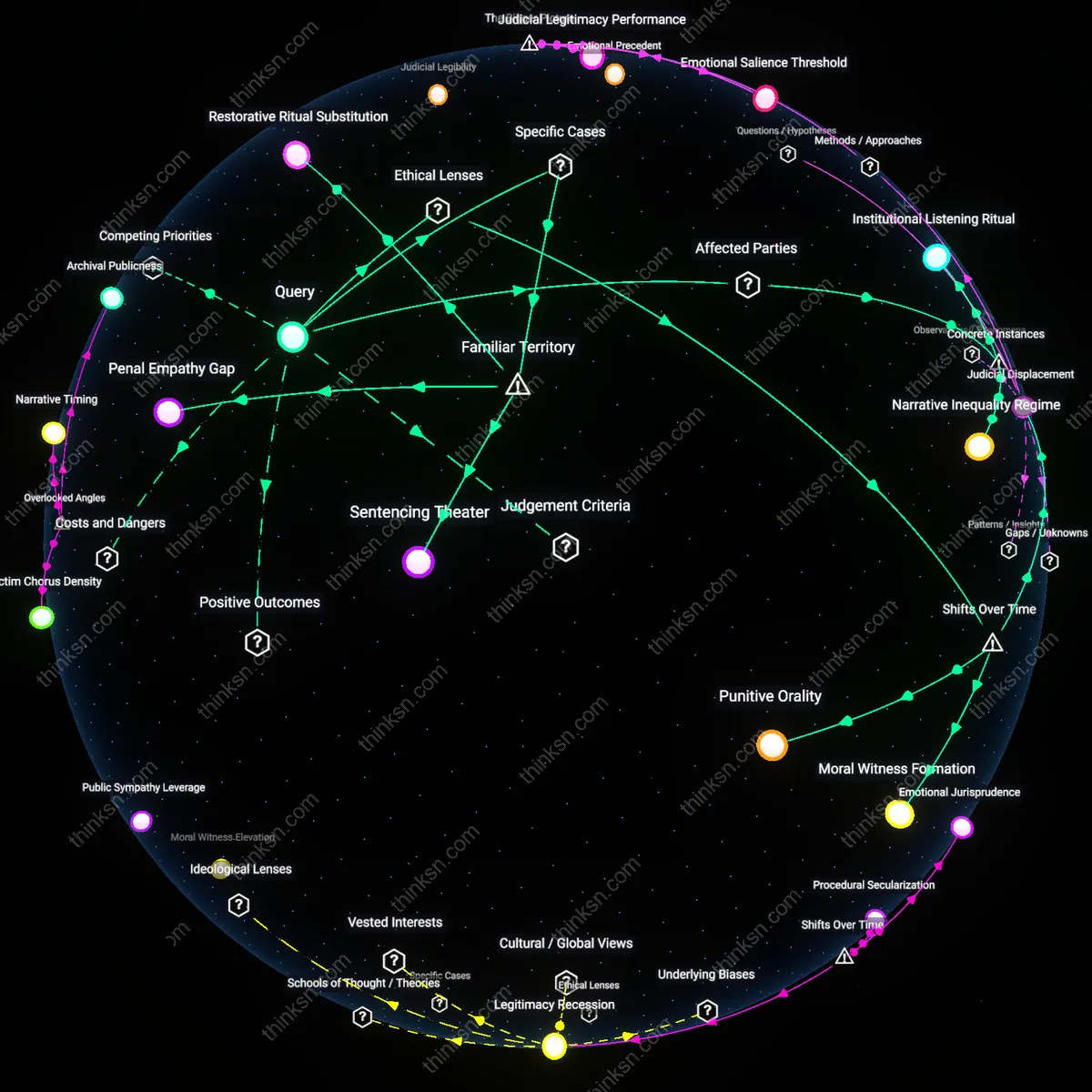
Analysis reveals 9 key thematic connections.
Key Findings
Judicial Discretion Distortion
Victims' impact statements in the 2016 Stanford sexual assault case (People v. Turner) amplified punitive outcomes by shifting judicial focus from proportionate sentencing to emotional retaliation, as seen when public outcry over the lenient six-month sentence for Brock Turner was directly attributed to the emotional weight of the victim’s statement. The trial judge, Aaron Persky, faced intense pressure leading to his eventual recall—demonstrating how victim narratives, while individually empowering, can distort judicial independence through political backlash. This reveals a structural vulnerability where restorative balance is undermined not in court, but in the post-sentencing public sphere, transforming individual healing into a tool of judicial accountability that skews toward punitiveness.
Institutional Listening Ritual
In New Zealand’s Family Group Conferencing system, victims’ statements are integrated within a Māori-inspired restorative framework where offenders, families, and community leaders co-construct outcomes—such as in the 1999 implementation of the Children, Young Persons, and Their Families Act, which mandated victim participation in youth justice processes. Here, victim statements do not feed into state-imposed punishment but are bounded within dialogic circles that prioritize relational repair over retribution, making the statement a ritual of institutional humility rather than a weapon of escalation. This shows that the restorative effect of victim speech depends not on its inclusion per se, but on being embedded within a broader cultural and procedural commitment to non-punitive resolution.
Narrative Inequality Regime
In South Africa’s Truth and Reconciliation Commission (TRC), victims’ statements were central to the nation’s post-apartheid healing, yet the evidence shows they often exacerbated racialized and class-based disparities in recognition—rural Black women survivors of state violence faced systemic barriers in having their testimonies documented or broadcast compared to urban, male, politically active victims. The asymmetry in whose pain is witnessed and validated turned victim speech into a stratified resource, where visibility became a function of literacy, location, and linguistic conformity to institutional norms. This reveals that victim impact processes, even in avowedly restorative settings, can reproduce hierarchies of suffering that deepen rather than mend social injury.
Moral Witness Formation
Victims' impact statements promote restorative justice when introduced through the rehabilitative ethics of 1970s correctional reform, where sentencing was reconceived as a forum for moral acknowledgment rather than pure deterrence. This shift, pioneered in state courts like those in Minnesota during experimental sentencing circles influenced by Mennonite restorative traditions, embedded the victim not as an agent of punishment but as a witness whose testimony restored moral order; the mechanism was the substitution of juridical silence with narrative inclusion, revealing how the rise of therapeutic jurisprudence created a non-punitive role for emotion in legal procedure. The underappreciated point is that the restorative function depended on a prior rejection of retributivism—not its co-optation.
Punitive Orality
Victims' impact statements exacerbate punitive tendencies when absorbed into the retributive legal expansions of the 1980s and 1990s, particularly through the Victims' Rights Movement enshrined in federal and state constitutional amendments that recast victim voice as a legitimizing instrument for longer sentences. This transition, accelerated by high-profile cases like those prosecuted under Megan’s Law and the 1994 Crime Bill, institutionalized emotional testimony as a performative demand for severity, operating through prosecutorial framing and media visibility that turned personal grief into public justification for carceral growth. The overlooked consequence is that oralization of trauma, once emancipatory, became a ritual of legitimation for punitive excess rather than a path to reconciliation.
Judicial Displacement
The introduction of victims' impact statements has progressively displaced judicial discretion in sentencing since the 2000s, not by design but as a cumulative effect of legislative mandates and appellate deference, shifting sentencing authority from judges to a hybrid forum of victim-prosecutor alignment shaped by neoliberal legal governance. As seen in post-*Crawford* rulings and state guidelines in places like California and Texas, the evidentiary status of victim narratives has been normalized without corresponding procedural safeguards, transforming judicial chambers into arenas of affective competition where proportionality erodes under moral pressure. What remains hidden is that the temporal displacement of judicial rationality—once anchored in Enlightenment legalism—has rendered sentencing less a legal than a performative judgment calibrated to emotional resonance.
Sentencing Theater
Victims' impact statements amplify punitive outcomes in high-profile U.S. criminal trials by channeling public emotion through charismatic survivor testimony, as seen in the 2016 Stanford sexual assault case involving Brock Turner, where widespread media circulation of the victim’s statement intensified public demand for maximum punishment, thereby aligning judicial perception with moral outrage rather than restorative metrics. The courtroom becomes a stage where emotional testimony, validated by media amplification, reshapes sentencing norms through affective persuasion, not procedural rehabilitation—what feels like justice delivery is often justice performance. This reveals how familiar narratives of victim courage and offender depravity, widely circulated in mainstream discourse, substitute for structural restorative mechanisms, making punitiveness appear both rational and humane.
Penal Empathy Gap
Victims' impact statements institutionalize emotional asymmetry in Canadian sentencing proceedings, where courts acknowledge suffering but lack capacity to translate it into reparative action, as evidenced in the 2018 Calgary sentencing of serial sexual predator Brian Smyl, whose victims delivered extensive statements that judges cited as aggravating factors while still imposing a standard custodial term. The legal system absorbs emotional testimony into existing punitive frameworks without developing corresponding restorative pathways, reinforcing the intuitive link between pain expressed and punishment owed. This reflects the public’s familiar belief that ‘being heard’ equals justice, masking the absence of institutional tools to convert that hearing into healing—what is mistaken for empathy becomes another rationale for incarceration.
Restorative Ritual Substitution
In New Zealand’s Family Group Conferencing model—applied in youth justice—victims' statements are structurally integrated into post-offense dialogue facilitated by iwi (Māori tribal) authorities, where the statement does not precede sentencing but coexists with offender accountability and community-led reparation plans, as seen in the Rotorua-based Te Whare Manaakitanga program. Unlike adversarial systems, this context treats the statement as an entry into relational repair, leveraging culturally embedded norms of communal responsibility that the public often associates with ‘indigenous wisdom’ but rarely replicates in mainstream courts. Here, the familiar image of the victim speaking is decoupled from punishment and reattached to ritualized reconciliation, exposing how procedural design, not the statement itself, determines whether voice fuels vengeance or restitution.