Does Good Moral Character Erase Minor Legal Past for Green Cards?
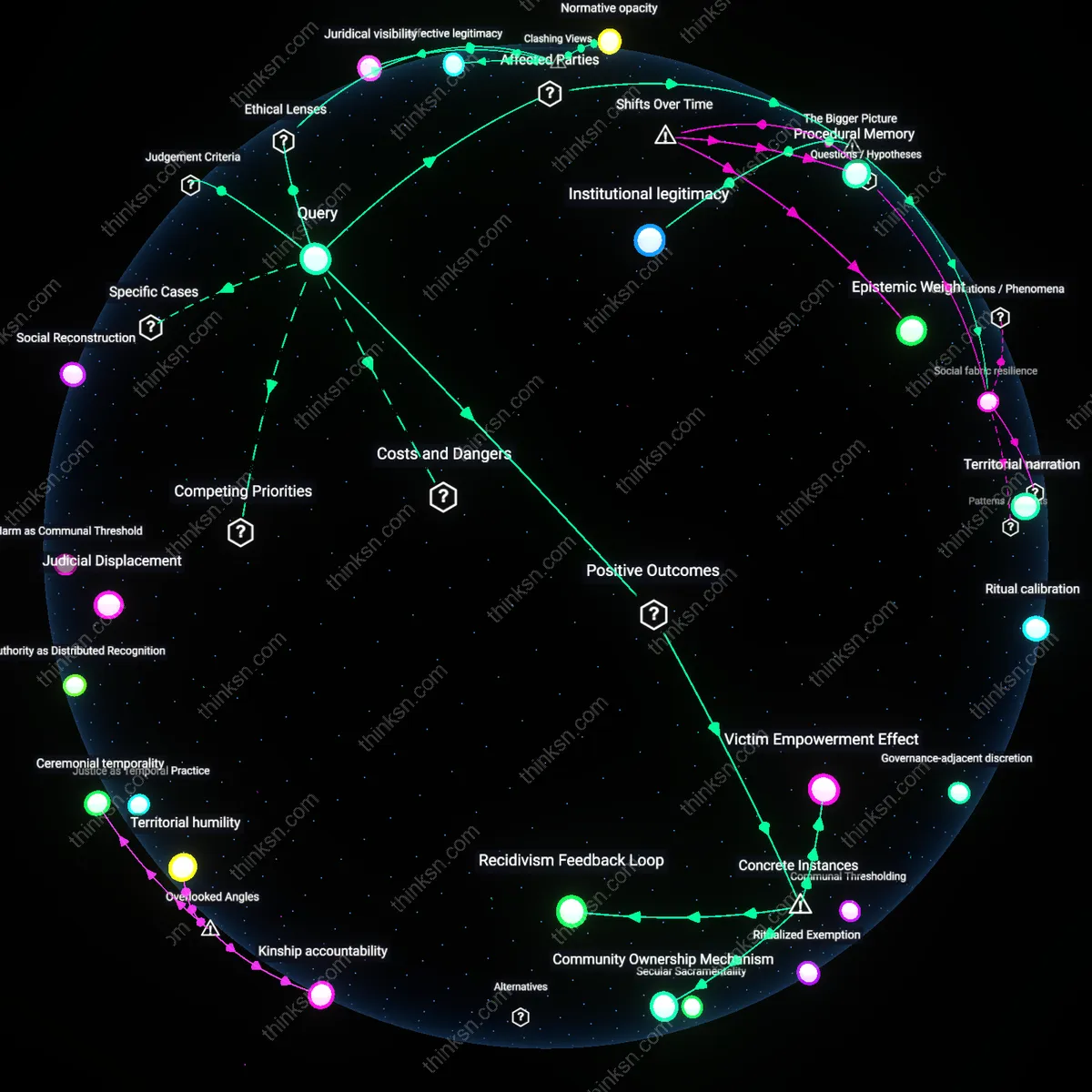
Analysis reveals 18 key thematic connections.
Key Findings
Moral Arbitrage
The 'good moral character' requirement treats minor legal infractions as proxies for moral fitness, a shift from early 20th-century naturalization practices where character was assessed through community affiliation and explicit racial eligibility; now, immigration officials leverage procedural discretion to convert traffic violations or petty offenses into moral failings, revealing how judgment based on 'justice' has been subordinated to bureaucratic control. This mechanism—where trivial infractions become disqualifying through subjective interpretation—reflects a post-1996 shift under the Illegal Immigration Reform and Immigrant Responsibility Act, which expanded deportability and tightened character scrutiny, thereby transforming legal minutiae into moral currency. The non-obvious consequence is that moral evaluation is no longer about virtue but about asymmetrical power to define legality as immorality.
Temporal Disqualification
The assessment of minor legal infractions in naturalization hinges on a redefined 'reformation period'—typically the five years preceding application—a temporal boundary that emerged distinctly after the 1952 Immigration and Nationality Act and was rigidified in post-9/11 enforcement culture, where the principle of 'autonomy' in self-improvement is outweighed by demands for linear behavioral predictability. Immigration officers now use this window not merely to assess conduct but to project future risk, turning past infractions into indicators of enduring unreliability, even when pardoned or expunged. This shift from rehabilitative timelines to performative moral consistency reveals how citizenship eligibility is increasingly gated by a forensic temporality that disadvantages marginalized applicants with uneven encounters with law enforcement.
Regulatory Asymmetry
Since the 1980s expansion of local-federal policing partnerships, minor infractions like loitering or fare evasion—disproportionately cited in low-income urban areas—have entered naturalization files not through federal statute but via data-sharing infrastructures such as ICE’s Criminal Apprehension Program, where the yardstick of 'efficiency' in enforcement overrides equitable access to citizenship. The historical shift from federal-only character review to integrated surveillance networks enables municipal policing patterns to de facto shape national belonging, even when infractions carry no moral weight beyond administrative penalties. The overlooked reality is that the naturalization process now reflects not individual morality but the uneven spatial distribution of policing, making regulatory systems the hidden authors of moral character determinations.
Procedural Leniency Signaling
Minor legal infractions are often conditionally waived during naturalization to signal institutional trust in applicant rehabilitation, thereby reinforcing civic integration when adjudicators use discretion to affirm aspirational belonging. This occurs through immigration officers’ documented use of mitigation narratives—such as community ties or employment history—not to excuse violations but to reframe them as evidence of moral growth, which strengthens social cohesion by transforming bureaucratic moments into rites of inclusion. The overlooked mechanism is that leniency itself functions as a performative endorsement of state trust, a dynamic rarely acknowledged because policy debates focus on exclusion thresholds rather than the affirmative social meaning of discretionary approval.
Moral Performance Infrastructure
The 'good moral character' requirement sustains a covert training ground for civic norm internalization by compelling applicants to preemptively self-audit behavior against idealized citizenship standards, even for infractions below prosecutive thresholds. Through preparation for interviews and mandatory disclosure of petty offenses—like traffic violations or minor misdemeanors—applicants engage in iterative self-discipline that mirrors participatory governance, fostering a latent sense of juridical responsibility that benefits democratic culture. This hidden curriculum, embedded in administrative diligence, is overlooked because analyses fixate on outcomes rather than the formative behavioral shaping that occurs during the lengthy naturalization pipeline.
Character Capital Accrual
Applicants convert minor infractions into compensatory demonstrations of rectitude by over-performing civic virtues—volunteering, financial responsibility, or rapid legal compliance—thus transforming moral blemishes into accumulation projects of 'character capital' assessed implicitly by adjudicators. This exchange operates through unstated balancing norms in USCIS internal guidance, where remedial actions offset past lapses, enabling equitable access despite uneven legal exposure across racial or economic lines. The overlooked dynamic is that infractions become catalysts for surplus civic investment, revealing a hidden economy of moral credit that redistributes procedural advantage to the highly compliant, a phenomenon obscured by legalistic readings of disqualification criteria.
Moral Gatekeeping
Minor past infractions are weaponized in naturalization reviews to exclude applicants despite rehabilitation, because immigration officers wield subjective discretion under the 'good moral character' clause; this transforms routine bureaucratic assessment into a tool of social sorting, where low-level offenses like traffic violations or petty theft—common across demographics—become disqualifying when interpreted through cultural or class biases. The mechanism operates through USCIS adjudication practices in field offices like those in Detroit or El Paso, where inconsistent standards amplify arbitrary outcomes, revealing that the real function of moral character review is not ethical screening but hierarchical filtering. What remains unspoken in public debate—where 'morality' sounds neutral—is how this process relies on familiar tropes of ‘deservingness’ to disguise exclusion as integrity.
Burden Inflation
The 'good moral character' requirement forces applicants to prove lifelong behavioral perfection, turning minor, resolved infractions into enduring liabilities that demand costly legal remediation and documentation; this shifts the burden onto marginalized immigrants who lack resources to navigate record expungement or obtain certified dispositions from overburdened municipal courts. The dynamic plays out in cities like Chicago or Houston, where decades-old misdemeanors resurface in naturalization interviews due to database persistence, making the process less about rehabilitation and more about surviving an amplified retrospective audit. While the public assumes moral character checks prevent fraud or danger, the real systemic cost is the inflation of trivial events into existential barriers—normalizing an expectation of flawlessness no native-born citizen is held to.
Legibility Penalty
Immigrants with minor legal histories face disproportionate scrutiny because their records become hyper-visible under naturalization checks, while native-born citizens with similar pasts remain shielded by non-involvement in immigration systems; the mechanism hinges on how data from state courts, police databases, and federal repositories like FBI fingerprints are activated only when someone is already under immigration surveillance. This occurs routinely in jurisdictions like Maricopa County or Harris Justice Court, where algorithmic background checks flag old citations, but the same data lies dormant for citizens. The familiar framing of 'character' as personal responsibility obscures how visibility—not conduct—determines consequence, exposing a penalty imposed simply for being legible to a system designed to monitor non-citizens.
Moral Debt Traps
The 'good moral character' requirement weaponizes minor legal infractions by disproportionately penalizing low-income applicants who lack resources to expunge or contest citations, transforming traffic tickets or loitering charges into moral failings that delay or deny naturalization. Immigration officers and adjudicators apply subjective moral judgments to administrative records, often from jurisdictions where policing targets marginalized communities, meaning that systemic biases in local law enforcement become hard criteria in federal citizenship decisions. This reveals how the guise of moral evaluation conceals a mechanism of exclusion rooted in economic and racial disparity, where compliance with law is treated as proof of virtue while ignoring structural inequities in enforcement.
Legitimacy Laundering
The 'good moral character' clause allows the state to reframe routine immigration scrutiny as ethical adjudication, thereby legitimizing broad surveillance and discretionary denials under the appearance of moral gatekeeping. By treating minor infractions as indicators of character rather than legal technicalities, the system shifts focus from institutional power to individual blame, masking how citizenship decisions serve political control rather than ethical consistency. This inversion turns immigration bureaucracy into a moral theater where compliance is conflated with worthiness, enabling authorities to reject applicants without transparent cause while preserving the illusion of a fair, values-based process.
Criminality Drift
Minor legal infractions gain disqualifying weight in naturalization not because they reflect actual moral deficiency but because the 'good moral character' standard absorbs expanding definitions of deviance through bureaucratic reinterpretation over time, such as treating dismissed charges or non-criminal violations as evidence of unrehabilitated behavior. Adjudicators rely on FBI background checks and discretionary 'totality of circumstances' assessments that lack uniform standards, allowing precedents to accumulate in ways that conflate poverty-related conduct with moral risk. This gradual hardening of boundaries reveals how administrative convenience and risk aversion, rather than ethical principle, shape who is deemed fit for citizenship.
Moral Performance Tax
Enforcing 'good moral character' through penalties for minor infractions compels noncitizens to perform exaggerated compliance, wherein routine behaviors like traffic violations or informal work become moral failures requiring public penance. Immigration authorities leverage discretionary review of petty records to demand proof of deference and self-policing, transforming bureaucratic acquiescence into a currency of worthiness. This dynamic reveals how the state extracts symbolic submission in lieu of actual harm prevention, disproportionately disciplining marginalized communities who lack the resources to sanitize their records or narrate their pasts persuasively.
Legibility Premium
Applicants with minor legal infractions face heightened scrutiny because their cases disrupt the state’s preference for administratively legible narratives, where clean records signal predictability and control. Officers tasked with assessing moral character default to reductive proxies—arrest histories, employment gaps, or inconsistent filings—because they lack time or training to parse context, so even resolved infractions become disqualifying markers. This exposes how efficiency in processing citizenship claims privileges those already integrated into formal economic and legal systems, penalizing immigrants whose survival strategies operate in gray zones the state cannot easily classify or trust.
Virtue Arbitrage
The ambiguity of 'good moral character' allows adjudicating officers to treat minor infractions as moral referenda, selectively invoking discretion to reward conformity to cultural expectations around language, family structure, or economic participation. This enables decision-makers to conflate legality with ideological alignment, where infractions become leverage points to filter applicants based on unspoken norms rather than statutory criteria. The practice reveals how citizenship functions as a rewards system not merely for legal compliance, but for adopting the behaviors and appearances associated with dominant national identity.
Procedural Dignity Deficit
The 'good moral character' requirement functions not through explicit denial over minor infractions, but through the erosion of procedural dignity when applicants must narratively repent for long-past, legally resolved conduct, revealing a moral accounting ritual enforced asymmetrically on noncitizens. Naturalization officers, operating under the adjudicative logic of discretionary virtue in U.S. immigration law, demand detailed self-incriminating narratives of remorse for infractions already punished, imposing a burden of moral performance absent for native-born citizens, thereby embedding a non-legal hierarchy of civic worth. This dynamic operates through Form N-400’s open-ended narrative sections, where the expectation of moral renewal—rooted in republican virtue theory—elevates character as a continuous personal debt, not a legal status. The overlooked angle is that the psychological and symbolic coercion to perform contrition reshapes identity as a condition of belonging, a dependency rarely acknowledged in due process critiques.
Temporal Jurisdiction Asymmetry
Minor legal infractions from adolescence may disqualify naturalization if they fall within the statutory 'character period,' thereby subjecting noncitizens to temporally extended moral jurisdiction that native-born citizens do not face after legal exoneration. Under doctrines influenced by retributive justice and developmental psychology, native-born individuals are typically afforded societal forgiveness for youthful conduct, but noncitizens must prove present virtue by negating past acts that no longer carry legal consequence, adjudicated through USCIS officers applying rigid moral continuity standards. This mechanism presumes an unbroken moral trajectory and penalizes those who cannot demonstrate a narrative of linear moral improvement due to socioeconomic or cultural barriers to self-documentation. The underappreciated reality is that citizenship processes demand retroactive moral coherence in ways that re-criminalize legally closed pasts, revealing a temporal power imbalance masked as character assessment.
Narrative Burden Disparity
Applicants from non-Anglophone, non-Western cultural backgrounds face systemic disadvantage in meeting the 'good moral character' requirement not because of conduct, but because their personal narratives of moral development often conflict with the liberal individualist expectations embedded in U.S. naturalization adjudication protocols. Adjudicators, trained in a legal culture that prioritizes explicit, introspective self-disclosure and moral chronology, interpret culturally reserved or communal explanations of past infractions as insufficient or evasive, despite doctrinal roots in Enlightenment autonomy theory demanding such introspection. This operates through subjective interpretations of Form N-400 statements, where the absence of expected psychological detail can be read as moral deficiency. The overlooked dynamic is that cultural competence in narrative articulation becomes a covert prerequisite for moral eligibility, making the standard not universal but ethnoculturally calibrated.