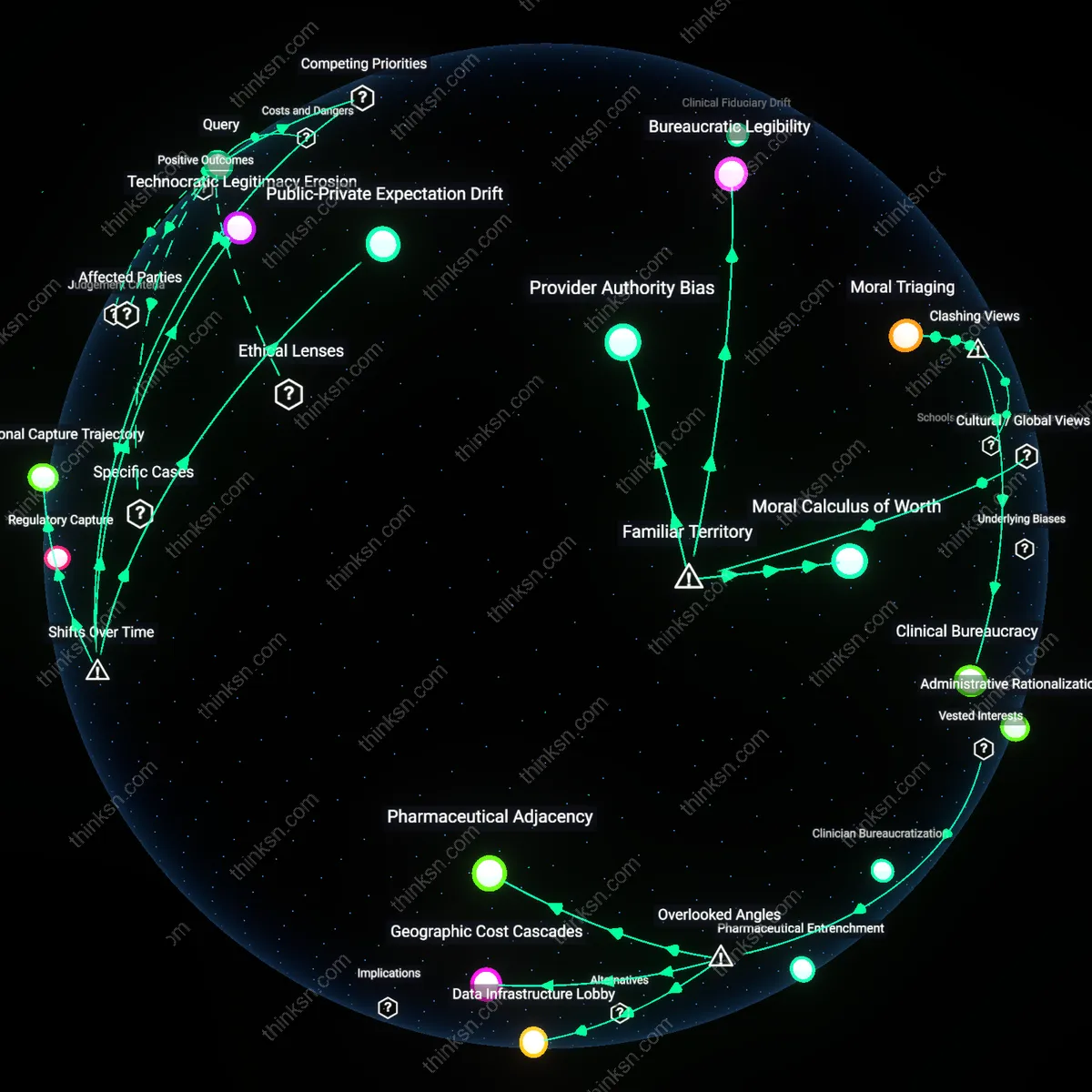
Screening Bias in Industry-Sponsored CT Lung Scans?
Analysis reveals 9 key thematic connections.
Key Findings
Guideline Captivity
Mandating independent oversight of clinical guideline panels prevents industry-affiliated experts from disproportionately shaping low-dose CT screening recommendations. Health systems and professional societies often appoint panel members with undisclosed financial ties to imaging firms, which introduces subtle but systemic bias in favor of frequent or earlier screening—despite equivocal evidence for broad populations. This mechanism operates through trusted institutions like the USPSTF or specialty colleges, where perceived neutrality masks private-sector influence in drafting criteria that directly benefit high-volume, industry-linked imaging centers. The non-obvious consequence is that evidence interpretation becomes selectively attuned to expand eligible cohorts, indirectly privileging centers with commercial incentives over public health rigor.
Reimbursement Stratification
Linking insurance reimbursement for low-dose CT screening to facility accreditation by non-industry-affiliated bodies reduces preferential access for for-profit imaging centers. Private radiology chains often exploit fee-for-service models by leveraging lobbying efforts to shape CMS payment structures that reimburse per-scan volume rather than population health outcomes, creating a built-in advantage over public or academic hospitals. This dynamic is entrenched in regional Medicare Administrative Contractors (MACs), where legacy billing codes incentivize scan volume over clinical necessity, particularly in rural areas with monopolistic imaging providers. The underappreciated effect is that reimbursement design—not medical need—becomes the primary driver of screening access, structurally favoring commercial over public infrastructure.
Referral Network Lock-in
Deploying standardized electronic referral pathways that require primary care providers to use public health-approved imaging registries disrupts preferential patient routing to industry-sponsored centers. In integrated health systems like Kaiser or large ACOs, referral algorithms are often influenced by backend integration with private imaging networks that offer faster scheduling and kickback-adjacent data-sharing agreements. This creates a self-reinforcing cycle where convenience and interoperability steer former smokers toward high-cost commercial sites, even when equivalent public capacity exists. The overlooked mechanism is that technical integration—often justified as improving care coordination—functions as a covert distributional gatekeeper, embedding commercial advantage into everyday clinical workflows.
Commercialized Prevention
Aligning public health screening guidelines with reimbursement structures in the 2010s transformed low-dose CT from a clinical tool into a revenue-generating service dominated by industry-sponsored imaging centers. As Medicare began covering annual screenings for eligible former smokers in 2015, private imaging firms rapidly expanded capacity, leveraging favorable billing codes and vertical integration with radiology groups to outcompete hospital-based or public clinics. This shift institutionalized a model where preventive care access became contingent on commercial scalability, privileging centers with marketing reach and insurance negotiation power over community health equity—an outcome not inherent to the technology, but emergent from its entanglement with post-Affordable Care Act financing incentives. The non-obvious consequence is that guideline adoption did not democratize access but instead triggered a market cascade that redefined prevention as a growth sector.
Evidence Regimes
The 2011 National Lung Screening Trial (NLST) results, which demonstrated a mortality benefit for low-dose CT, initiated a decisive shift from viewing lung imaging as a diagnostic act to positioning it as a standardized preventive intervention—creating a new evidentiary standard that inadvertently favored industrial delivery systems. This trial's design, reliant on high-volume scanning infrastructure, established technical reproducibility and throughput as implicit criteria for guideline eligibility, disadvantaging smaller clinics lacking automated scheduling, digitized tracking, or PACS integration. Over time, this redefined 'best practice' not as clinical appropriateness alone but as operational consistency at scale, enabling industry-sponsored centers to meet quality metrics more reliably than decentralized providers. The underappreciated result is that the very conditions of scientific validation became a gatekeeping mechanism, embedding structural advantage into what appeared to be neutral clinical evidence.
Referral Pathway Lock-in
After the 2013 USPSTF endorsement of low-dose CT screening, primary care networks increasingly outsourced coordination to imaging centers offering turnkey referral platforms, embedding commercial providers into the administrative fabric of prevention by the late 2010s. These systems—equipped with automated eligibility checks, pre-populated orders, and direct patient scheduling—reduced clinician workload but simultaneously bypassed public health clinics that lacked interoperable health IT or dedicated care navigators. As a result, the path of least resistance for busy practices became alignment with private centers, not due to explicit bias but through incremental adoption of efficiency-enhancing tools that concentrated patient flows. The historically specific insight is that systemic favoritism did not originate in corruption or intent, but solidified through mundane workflow integration during a period of rapid digital standardization in outpatient care.
Regulatory Arbitrage Pathways
Mandate independent validation of screening outcomes through publicly funded imaging registries to detect referral bias. When Medicare began covering lung cancer screening via low-dose CT in 2015, industry-affiliated centers rapidly expanded access but also concentrated scans among lower-risk former smokers, as seen in Florida’s regional imaging chains, which leveraged referral networks to maximize reimbursement while diluting diagnostic yield—revealing how payment-linked adoption creates regulatory arbitrage pathways that subvert epidemiological intent.
Clinical Trial Feedback Loops
Restructure guideline adoption criteria to require disaggregation of trial data by sponsorship and care setting. The National Lung Screening Trial (NLST), which prompted USPSTF recommendations, was conducted primarily within academic and integrated health systems with rigorous protocols, but its outcomes were extrapolated to profit-driven outpatient centers where scanning volume eclipsed counseling and follow-up—exposing how clinical trial feedback loops form when efficacy evidence from controlled environments legitimizes expansion into unregulated commercial markets.
Referral Ecosystem Distortions
Implement geospatial audit mechanisms to monitor deviations from risk-stratified screening eligibility. In Ohio’s Appalachian region, third-party management companies partnered with local clinics to promote 'free' lung scans using mobile CT units, generating a 300% increase in screenings over two years, mostly among non-qualifying patients—this surge, documented by the Ohio Department of Health in 2018, illustrates how referral ecosystem distortions emerge when mobile infrastructure and patient incentive programs bypass clinical risk thresholds for market growth.