Do Insurers Secretly Change Policies After Claims Harm Trust?
Analysis reveals 12 key thematic connections.
Key Findings
Regulatory Arbitrage
Insurers retroactively adjust policy terms after claims when state insurance regulators fail to uniformly enforce restrictions on post-claim underwriting, enabling companies to exploit jurisdictional variation in oversight. This occurs particularly in U.S. states with weak legislative guardrails around policy modification, where insurers leverage actuarial ambiguity to redefine coverage language after a high-cost claim, effectively narrowing liability without formal notice. The mechanism is not fraudulent per se but operates through legally permissible re-interpretation of ambiguous clauses, revealing how decentralized regulation creates structural opportunities for unilateral changes. The non-obvious consequence is that consumer distrust emerges not from isolated bad actors but from a system designed to allow interpretive dominance by insurers.
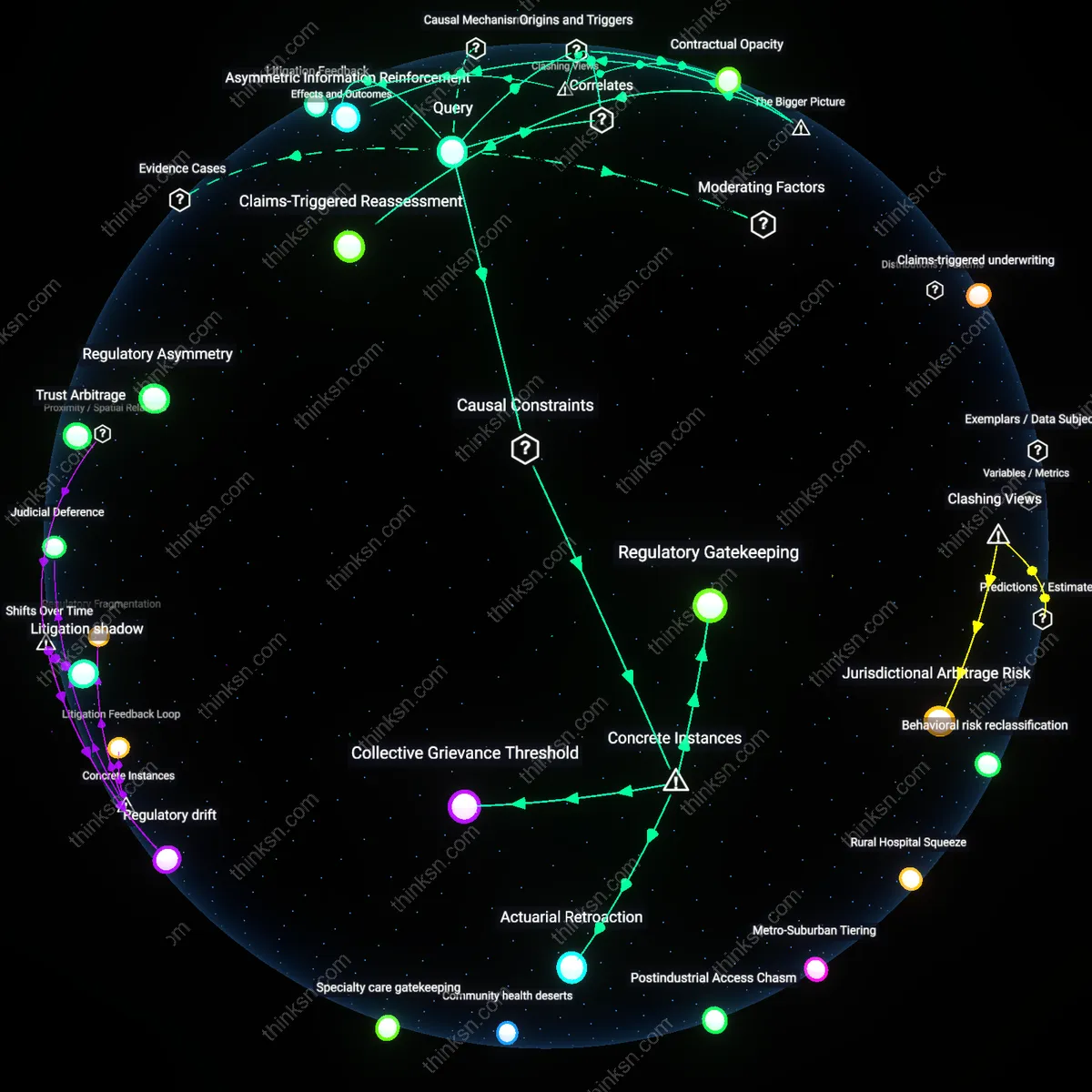
Claims-Triggered Reassessment
Insurers initiate retroactive policy term adjustments following a first major claim because that event serves as a credible signal of previously unobserved risk exposure, activating internal underwriting algorithms that reclassify policyholders into higher-risk tiers. This reassessment is embedded in modern insurance platforms that treat claims data as real-time feedback for risk modeling, particularly in health and auto lines where predictive scoring systems automatically flag policies for review after payout events. The shift is systemic, driven by data infrastructure that equates claims with risk deterioration, thereby justifying post-hoc premium increases or coverage exclusions under the guise of risk-based pricing. The deeper issue is that the claim itself becomes the trigger for disadvantage, undermining the implicit consumer expectation of static terms post-enrollment.
Asymmetric Information Reinforcement
Policy terms are retroactively narrowed after claims because insurers possess exclusive access to aggregated claim pattern analytics, allowing them to identify and exploit ambiguities in policy language only after real-world losses reveal coverage vulnerabilities. This practice is amplified in complex policies—such as disability or long-term care—where indemnity conditions are open to interpretation and legal precedents on enforceability are sparse, giving insurers the advantage of timing and technical expertise. Unlike overt breaches, these changes occur through subtle redefinitions in renewal documents or internal claim processing guidelines not disclosed to policyholders, deepening information asymmetry. The resulting distrust stems not from visible contract violations but from the realization that insurance contracts are treated by providers as evolving instruments, calibrated against consumer need.
Regulatory Asymmetry
Insurers rarely alter policy terms retroactively after claims due to state insurance commissioner oversight, but the shift from state-led to federally constrained regulation since the McCarran-Ferguson Act of 1945 created a permissive environment for non-price competition, including subtle post-claim underwriting adjustments that mimic term changes without formal amendments. This mechanism operates through state-level rate-filing regimes and insurer appeals to federal preemption in cases like Medicare Advantage plans, where federal benefit mandates indirectly pressure private carriers to shift risk post-enrollment. The non-obvious insight is that retroactive change is not necessary when post-claim practices—such as intensified documentation demands or claims denials based on marginal non-compliance—can achieve similar financial outcomes without triggering regulatory penalties, revealing how the stability of formal policy terms masks a deeper erosion of substantive coverage predictability.
Claims-Driven Reunderwriting
Insurers have increasingly replaced retroactive term revisions with dynamic risk reassessment following claims, a shift accelerated after the Affordable Care Act curtailed pre-existing condition exclusions and prompted alternative risk-mitigation strategies, particularly in disability and long-term care markets. This operates through proprietary claims algorithms that flag recurrent or high-cost claimants for intensified review, not formal term changes, but subsequent premium adjustments or non-renewals that functionally reshape coverage. The underappreciated consequence is the emergence of de facto experience-rated renewal cycles in traditionally community-rated products, illustrating how post-ACA insurers circumvented statutory constraints on retroactivity by embedding temporal risk recalibration into renewal mechanics, thereby converting isolated claims into persistent liability signals.
Trust Arbitrage
Consumer trust in insurers declined most sharply not when retroactive changes were common—pre-1980s—but during the 1990s managed care backlash, when health maintenance organizations used retrospective claims audits to justify retroactive eligibility denials and network-based restrictions, even as formal policy language remained unchanged. This pivot occurred alongside the rise of employer-mediated coverage and third-party administrators, distancing the policyholder from direct insurer accountability and normalizing administrative opacity. The historically specific transition—from insurer-as-guarantor to insurer-as-arbiter—revealed that trust erosion stems less from explicit contractual reversals than from the institutionalization of discretionary review, a shift that privatized risk interpretation under the guise of medical necessity protocols and rendered trust contingent on procedural legitimacy rather than contractual fidelity.
Regulatory Forbearance
Insurers rarely retroactively alter policy terms after claims because state insurance departments in the U.S., such as those governed by the National Association of Insurance Commissioners (NAIC) model regulations, legally prohibit unilateral changes to in-force contracts; what appears to be retroactive alteration is often the selective enforcement of pre-existing, ambiguous clauses under claims scrutiny, a practice enabled by regulatory tolerance for industry-standard language that favors carriers in dispute resolution. This occurs through the gap between formal contract law and the practical authority of claims adjusters to interpret provisions, a dynamic that shifts the site of contestation from policy wording to interpretive discretion—revealing that consumer distrust stems less from actual term changes than from perceived arbitrariness in adjudication. The non-obvious insight is that retroactivity is not the mechanism of advantage; interpretive asymmetry is.
Litigation Feedback
Insurers do not meaningfully change policy terms retroactively because the threat of class-action lawsuits and state attorney general enforcement—evident in cases involving major carriers like State Farm or Allstate—makes outright retroactive amendment legally hazardous; instead, observed shifts in claim outcomes correlate with post-claim data harvesting and actuarial reclassification, where consumer risk profiles are updated and applied to renewal terms, creating the perception of retroactive penalty without altering the original policy. This occurs through actuarial systems that decouple pricing and eligibility decisions from the policy document itself, embedding behavioral consequences in renewal offers rather than contract text. The dissonance lies in recognizing that trust erosion is driven not by broken contractual promises but by invisible risk recalibration masked as administrative routine.
Contractual Opacity
Retroactive change is more imagined than real, but its persistent attribution to insurers reflects long-term industry success in designing policies with layered, cross-referenced exclusions and discretionary clauses—such as those around 'material misrepresentation' or 'non-cooperation'—that allow claims denial without formal amendment, a pattern reinforced by court rulings that defer to insurer interpretation under the doctrine of contra proferentem only when ambiguity is clear. This structural opacity, built into standard ISO forms adopted across state markets, creates statistical co-occurrence between claim filing and adverse policy outcomes, even when no terms are altered, because the activation of dormant clauses mimics retroactive enforcement. The overlooked reality is that the contract is designed to be indeterminate until tested, making trust a function of revelation, not breach.
Regulatory Gatekeeping
Insurers retroactively altered coverage terms for homeowners in wildfire-prone areas of California only after state regulators temporarily blocked new policies from being canceled, revealing that legal authority acts as a bottleneck preventing immediate contractual changes post-claim. The California Department of Insurance’s 2020 emergency regulation on Senate Bill 824 created a moratorium that halted non-renewals within disaster zones, exposing how insurers rely on regulatory silence to reshape risk exposure after claims. This instance shows that without preemptive oversight, carriers can exploit post-claim windows to redefine coverage, but only when agencies fail to activate procedural constraints. What is non-obvious is that the delay, not the policy content, becomes the critical variable in preserving consumer trust.
Actuarial Retroaction
After Hurricane Katrina, several private insurers in Louisiana leveraged revised loss models to reclassify entire zip codes as 'uninsurable,' effectively altering de facto policy terms for existing claimants by denying future renewals based on updated risk profiles. These changes were not framed as contractual amendments but as algorithmic risk reassessments, operating through internal actuarial systems now calibrated to post-disaster data. The bottleneck here is the lack of transparency in risk-model recalibration, which allows insurers to evade formal disclosure requirements while producing the same effect as term changes. This case reveals that retroactive change often occurs not through visible contract edits but through invisible model updates that reframe eligibility.
Collective Grievance Threshold
In 2017, after widespread claims from sinkhole damage in Hernando County, Florida, State Farm quietly tightened subsidence coverage definitions in renewal contracts, but only resumed broad enforcement after a class-action suit (Doe v. State Farm) was dismissed due to insufficient plaintiffs. The causal chain from claim to term alteration only completed once legal aggregation failed, showing that individualized claims without collective action permit unilateral adjustments. The bottleneck is the minimum number of coordinated claimants needed to trigger legal resistance—a threshold that, when unmet, enables silent recalibration of coverage expectations. This illustrates that consumer trust erodes not from isolated incidents but from the collapse of collective recourse capacity.