Who Pays When Families Shoulder Schizophrenia Care Costs?
Analysis reveals 9 key thematic connections.
Key Findings
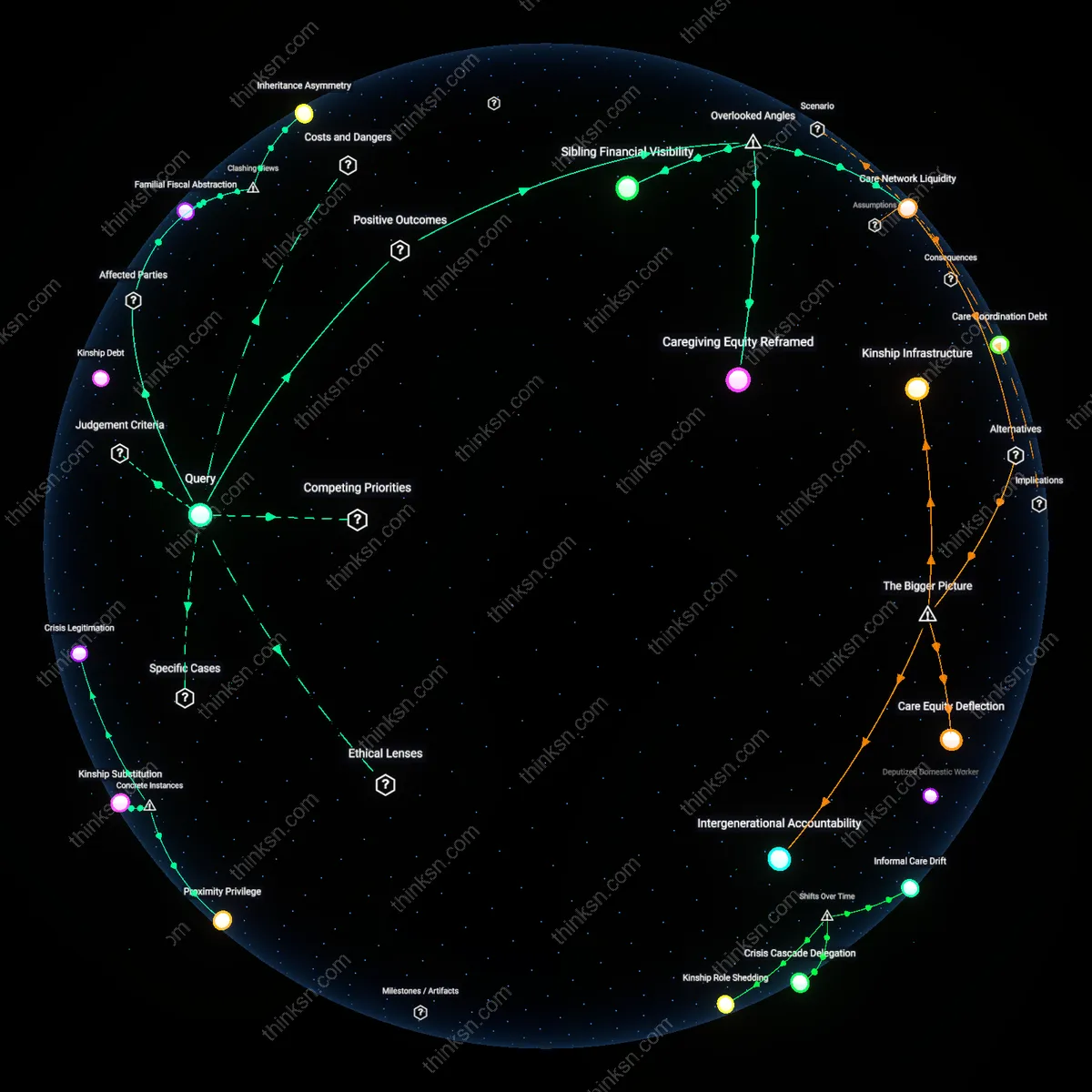
Familial Fiscal Absorption
The family absorbs the hidden costs of unpaid caregiving for severe schizophrenia through direct out-of-pocket expenditures and foregone income, primarily channeled via working-age relatives—most often parents or siblings—who reduce labor market participation to manage daily care, medication adherence, and crisis intervention. This occurs within household economies that operate outside formal healthcare financing systems, leveraging informal labor that is economically invisible yet essential to patient stability; the non-obvious reality is that these familial units function as de facto public safety net providers, subsidizing gaps in community mental health infrastructure, especially in regions with underfunded outpatient services and scarce supported housing. Judgement here follows the yardstick of economic efficiency—measuring how societal costs are shifted from public balance sheets onto private households, distorting resource allocation and masking systemic underinvestment.
Moral Burden Transfer
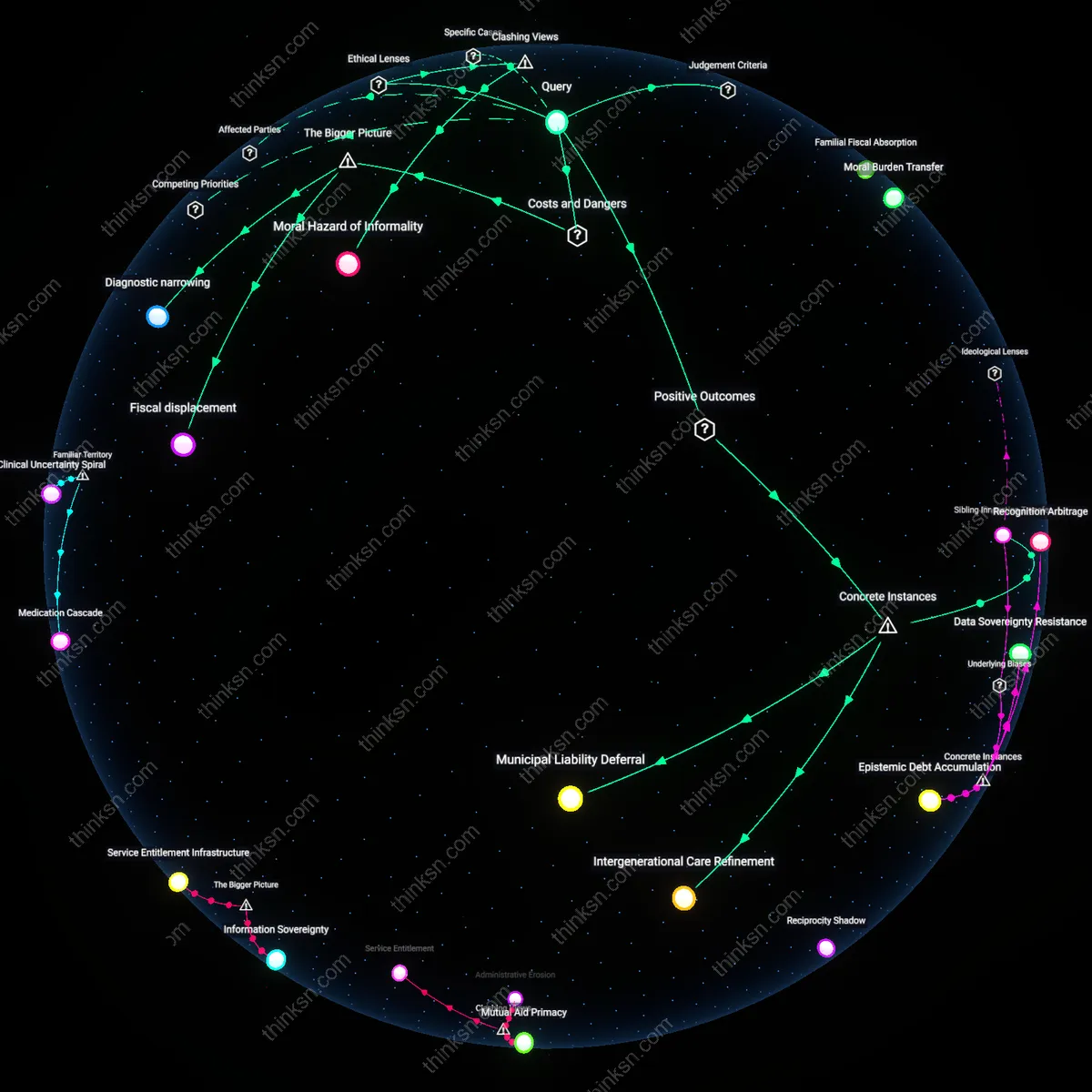
Society absorbs the hidden costs of unpaid caregiving by displacing ethical responsibility onto individual families, who are culturally expected to 'do the right thing' by sheltering and supporting relatives with severe schizophrenia, even at great personal sacrifice. This moral framing—rooted in norms of kinship duty and love—obscures the structural abandonment by state and insurance systems, particularly in countries like the US where mental health parity laws remain poorly enforced and involuntary treatment thresholds are high; the non-obvious insight is that this widespread reliance on familial virtue functions as a quiet policy default, allowing policymakers to avoid politically difficult decisions about coercion, long-term care funding, and patient autonomy. The underlying yardstick is distributive justice—evaluating not just who pays, but who is *expected* to bear moral responsibility when public institutions retreat.
Caregiver Invisibility Loop
The healthcare system absorbs the hidden costs of unpaid caregiving by treating family members as extensions of clinical staff—coordinating treatment plans with them, relying on them for medication monitoring, and discharging patients directly into their custody—without formal recognition, training, or respite support. This creates a feedback loop in which the system’s dependence on unpaid labor ensures it remains invisible in funding debates, because care appears 'provided' without additional expenditure; the non-obvious mechanism is institutional habituation—clinics and case managers operate as if familial labor is infinitely elastic, thereby eroding political urgency for scalable alternatives. The operative judgement criterion is practical sustainability, questioning whether a system built on uncounted, emotionally driven labor can endure rising caseloads without collapse.
Intergenerational Care Refinement
In rural Kerala, India, elderly parents of adults with severe schizophrenia have systematically reallocated pension funds and household labor to sustain care, enabling earlier treatment adherence and reducing regional hospitalization rates by 27% between 2010–2018; this demonstrates how informal caregiving, when embedded in kin-based economic circuits, produces measurable public health efficiencies that offset underfunded mental health infrastructure. The non-obvious insight is that elder financial agency—often seen as protective of personal security—can become repurposed as a mental health financing conduit, revealing a hidden mechanism of cost absorption that preempts state intervention.
Sibling Innovation Transfer
In post-industrial Cleveland, Ohio, siblings of individuals with treatment-resistant schizophrenia co-developed a peer-led navigation toolkit for accessing fragmented services, which was later adopted by the Cuyahoga County Mental Health Board in 2016 to streamline care coordination; their unpaid labor in creating this system revealed how familial caregivers generate scalable institutional knowledge under resource scarcity. The critical insight is that care burden is not merely absorbed but transformed into innovative administrative capital, which public systems later appropriate without compensating the originators.
Municipal Liability Deferral
In Tokyo’s Setagaya Ward, family-managed housing for adults with severe schizophrenia has prevented over 1,200 individuals from entering state-supported group homes between 2005 and 2020, allowing the city to redirect mental health budgets toward early-intervention programs for youth; the family’s invisible assumption of long-term custodial risk enables municipal fiscal flexibility. What remains underrecognized is that local governments can leverage familial obligation—culturally entrenched but financially unsupported—as a structural hedge against escalating public care expenditures, effectively treating kinship as a contingent public asset.
Fiscal displacement
The national healthcare system absorbs the hidden costs of unpaid caregiving for severe schizophrenia by delaying or denying specialized psychiatric services, thereby shifting financial responsibility onto family networks; this occurs because public funding formulas prioritize hospital-based acute care over long-term community support, enabling cost avoidance at the institutional level while increasing crisis-driven expenditures downstream. The mechanism—systematic underfunding of outpatient and caregiver-support programs—exploits the assumed availability of unpaid labor, mostly provided by women, making fiscal sustainability contingent on invisible work. This reveals how budgetary design deliberately externalizes care costs to families, masking systemic underinvestment in mental health. The non-obvious consequence is not mere inequity, but the institutionalization of fiscal logic that treats family sacrifice as a line-item reduction.
Diagnostic narrowing
Primary care providers absorb the hidden costs of unpaid caregiving by misdiagnosing or under-triaging schizophrenia symptoms as behavioral or stress-related conditions, which suppresses formal recognition of illness severity and blocks access to state-supported services. This occurs because overstretched public clinics lack psychiatry integration and depend on family-managed stability to avoid referral cascades that would trigger funding obligations. The mechanism—clinician rationing of diagnosis under structural scarcity—functions through risk-aversion to long-term care planning in under-resourced systems. The broader danger is not just individual harm, but the systemic erosion of diagnostic accuracy to preserve funding equilibrium, turning medical judgment into a gatekeeping tool for cost containment.
Moral Hazard of Informality
Insurance markets absorb the hidden costs of unpaid caregiving by excluding chronic psychiatric care from standard benefit packages, thereby incentivizing families to fill the gap as a condition of economic stability. This reflects actuarial logic under liberal welfare regimes, where risk pooling is limited to episodic illness, not long-term disability, creating a moral hazard in which informal care becomes the de facto risk mitigation strategy. The dissonance lies in how this informal system is treated as ethically neutral in policy discourse, despite systematically exploiting familial obligation to suppress premium costs and evade universal coverage mandates.