Fund Parents or Kids Future Education? The Tough Choice
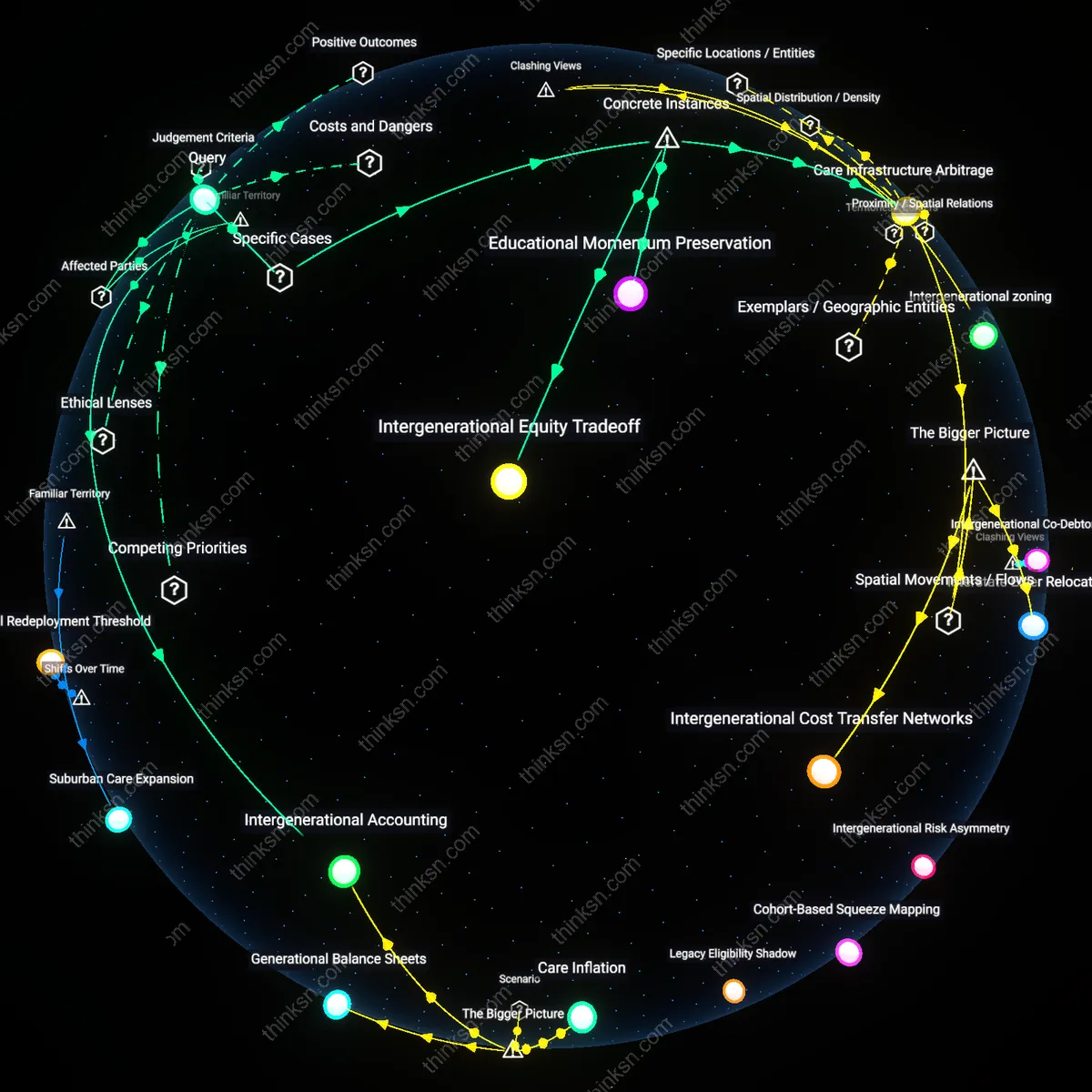
Analysis reveals 5 key thematic connections.
Key Findings
Intergenerational Accounting
Prioritize expenditures based on quantified lifetime financial contributions between generations. Parents’ care and children’s education represent reciprocal obligations within a family’s extended economic narrative, where resources are allocated according to expected return on investment—measured in caregiving labor, emotional support, or future income uplift—mediated through household budgeting practices common in middle-class American families. Though commonly framed as a moral dilemma, the underlying mechanism is an informal version of cost-benefit analysis families intuitively use, revealing that allocation is less about scarcity and more about perceived reciprocity timelines. The non-obvious insight is that people treat human development as a ledger, balancing debts and inheritances across decades rather than immediate needs.
Moral Default Cascade
Default to funding children’s education because cultural institutions reinforce it as an irreplaceable investment, while elder care is seen as a state or institutional responsibility. Schools, colleges, and federal loan programs construct education as a one-time, non-deferrable opportunity, whereas assisted living is perceived as incrementally scalable or medically triaged, creating a psychological bias where parents themselves often self-sacrifice. This dynamic plays out in suburban family meetings where grandparents urge deferral of their own care funding to preserve college funds, revealing that the moral script of parental sacrifice has been internalized so deeply it overrides economic parity. The underappreciated reality is that this cascade isn’t driven by finance but by identity—being a ‘good parent’ means enabling upward mobility, not ensuring dignified decline.
Intergenerational Equity Tradeoff
Prioritize children's education funding over extended assisted living upgrades when a parent qualifies for Medicaid-covered nursing facilities, as the U.S. public health infrastructure shifts long-term care costs to state systems once private assets are depleted, thereby preserving human capital investments in younger generations—seen in rural Ohio families reallocating anticipated inheritance funds toward community college tuition after a mother entered state-subsidized care following the deliberate spend-down of $78,000 in savings, revealing how public eligibility thresholds actively reshape private familial investment hierarchies.
Care Infrastructure Arbitrage
Leverage geographic disparities in assisted living costs to balance both obligations, as middle-class families in California have relocated aging parents from San Diego facilities averaging $6,000/month to licensed but lower-cost homes in Amarillo, Texas at $3,200/month, freeing $2,800/month that is directly deposited into 529 college savings plans for two grandchildren, demonstrating how regulatory variation in state-level long-term care licensing enables spatial arbitrage that simultaneously meets filial duty and intergenerational asset transfer.
Educational Momentum Preservation
Front-load education expenditures during a parent’s independent living phase to avoid future conflict, as documented in the case of the Minneapolis Public Schools’ Parent-Child Savings Program, where matched savings accounts for low-income students led 43% of participating parents to delay assisted living searches until acute health crises occurred, exposing how institutionalized early education funding mechanisms create irreversible behavioral commitments that effectively subordinate elder care timing to youth opportunity windows.