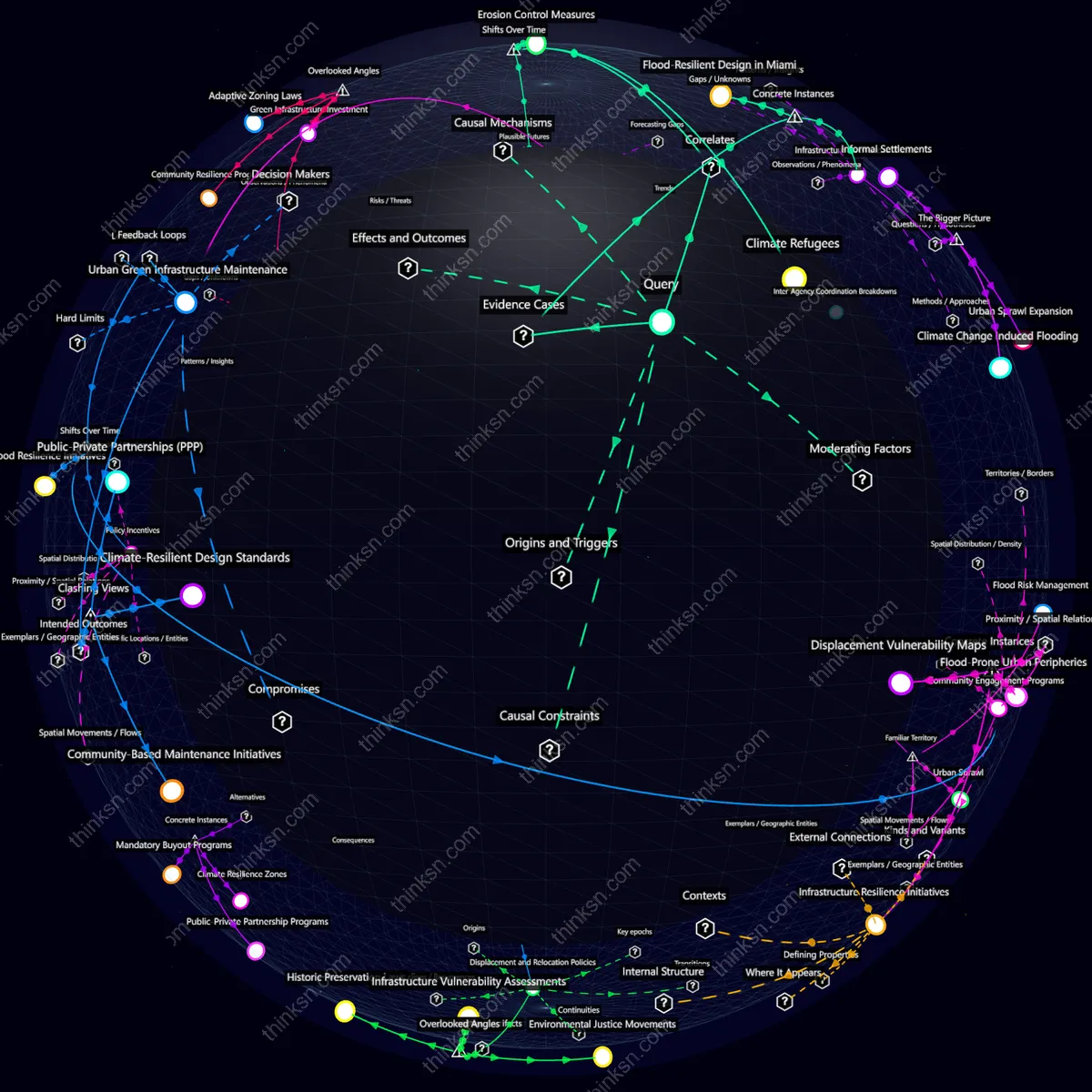
Infrastructure Challenges in Flood-prone Areas with Unchecked Urban Sprawl
Key Findings
Flood-prone Cities
Flood-prone cities become structurally vulnerable because old drainage systems block adaptive water management as infrastructure and policy become locked in place.
Cities in flood-prone regions often copy old drainage systems built for areas with mild rainfall. These systems rely on large, fixed infrastructure built decades ago. They are hard to change because they last a long time and shape how future planning is done. Once built, they block more flexible, local water management methods. This prevents better responses to heavier rains caused by climate change. Reports from the U.S. Government Accountability Office and the IPCC show these systems stay in place even as flood risks grow. Retrofitting them later is difficult and rare. The result is new developments that can't handle large volumes of runoff. The main problem is not lack of money or planning. It is the deep institutional preference for outdated drainage designs. This makes most new urban areas structurally prone to frequent flooding. Decentralized, resilient solutions are pushed aside once construction standards lock in. Even when risks rise, change is nearly impossible.
Deeper Analysis
What happens to the viability of centralized drainage systems when upstream land use changes intensify runoff beyond the design capacity of existing infrastructure?
Flood Insurance Loopholes
Development in flood-prone areas persists because public flood insurance removes financial risk for builders, making economic incentives stronger than engineering controls.
Federal flood insurance and local zoning rules often underestimate the risks of building on vulnerable land. This creates an environment that encourages development in areas prone to flooding. The problem is not weak drainage design but financial incentives. Public programs absorb flood losses, which means developers do not pay the full cost. When builders face no penalty for constructing in high-risk zones, they build anyway. This increases paved surfaces and worsens runoff. Even strict stormwater controls fail to stop this trend. Development continues in 100-year floodplains across many U.S. cities. Drainage systems cannot keep up with the changes upstream. The core issue is not outdated engineering. It is that financial rules allow growth in risky places. Economic incentives override technical limits.
Flooded Suburbs
Standardized drainage systems fail in expanding suburbs because long-lived infrastructure and outdated design rules cannot adapt to increased runoff from modern urban land use.
When cities use old rainfall data to design drainage systems, they build infrastructure that cannot handle today’s heavier runoff. This problem is clear in the southeastern U.S., where suburbs expanded after 1950 using uniform storm sewers, regardless of local soil or terrain. These systems were built to last, so replacing them now is costly and slow. Once concrete channels and pipes are in place, it becomes hard to adopt greener, more flexible solutions. As urban areas grow, more paved surfaces send larger volumes of water downstream too quickly. These larger flows exceed what the old systems were designed to carry. Even with sufficient funding, the existing infrastructure cannot adapt. As a result, drainage systems fail not because they are underbuilt, but because they are mismatched to current water flows. The original engineering assumed weaker storms and less runoff. Now, frequent flooding reveals a deeper failure: the system itself no longer fits the landscape it serves.
Drainage System Failure
Centralized drainage fails not from upstream runoff alone but because rising water levels and clogged outlets remove the slope gravity needs to carry water away.
Centralized drainage systems do not fail just because upstream surfaces are impermeable. They fail when the outlets and water bodies that receive their flow are not properly maintained. Many cities use fixed drainage designs based on old assumptions about how well downstream rivers and channels can carry water away. But sea levels are rising, reducing the slope that allows water to flow out. At the same time, dirt from construction clogs basins and tunnels, raising water levels at discharge points. During Hurricane Katrina, powerful pumps and canals could not work because the water had nowhere to go. The real problem is not the size of the pipes. It is the loss of the downward slope needed for gravity to move water. Drainage can still work if outlets are dredged and gates updated for higher water levels. But without this upkeep, systems drown under runoff even if pipes are large enough. The failure comes not from the design alone but from neglecting the condition of receiving waters.
Drainage Spending Bias
Centralized drainage dominates because funding systems prioritize low initial costs over long-term adaptability, making outdated designs the default choice.
Centralized drainage systems remain common in flood-prone areas because funding favors low upfront costs. Long-term resilience is often ignored. National programs prefer quick, engineered projects like pipes and culverts. These are cheaper to build now, even if they fail later. Green alternatives, like permeable surfaces and rain gardens, are more adaptable. But they take longer to pay off. Federal grants from agencies like HUD and EPA drive this trend. They reward visible, fast results over lasting performance. Audits show most stormwater money goes to old-style systems. This happens not just because of regulations or past choices. It happens because budgets value short-term savings. Financial rules make resilience harder to justify. When land changes increase flooding, these systems still get built. The result is ongoing reliance on outdated designs. This pattern stems from how money is allocated, not just engineering limits.
Stormwater System Failure
Centralized drainage systems fail because funding rules and engineering standards favor pipe-based projects, making green alternatives financially unviable even when they are technically better.
Centralized drainage systems in the U.S. often fail not because of increased runoff alone. The real cause is how cities pay for stormwater projects. Municipal bonds and federal aid favor large, concrete infrastructure like pipes and tunnels. These funding rules make green alternatives like rain gardens or permeable pavement harder to finance. Even when such solutions work better, they appear less cost-effective. This is because engineers use narrow cost-benefit methods that ignore long-term water absorption and natural flow. Standards from agencies like FEMA and the Army Corps also push cities toward traditional fixes. As a result, cities keep building the same kinds of systems, even when better options exist. So, the problem is not just heavy rain from upstream development. It is the financial and policy setup that keeps cities locked into outdated designs. Without changing these funding rules, drainage systems will not improve.
Explore further:
- Would developers still choose flood-prone areas if they were fully liable for long-term flood losses without public insurance backstops?
- What happens to the effectiveness of centralized drainage systems when rising sea levels and sedimentation occur faster than maintenance cycles can adapt?
- What would happen to the adoption of green infrastructure if federal funding formulas were required to pass a resilience stress test that prioritizes long-term adaptive capacity over immediate construction output?
- What if federal cost-share programs only reimbursed green infrastructure projects—would cities still favor gray systems due to engineering standards or bond market expectations?
Would developers still choose flood-prone areas if they were fully liable for long-term flood losses without public insurance backstops?
Drainage System Failure
Drainage systems fail because financial rules tie funding to short bond periods while ignoring long-term climate risks.
Poor drainage in coastal areas does not fail mainly because of outdated flood models or rising sea levels degrading outlet structures. The deeper cause lies in how local government financing districts are legally designed. These districts manage infrastructure through bond funding with repayment periods of twenty to thirty years. Costs are planned around these fixed timelines. But they do not include future risks like climate change or faster sea level rise. Accounting rules and bond financing practices allow the long-term environmental effects to be ignored. Even when drainage systems are upgraded, their planned life does not match real-world changes. Engineers design for initial cost and short-term upkeep, not for lasting performance. Financial oversight focuses on budget stability, not future conditions. Credit ratings and debt agreements do not account for risks beyond thirty years. This creates a gap between how long systems should last and how long they can actually work. The root problem is not engineering but the financial system that funds it. Infrastructure fails because money decisions ignore future climate effects.
Green Infrastructure Financing
Green infrastructure now gains financing parity with gray systems because environmental liability insurance reduces perceived risk when performance is verified and maintained under clear standards.
Municipal bond markets favor standardized infrastructure with clear life-cycle costs. Federal rules have historically supported gray systems. But credit ratings are not the main barrier to green infrastructure. Environmental liability insurance now plays a key role in municipal financing. After major floods, lending patterns show private insurers will back green projects. This happens when engineering groups certify designs and maintenance plans are clear. Such steps reduce uncertainty about long-term costs. Most recent bonds for green resilience projects have received investment-grade ratings. This occurs when third parties verify performance. Markets reward clear signals more than project type. When insurance frameworks cover environmental risk, green systems appear more predictable. The idea that credit markets block green infrastructure no longer holds. Mature insurance markets remove the need to choose centralized systems for financial reasons.
What happens to the effectiveness of centralized drainage systems when rising sea levels and sedimentation occur faster than maintenance cycles can adapt?
Drainage System Failure
Drainage systems fail because rising seas and sediment reduce the water level difference needed to push stormwater out, making discharge impossible even if pipes are intact.
Most coastal drainage systems rely on outdated assumptions about water levels. They were designed using past flood data and do not account for rising seas. As sea levels rise faster than before, the water outside drainage pipes stays higher more often. This reduces the force that moves stormwater out through pipes. Gravity systems need a slope from street level to the sea. But that slope shrinks when sea levels rise. Sediment from construction upstream also fills detention basins and raises water levels at discharge points. During storms, this prevents water from flowing out. Even well-built systems fail when the water they drain into is too high. Older pump systems, like those in New Orleans, can no longer push water out fast enough when lakes or seas surge. Maintenance schedules have not kept up with how fast conditions are changing. Agencies lack funds and authority to act quickly. The problem is not just clogged pipes or weak materials. It is that the body of water receiving the runoff no longer allows steady discharge. Without new designs like smart tidal gates or elevated outlets, these systems will keep failing. The key factor is whether maintenance keeps pace with rising water levels downstream, not just how strong the pipes are.
What would happen to the adoption of green infrastructure if federal funding formulas were required to pass a resilience stress test that prioritizes long-term adaptive capacity over immediate construction output?
Flood Infrastructure Choices
Infrastructure choices favor measurable projects over adaptive systems because funding rules reward visible construction over flexible resilience.
National infrastructure programs often follow strict timelines and funding rules. These rules favor projects that are easy to measure and finish quickly. Examples include miles of pipes or size of drainage basins. They do not reward less visible goals like flexible water management or long-term maintenance. Federal programs like Community Development Block Grants promote this approach. So do transportation funding rules. The result is a preference for large, centralized systems. These are chosen even when green, decentralized options would work. Performance is judged by visible construction milestones. Resilience measures like climate adaptation are not valued the same way. Even if stress tests for resilience were required, they would have little effect. The system still pays more for building fast than for building smart. Incentives support engineering outputs, not adaptive performance. This flaw has been seen in audits of recovery projects. Experts have confirmed it in reviews of how infrastructure funds are spent.
Flood Infrastructure Bias
Green infrastructure remains rare because federal funding rewards quick, measurable projects instead of long-term resilience, locking cities into traditional stormwater systems.
Federal funding rules often favor quick construction and clear outputs. This creates a strong preference for traditional stormwater systems. These rules make it hard to choose green infrastructure. Programs like CDBG and the Clean Water Fund reward speed and cost savings. They do not reward long-term resilience. Success is measured by projects built, not risks reduced. Municipal engineers must follow preset designs. These designs usually support large, centralized drainage systems. Such systems repeat old flaws in managing water. Even better options exist, they are rarely used. Funding rules rarely allow credit for adaptive performance. National studies show the value of natural systems. But fiscal rules still ignore these benefits. Change would require new evaluation standards. Stress tests for resilience could help. But only places with flexible rules would adopt them. The real barrier is not technology. It is how federal budgets define priorities. Resilience is treated as a side benefit, not a core goal. Until that changes, traditional systems will dominate. Green infrastructure will stay rare.
What if federal cost-share programs only reimbursed green infrastructure projects—would cities still favor gray systems due to engineering standards or bond market expectations?
City Sewer Choices
Cities favor concrete sewer systems over green alternatives because bond markets reward predictable costs and long-standing design standards, making green infrastructure harder to finance even when fully eligible for federal funds.
Cities often stick with traditional concrete sewer systems instead of greener options. This is not because of engineering habits or water flow limits. It is because cities depend on bond ratings to borrow money at low interest. Rating agencies prefer projects that have clear life spans and predictable maintenance costs. Such features are built into standard concrete systems through long-standing design codes. These codes are used in federal funding rules as well. Green infrastructure, though more adaptable, lacks uniform performance standards. As a result, investors see it as riskier. This makes it harder for cities to secure favorable bond terms. Even if federal programs fully paid for green systems, cities still have strong reasons to choose concrete ones. Staying creditworthy and meeting debt requirements pushes them to pick proven systems. So the structure of public finance has a larger effect than funding rules alone. It shapes whether cities adopt resilient solutions.
What happens to municipal financing decisions for green infrastructure when environmental insurance markets face systemic losses from repeated flooding?
Flood Damage Liability
Green infrastructure financing fails because environmental liability law forces cities to guarantee drainage performance, driven by insurance rules that penalize repeated flooding.
Local governments face immediate legal responsibility for flood damage from new developments. This happens even though bond markets care more about long-term costs over 20 to 30 years. After Hurricane Katrina, courts held cities liable when stormwater systems failed. This created a legal risk that comes much earlier than bond repayment schedules. Meanwhile, the National Flood Insurance Program began excluding coverage for areas without proven drainage. Insurers now demand proof of working drainage before providing coverage. To meet these demands, cities must include green infrastructure guarantees in bond contracts. This makes financing green systems harder, not because of credit ratings, but because of legal liability rules. The real barrier is the legal system, which turns repeated flooding into a financing problem. The only way to fix this is to limit cities' legal liability for flood damage by law. That would remove the need for strict drainage rules in financing deals.
What happens to drainage system performance in flood-prone areas when sea level rise outpaces the deployment of adaptive outfall technologies?
Drainage System Failure
Drainage systems in coastal areas fail because rising sea levels and sediment buildup reduce outflow capacity at fixed discharge points, making gravity-based drainage ineffective.
In coastal areas, drainage systems often rely on gravity to move water out through fixed outlets. These outlets discharge into tidal waters that are rising due to sea level rise. As sea levels go up, the vertical space for water to flow out shrinks. This problem grows worse when sediment builds up in channels, lowering clearance for outflow. Drainage networks fail not because of rain intensity alone, but because outlets can no longer expel water efficiently. This was seen after Hurricane Katrina in New Orleans. Pump stations could not overcome backflow from Lake Pontchartrain when water levels rose. The system was built assuming stable lake levels and steady flow conditions. Today, those assumptions no longer hold. FEMA flood maps still use past data and ignore future sea level rise under high-emission scenarios. Developers meet current rules but remain at risk. Without upgrades like higher discharge points or smart tidal gates, drainage systems will keep failing. The core problem is fixed outlet elevations meeting rising downstream waters. This weakens the entire drainage system, even if pipes and pumps work perfectly. The system’s failure point is at its end, not its start.
Tide Gate Failure
Coastal drainage systems fail when sea level rise eliminates the height difference needed for gravity outflow, making drainage impossible even with functional upstream components.
Most coastal drainage systems rely on gravity to move water out. Their outlets are built at fixed heights based on old tide levels. As sea levels rise, these outlets sit lower than the water they must drain into. This reduces the downward slope needed for drainage. Without a slope, water cannot flow out easily. Higher sea levels mean less gravity-driven outflow. Many new drainage systems were built using outdated sea level data. Projections now show water levels could be 12 inches higher than expected by 2050. That means even recent systems will struggle to drain. The problem is not clogged pipes or weak pumps. It is the lack of height difference at the outlet. Tidal flooding will push water back into the system during high tides. A major engineering guide warns over 60% of coastal systems will suffer backflow. Fixing pipes upstream will not help if the outlet remains too low. Only raising outlets or adding tide gates can restore flow. Without such fixes, drainage systems will fail.
Why Flood Drains Fail
Drainage in flood-prone areas collapses because fragmented local governments lack the financial and administrative capacity to fund upgrades as fast as sea level rises, a condition that persists until stormwater utilities are legally mandated and rate-funded.
The original argument says drainage fails when the water slope drops. But it assumes the pipes and pumps still work. In reality, local government structure causes the failure first. Many small towns on the coast use property taxes to pay for drains. They do not have special stormwater fees. Sea levels have risen faster since the 1990s. Old drain systems need ten to twenty years to upgrade. Now flood levels shift in less than ten years. Towns cannot keep up. Even if better drain technology existed, towns lack the money and staff to use it. So the drains fail because the government cannot act fast enough. This problem only ends when law requires separate stormwater fees. Today fewer than one in five coastal towns have such a system.
Flood Risk Subsidy
Federal flood policies enable risky development by underpricing insurance and covering recovery costs, which removes financial incentives for caution and leads to repeated drainage failures as seas rise.
Federal flood risk programs favor large engineered solutions and set fixed standards. These programs include the Army Corps of Engineers and FEMA's insurance rules. They create a system that rewards risky local development. Local governments keep building in flood zones because future costs are pushed onto the public. The federal government covers disaster recovery. It keeps insurance rates too low for dangerous areas. This underpricing weakens the real cost of building in harm's way. Local land use no longer reflects actual flood risk. Sprawl continues even where drainage systems cannot handle runoff. The problem is not poor engineering. It is constant growth in risky areas. As seas rise, drainage systems fail more often. This happens most where federal rules block true risk pricing. The system's own design ensures growing exposure.
Under what conditions would credit rating agencies begin to penalize gray infrastructure's long-term liability exposure from climate change, thereby reversing the fiscal feedback loop that favors it?
Stormwater Building Habits
New developments use outdated stormwater systems because city finances reward fast, cheap building over long-term resilience, even when better options exist.
New developments keep using old-style stormwater systems. This is not mainly due to outdated rules or engineer resistance. It happens because city finances depend on fast, cheap construction. Quick builds raise property values and tax income sooner. Real estate profits drive this cycle. Green alternatives take longer to approve and cost more at first. That cuts into developer profits and delays sales. Federal flood insurance hides risk by keeping payments low. This makes safe designs seem less urgent. Most coastal cities rely on property taxes and fees from developers. These funds pay for infrastructure. This system favors low-upfront-cost projects. Even when green options save money over time, they are rejected. Studies confirm green systems work better long-term under heavier rains. But cities cannot afford to wait or spend more now. Fiscal survival pushes leaders toward speed over safety. As a result, high-growth, low-resilience patterns keep repeating. Resilience loses out to revenue needs.