Vague Non-Competes: Litigation Risk or Stay Stagnant?
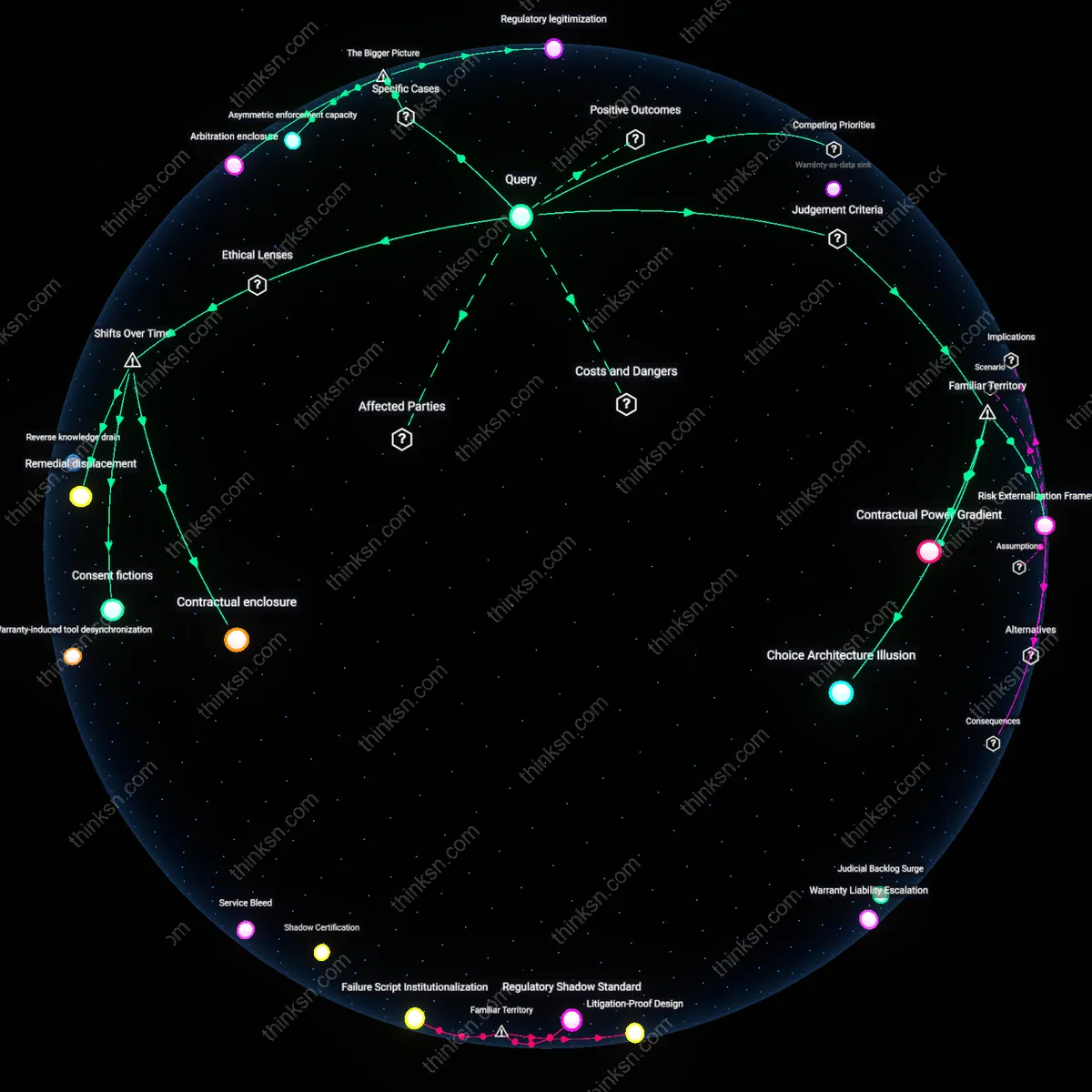
Analysis reveals 6 key thematic connections.
Key Findings
Temporal Liability Asymmetry
A software engineer under a vaguely worded non-compete risks escalating legal exposure the longer they remain employed, because delay dilutes their ability to establish a clear temporal boundary between former and new work—creating a factual ambiguity that courts often resolve against the employee. Most analyses focus on jurisdiction or enforceability, but overlook how the accumulation of undocumented technical decisions during tenure becomes evidentiary ballast that can be retroactively framed as proprietary leakage, even when none exists. This temporal distortion matters because it transforms routine professional evolution into perceived threat, shifting the burden of proof onto the engineer to demonstrate innocence rather than the employer to prove harm.
Cognitive Opportunity Drag
Remaining in a position with a vague non-compete imposes a hidden tax on technical creativity, as engineers unconsciously avoid mastering certain architectural patterns or tools associated with anticipated future roles to reduce perceived breach risk. This self-censorship alters skill trajectories in ways that are rarely tracked but materially degrade long-term employability, especially in fast-evolving domains like distributed systems or ML infrastructure. The overlooked mechanism is internalized constraint—engineers become risk-calibrated not to market demand but to legal paranoia, which silently hollows out their competitive edge despite surface-level productivity.
Jurisdictional Arbitrage Risk
Vague non-competes create a trap for engineers considering remote or international roles, because the clause’s enforceability may hinge on unstated venue selection biases that only manifest during litigation, such as a company’s historical pattern of forum shopping in employee-friendly jurisdictions like Delaware or Texas. Standard advice assumes geographic scope is the primary variable, but the real danger lies in procedural weaponization—where employers exploit procedural familiarity to impose disproportionate response burdens on geographically dispersed defendants. This invisible forum dependency transforms what appears to be a bilateral contract into a one-sided enforcement mechanism masked as legal uncertainty.
Litigation Chilling Effect
A software engineer at a Silicon Valley startup funded by Sequoia Capital faces heightened litigation risk from a vaguely worded non-compete because venture-backed firms systematically leverage legal ambiguity to deter employment mobility, enabling enforceability through asymmetric resource allocation in jurisdictions like California where such clauses are nominally unenforceable—yet still weaponized in pre-trial intimidation. This dynamic persists because startups under investor pressure externalize legal costs onto employees, making the threat of litigation itself a coercive tool despite low statutory validity, revealing how perceived risk is manufactured through institutional power imbalances rather than legal merit.
Opportunity Cost Inertia
An engineer at IBM during its post-2010 cloud transition period remains in a restricted role due to uncertainty over a non-compete’s reach, sacrificing opportunities at AWS and early-stage AI firms, because legacy corporate legal frameworks create decision-making paralysis when future career trajectories depend on unclear technological adjacency—here, whether 'cloud infrastructure development' overlaps with proprietary mainframe optimization. The systemic trigger is institutional legacy lock-in, where risk assessment becomes subordinate to internal career capital preservation, exposing how organizational path dependency distorts individual opportunity cost calculations even in the absence of active litigation.
Jurisdictional Arbitrage Pressure
A software engineer in Texas evaluating a move from Oracle to a competing data analytics startup must weigh litigation exposure not against the clause’s content but against the state’s unique enforcement regime that tolerates partial enforcement of non-competes despite national trends toward invalidation, enabling employers to exploit forum-specific doctrines like 'modification upon proof.' This creates a downstream consequence where mobility decisions are increasingly determined by geographic legal differentials rather than technical alignment or compensation, illustrating how subnational judicial policies become structural determinants of labor market fluidity in high-skill tech sectors.