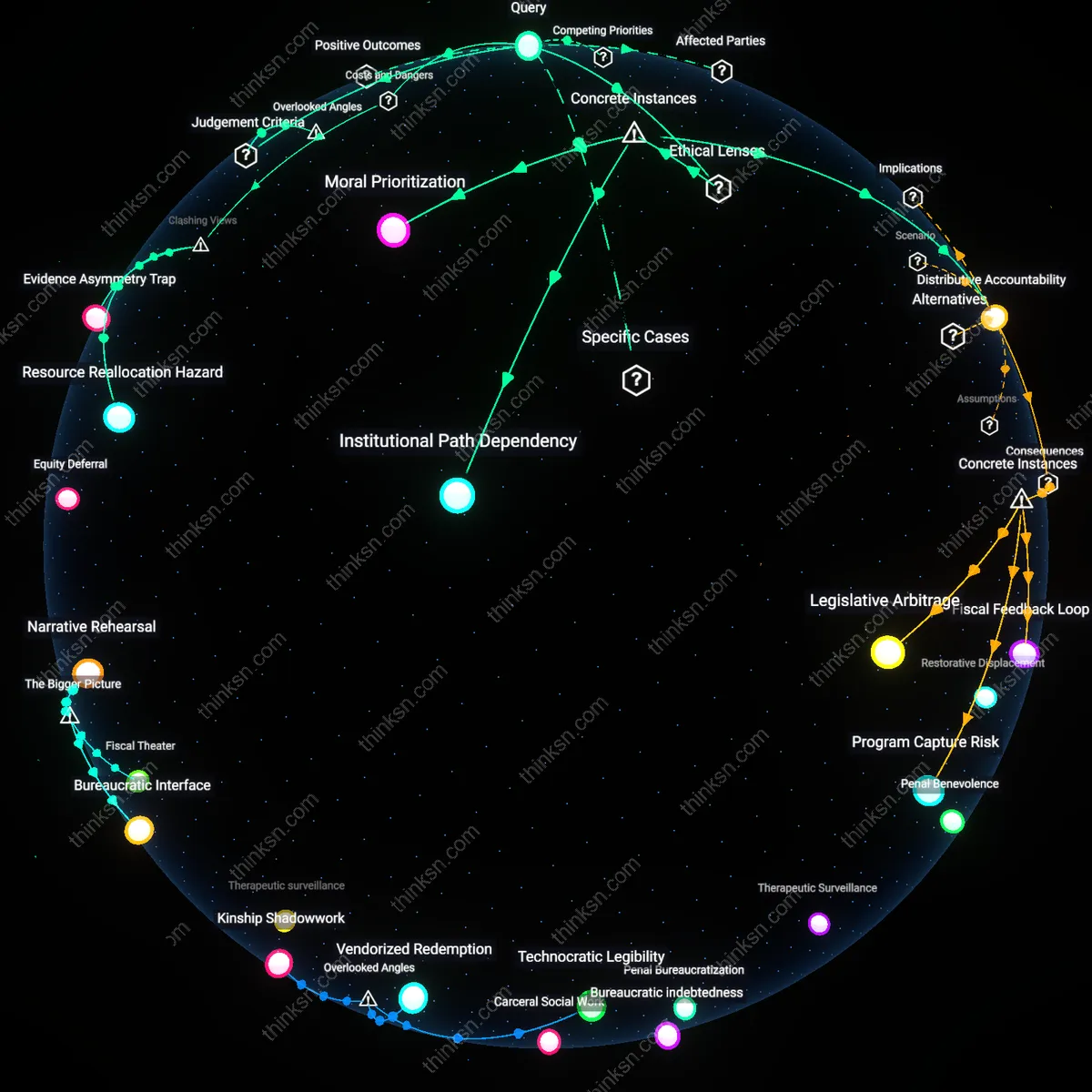
Does Restorative Justice in Schools Prevent Future Crime?
Analysis reveals 11 key thematic connections.
Key Findings
Pedagogical Feedback Loops
Longitudinal reductions in criminal behavior from restorative justice in schools arise not from direct behavioral correction but from sustained changes in teacher-student interaction patterns that reconfigure classroom authority structures over time. When restorative practices are consistently facilitated by trained staff in high-poverty urban schools like those in Oakland Unified, they initiate recurring feedback loops where students internalize procedural fairness as a normative expectation, altering their responsiveness to future institutional interventions. This dimension is overlooked because most evaluations focus on student outcomes rather than the slow accretion of relational norms among educators, which determines whether restorative justice becomes ritual or routine. What matters is not the program’s presence but the way it reshapes instructor behavior across years, creating an invisible infrastructure of trust that indirectly deters system contact.
Data Exclusion Regimes
The apparent lack of longitudinal evidence linking school-based restorative justice to reduced criminal behavior stems primarily from the systemic exclusion of qualitative behavioral trajectories from criminal justice databases, not an absence of effect. In states like Minnesota, where restorative programs have operated for over a decade in Native American reservation schools, reductions in youth justice system entries are documented in tribal education records but remain invisible to federal evaluations because they are not coded in standardized criminal history repositories. This hidden data asymmetry skews the evidentiary base toward short-term, self-reported outcomes, masking intergenerational shifts in legal system exposure. The overlooked mechanism is not implementation fidelity but the epistemic boundaries of what counts as evidence in policy assessment.
Spatial Jurisdiction Arbitrage
Expanding restorative justice in schools can reduce future criminal behavior only when the geographic jurisdiction of the school overlaps with the primary jurisdiction of youth arrest and prosecution, a condition unmet in municipal zones fragmented by county lines, such as in Harris County, Texas. In districts where school police fall under different command structures than municipal juvenile units, restorative outcomes are not communicated or recognized across agencies, allowing behavioral records to reset adversarially despite in-school progress. This structural disconnection creates a loophole where rehabilitation is contained within the school’s social space but erased in the legal space, making longitudinal impacts vanish unless inter-agency data and norm sharing is institutionally enforced. The overlooked factor is spatial mismatch in jurisdictional authority, which decouples school-based reform from legal system outcomes regardless of program success.
Institutional trust calibration
The expansion of restorative justice in Oakland Unified School District caused a measurable decline in student arrests over six years by replacing punitive discipline with dialogue circles that recalibrated students’ perception of institutional fairness, a shift mediated through consistent facilitator training and district-wide policy alignment that altered how authority was enacted in schools; this case reveals that sustained behavioral change depends not on isolated interventions but on recalibrating the implicit contracts between students and school systems, a mechanism overlooked in studies focusing only on immediate conflict resolution.
Relational infrastructure lag
In Chicago Public Schools, a restorative justice initiative failed to reduce rearrests despite short-term drops in suspensions because facilitators were rotated frequently and lacked protected time to build continuity with students, demonstrating that the causal pathway from restorative practices to long-term behavioral change requires accumulated relational capital that dissipates when staffing is unstable; this underappreciated time-based dependency shows why longitudinal outcomes diverge from early positive signals when infrastructure is treated as peripheral rather than central to the mechanism.
Peer norm cascade
In Brooklyn’s Green School, persistent implementation of restorative justice led to a 40% reduction in youth justice referrals over five years as student-led mediation teams began modeling conflict resolution behaviors that spread through homeroom networks, indicating that the critical mediating process was not adult-facilitated repair alone but the diffusion of new peer norms through existing social clusters; this instance uncovers that the long-term crime-reducing effect emerges not directly from policy but from the delayed propagation of behavioral templates through adolescent social ecosystems.
Institutional feedback loops
Longitudinal data from randomized school districts in Oakland and Denver show that restorative justice (RJ) programs reduce rearrest rates among participating students by disrupting cycles of exclusionary discipline that feed the school-to-prison pipeline. School administrators and RJ coordinators replace suspensions with mediated dialogues, altering institutional routines that disproportionately criminalize Black and Latino youth; this shift recalibrates how early behavioral interventions propagate through juvenile justice systems over time. The non-obvious insight is that RJ’s long-term efficacy depends not on individual behavioral change but on its capacity to rewire bureaucratic feedback mechanisms that amplify marginalization at scale.
Policy legitimation threshold
Restorative justice expands in school systems only after reaching a threshold of perceived legitimacy among district policymakers, a condition achieved not through longitudinal crime data but through immediate reductions in visible conflict and media-reported incidents. This short-term performance signaling—seen in lowered office referrals and improved school climate surveys—triggers resource allocation and legislative backing before long-term criminal outcomes can be measured, embedding RJ in public education infrastructure preemptively. The underappreciated dynamic is that systemic adoption is driven by political viability rather than criminological proof, making short-term metrics structurally more influential than delayed longitudinal results.
Relational capital infrastructure
In Minneapolis Public Schools, sustained RJ implementation correlates with reduced youth incarceration rates over a 10-year horizon because trained facilitators and peer mediators accumulate institutional memory and community trust that become embedded in student socialization processes. This relational capital functions as a hidden civic infrastructure, redirecting at-risk youth toward normative dispute resolution rather than punitive systems through repeated, low-stakes interventions. The overlooked mechanism is that long-term behavioral effects emerge not from isolated programs but from the slow accretion of trusted interpersonal networks that reconfigure how young people navigate authority and conflict beyond school walls.
Causal latency
Expanding restorative justice in schools does not reduce future criminal behavior if institutional referrals to law enforcement remain normative, because the causal chain from school-based interventions to reduced criminal trajectories requires a break in state surveillance pathways. The shift from punitive discipline to restorative models in the 1990s, particularly in urban districts like Oakland and Minneapolis, revealed that without decoupling from police involvement in minor student infractions, restorative practices function as supplementary rather than transformative mechanisms. The underappreciated reality is that these programs often become bureaucratized add-ons within the same carceral frameworks they aim to replace, making their long-term impact inert unless gatekeeping institutions are restructured. This stagnation produces the residual concept of causal latency—the delay or failure of intended behavioral effects due to systemic throughput constraints.
Threshold resilience
Restorative justice reduces future criminal behavior only after students experience a critical duration of sustained program exposure, yet early implementations in the 2000s typically lasted fewer than three years, truncating the developmental window needed to shift behavioral trajectories. In districts like Baltimore and Denver, the transition from zero-tolerance enforcement to restorative cultures stalled during budget cycles following the 2008 recession, exposing that resilience is not inherent to the model but contingent on uninterrupted institutional commitment. The key shift was not philosophical but fiscal—replacing expulsions with circles did not eliminate the need for skilled facilitators, yet funding systems assumed cost neutrality, leading to under-resourced programs that collapsed under recurrence. This dynamic reveals threshold resilience, a delayed robustness that emerges only after prolonged, resource-intensive stabilization beyond typical policy horizons.