Higher RPS: Industrial Rates Soar or Stall?
Analysis reveals 6 key thematic connections.
Key Findings
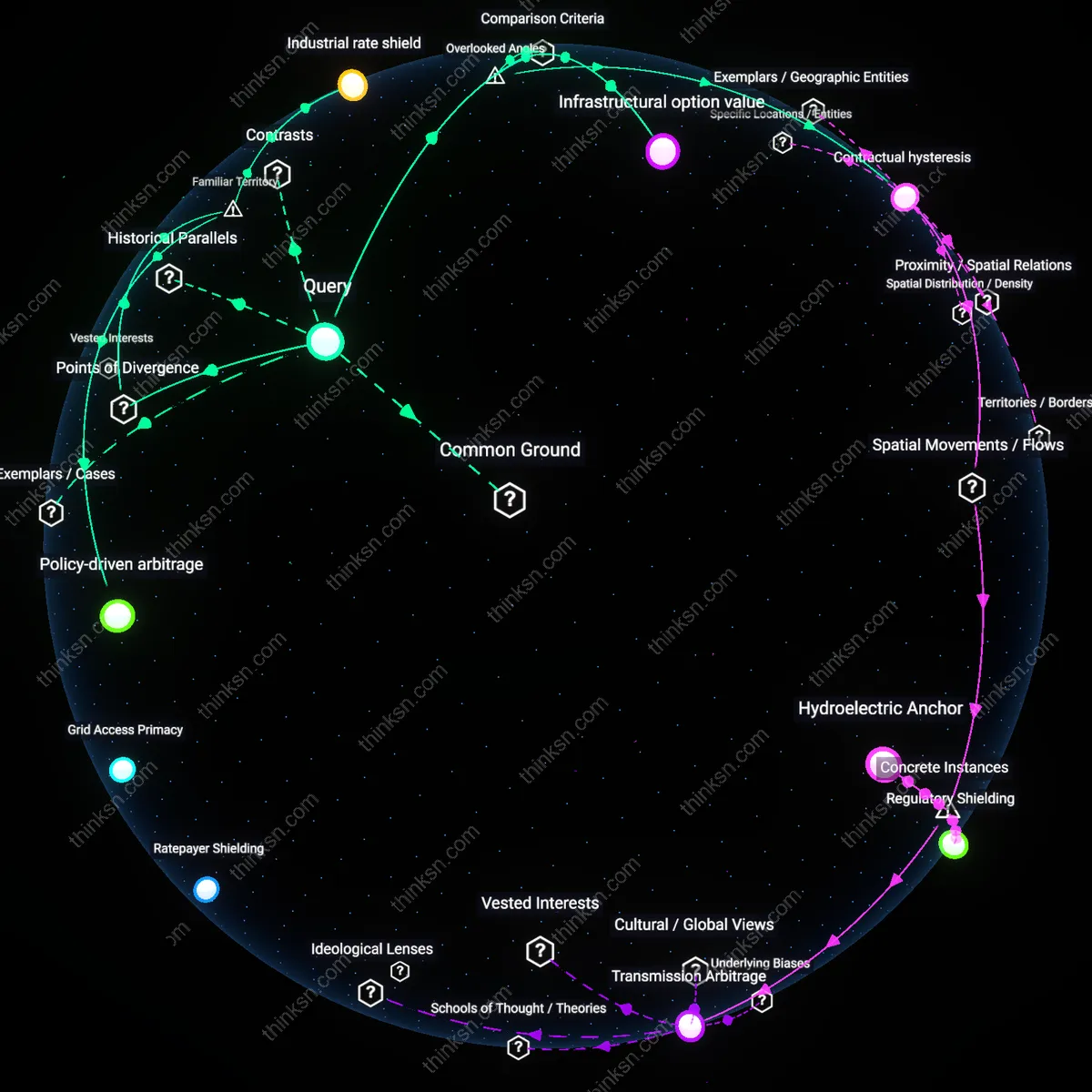
Contractual hysteresis
Stricter renewable portfolio standards disproportionately shield residential consumers from rate hikes by locking industrial users into long-term power purchase agreements that absorb early compliance costs. Industrial facilities often sign fixed-price PPAs with renewable developers to meet corporate sustainability targets or regulatory expectations, effectively subsidizing grid integration expenses that would otherwise fall on general ratepayers; residential consumers, in contrast, benefit from delayed exposure to these costs due to political resistance to sudden utility bills increases. This dynamic is rarely acknowledged because most rate impact models assume pass-through cost structures, not staggered contractual liabilities, obscuring how industrial users act as financial shock absorbers during transition periods. The residual concept is the inertia embedded in industrial procurement cycles, which delays but ultimately distorts cost flows across customer classes.
Infrastructural option value
Residential electricity rates face greater long-term volatility under stricter renewable portfolio standards because housing stock cannot easily relocate from grids with high renewable penetration, whereas industrial consumers can exercise geographic optionality by shifting operations to jurisdictions with more favorable energy policies. This asymmetry increases the de facto price elasticity of industrial demand, allowing large firms to negotiate bespoke rate structures or exit markets altogether, thereby concentrating stranded grid modernization costs on residential ratepayers who lack such exit options. Standard analyses overlook this spatial rigidity of residential consumers, treating demand elasticity as uniform, when in fact the immobility of homes imbues local distribution infrastructure with diminished option value—raising the risk premium embedded in residential rates over time.
Interconnection queuing friction
Stricter renewable portfolio standards increase interconnection queue congestion, which delays project completions and raises soft costs that are unequally allocated—industrial consumers often pay lower marginal grid access fees despite driving higher interconnection demand through off-site renewable procurement, while residential rates absorb fixed cost recovery from stalled projects. Because transmission access charges are typically socialized across all customers, the growing backlog of commercial and industrial-driven renewable interconnection requests inflates system-wide cost recovery needs without proportional fee scaling for large users. This hidden redistribution mechanism is invisible in typical rate impact assessments, which focus on generation costs rather than the administrative and temporal frictions in grid access, thereby masking how interconnection process inefficiencies regressive cost burdens onto smaller consumers.
Industrial rate shield
Stricter renewable portfolio standards lower electricity rates for industrial consumers relative to residential ones by enabling large users to negotiate long-term power purchase agreements with renewable generators. Industrial consumers often have dedicated procurement teams and credit ratings that let them access wholesale markets and sign directly with wind or solar farms, locking in stable, inflation-resistant prices before transmission and distribution markups. This institutional advantage—rooted in scale and market access—means they capture the cost declines of renewables more fully than residential consumers, whose rates are set by regulated utilities that pass through integration costs. The non-obvious reality beneath common belief in 'green energy costs' is that big industry doesn’t just avoid rate hikes—they often gain a pricing edge.
Residential cost cascade
Stricter renewable portfolio standards raise electricity rates for residential consumers because utility-mandated grid modernization and renewable integration are funded through volumetric ratepayer charges. Unlike large industrial users who can exit the regulated rate base via self-generation or wholesale contracts, households remain trapped in vertically integrated utility tariff structures that amortize new transmission lines, battery storage, and grid resilience measures across dispersed residential accounts. This creates a cost cascade where decarbonization infrastructure—though ultimately benefiting system stability—is priced regressively into kilowatt-hour charges. The public assumes renewables lower bills, but the lived experience of most homeowners reflects rising rates, exposing the gap between systemic goals and household economics.
Policy-driven arbitrage
Stricter renewable portfolio standards create arbitrage opportunities for industrial consumers who can strategically relocate facilities to states with abundant renewable supply before standards fully take effect. By positioning themselves in regions like West Texas or the Oklahoma wind corridor ahead of RPS-driven transmission buildouts, manufacturers access lower-cost power that hasn't yet been priced upward by demand surges or congestion. Residential consumers lack mobility and contract flexibility, forcing them to absorb rates shaped by lagging infrastructure investments and political compromises. The overlooked mechanism isn’t technology cost—it’s spatial and temporal positioning within energy policy cycles, turning regulatory timelines into corporate profit levers.