Why Paid Sick Leave Laws Fail Low-Wage Workers?
Analysis reveals 11 key thematic connections.
Key Findings
Managerial Discretion Override
Supervisors routinely deny or discourage sick leave requests despite legal eligibility. Frontline managers in retail and food service wield informal authority to override statutory rights by enforcing strict attendance quotas, threatening schedule reductions, or creating a culture of retaliation, particularly in decentralized franchise operations where corporate accountability is weak. This reveals that workplace power structures often function as de facto policy filters, undermining top-down mandates through localized control mechanisms that exploit worker vulnerability.
Hour-Based Precarity
Workers lose income proportionally with hours not worked, making even paid leave feel financially risky. For hourly employees in sectors like home health or gig platforms, every missed shift erodes take-home pay, housing stability, and eligibility for benefits tied to consistent hours, creating a rational aversion to time away—even when nominally compensated. The non-obvious insight is that pay structure, not just leave policy design, determines utilization, exposing how income instability embeds risk into legally protected choices.
Documentation Burden Trap
Eligibility requires navigating complex documentation that disproportionately excludes marginalized workers. Urban service-sector employees facing language barriers, irregular schedules, or lack of digital access struggle to submit timely medical notes or HR forms, especially when protocols mirror corporate standards ill-suited to high-turnover environments. The underappreciated dynamic is how administrative design covertly enforces exclusion, transforming neutral procedures into systemic filters that replicate inequity despite universal statutory coverage.
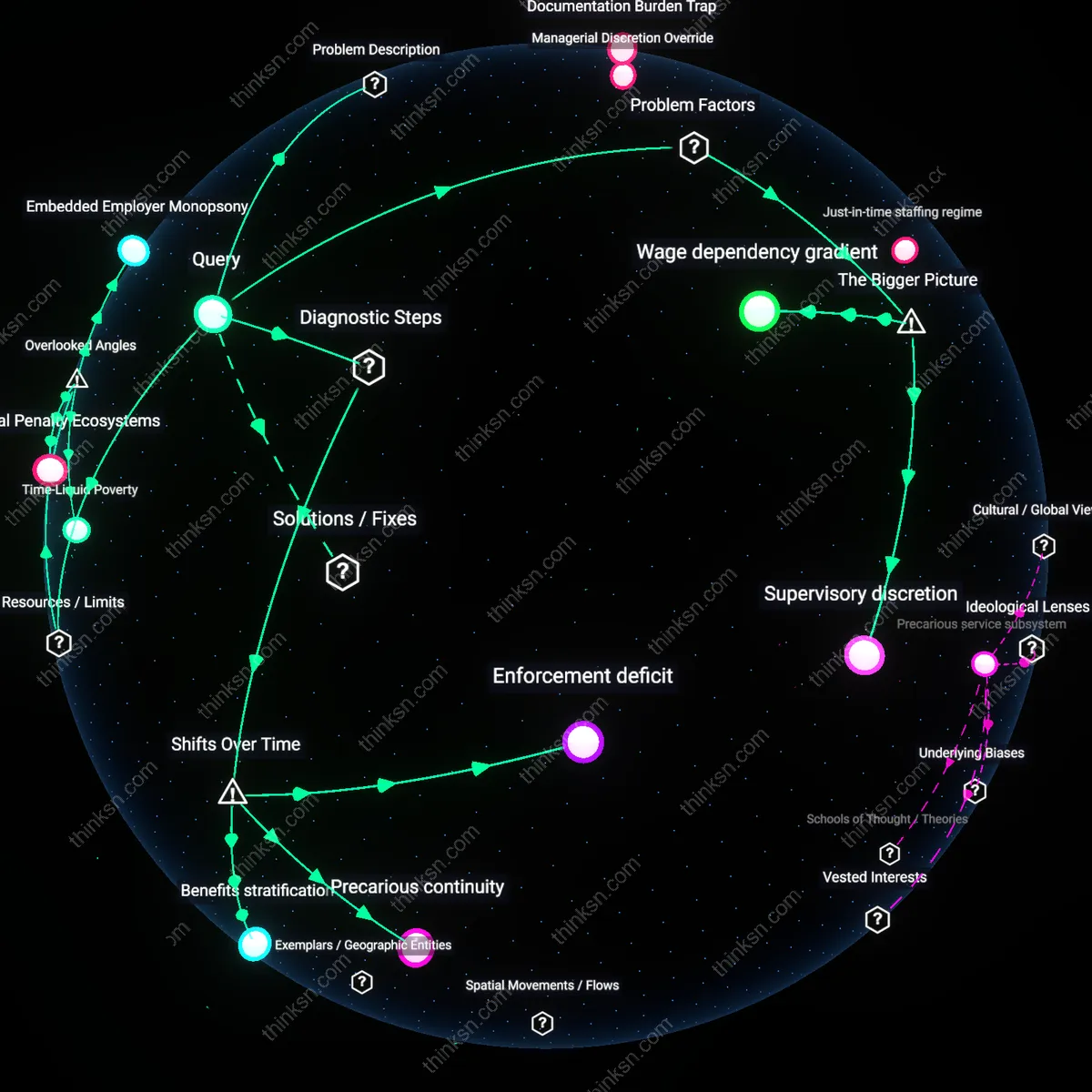
Supervisory discretion
Low-wage workers avoid using paid sick leave even in protected states because front-line supervisors control its de facto availability through informal social pressure and attendance point systems. Managers in retail and food service, evaluated on labor cost and schedule adherence, routinely discourage leave use via verbal warnings or threatened shifts reductions—turning legally protected time off into a career risk. This creates a dual compliance system where corporate policy meets on-the-ground enforcement that punishes vulnerability, revealing how decentralized human resource practices undermine centralized legal mandates. The non-obvious insight is that statutory rights erode not through illegality but through the operational autonomy of mid-level labor controllers.
Wage dependency gradient
Paid sick leave goes unused among low-wage workers because the marginal loss of even one day’s pay destabilizes already fragile liquidity buffers, rendering 'paid' leave effectively unpaid in lived experience. Workers earning near minimum wage, especially those supporting dependents or working multiple jobs, calculate that the indirect costs—shift forfeiture, reduced future hours, or triggering of attendance penalties—outweigh the formal benefit, particularly when earnings are close to subsistence. This reveals a behavioral threshold where income precarity overrides statutory entitlements, exposing a hidden calculus of survival that policy assumes away. The systemic insight is that economic nearness, not legal access, determines benefit activation.
Enforcement deficit
The erosion of labor inspection capacity after the 1980s shifted compliance from proactive state monitoring to individual worker enforcement, which fails when low-wage workers fear retaliation for asserting rights. This mechanism operates through the devolution of regulatory oversight to underfunded state labor departments and the rise of employer-controlled work sites, where supervisors dictate leave approval despite statutory entitlements. The non-obvious implication is that strong laws became decoupled from implementation not through legislative rollback but through the hollowing out of administrative capacity, revealing that legal protections can collapse without formal repeal.
Precarious continuity
The rise of just-in-time scheduling after the 1990s transformed job stability into a conditional privilege, making workers withhold sick leave requests to preserve unpredictable but essential work hours. This operates through algorithmic scheduling systems in retail and food service that optimize labor costs by minimizing fixed shifts, thus positioning attendance as a silent performance metric. The historical shift from stable shift assignments to dynamic hour allocation reveals that statutory leave rights are undermined not by ignorance of the law but by the worker’s rational calculation that job retention outweighs short-term health needs.
Benefits stratification
The exclusion of part-time and gig workers from standard employment classifications during the 2000s expansion of platform-based labor created a growing segment of workers legally entitled to sick leave on paper but structurally denied access through misclassification. This operates through employer-driven contractual fragmentation in states like California and New York, where companies exploit gray zones in wage-and-hour law despite strong statutory frameworks. The pivotal shift was not the absence of law but the divergence between formal labor rights and the material conditions of employment, exposing how legal categories lag behind evolving business models.
Informal Penalty Ecosystems
Fear of schedule retaliation disincentivizes leave use even where legal protections exist. Low-wage workers in gig-contracted or on-call hourly roles—such as in regional warehouse chains or franchise retail—avoid formal leave requests because prior patterns of subtle retaliation (shift reductions, exclusion from preferred routes or hours) are enforced through informal managerial discretion, not documented policy. This mechanism operates outside statutory compliance, rendering legal safeguards ineffective when supervisors control access to full schedules or overtime through reputation-based judgments. The overlooked dimension is that retaliation often takes indirect, administratively invisible forms that evade regulatory scrutiny while remaining acutely visible to workers, which shifts the locus of deterrence from law to localized power asymmetries.
Time-Liquid Poverty
The urgency of immediate income needs collapses future-oriented benefit calculations for workers earning near minimum wage. In urban service sectors—such as ride-share drivers or home health aides paid hourly—delayed pay cycles, irregular shifts, and reliance on daily tips create a temporal economy where even a single day’s lost income triggers cascading defaults on rent, transit, or child support payments. This dynamic makes paid leave, despite statutory availability, functionally inaccessible when its documentation requirements (e.g., advance notice or medical certification) demand planning horizons that do not exist. The overlooked insight is that legal access does not overcome the implosion of time autonomy under liquidity-constrained poverty, revealing a hidden dependency between temporal bandwidth and benefit utilization.
Embedded Employer Monopsony
In rural regions where a single employer dominates labor demand—such as a meat-processing plant in a Southern agricultural county—workers decline sick leave not due to ignorance or distrust of law, but because opting out of work signals disloyalty in an environment of near-total employment dependency. Here, statutory rights are functionally muted because the employer sets cultural norms around availability and enforce them through communal influence, including peer surveillance and familial economic entanglement. The overlooked dynamic is that monopsony power extends beyond wage-setting into social control, shaping behavioral norms that delegitimize legally protected actions as socially costly, thereby suppressing utilization without any formal policy violation.