Is Family Leave Punishing Your Career Commitment?
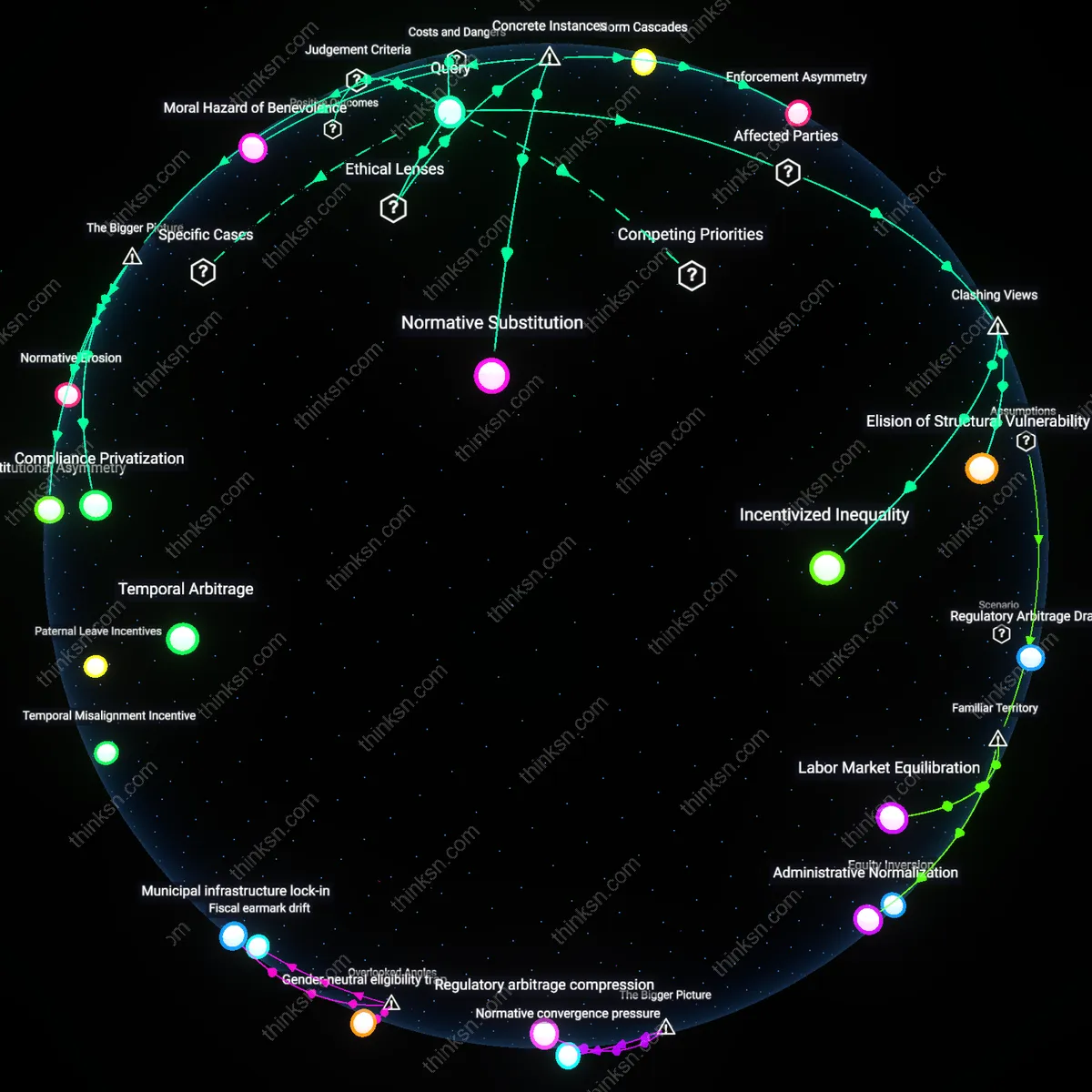
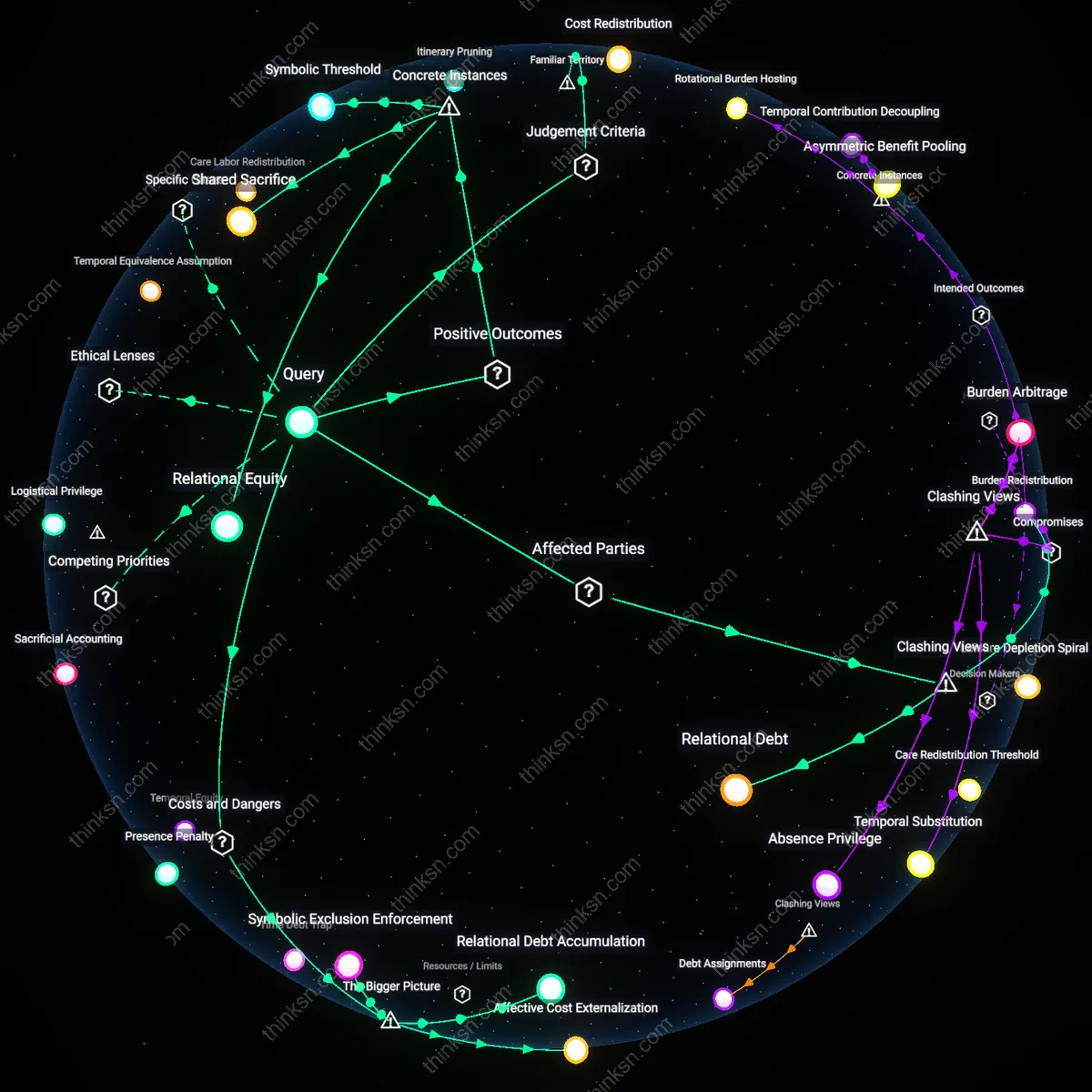
Analysis reveals 10 key thematic connections.
Key Findings
Peer-Enforced Norm Cascades
Yes, it is rational for an employee to avoid claiming family leave because peer groups in high-intensity workplaces often act as informal disciplinary bodies, where departures from unwritten norms trigger subtle but effective social sanctions such as exclusion from key projects or networking opportunities. These peer-enforced dynamics can matter more than top-down policies, as cohesion within project teams often depends on unwritten expectations of constant availability, particularly in industries like finance or tech where team-based bonuses and visibility shape careers. The overlooked reality is that employees may self-censor leave usage not due to direct management pressure, but to avoid rupture in peer-based trust networks that function as covert gatekeepers of advancement.
Structural Temporal Debt
Yes, it is rational for an employee to avoid claiming family leave because organizational time structures—such as rigid fiscal calendars, product release cycles, or client review quarters—are rarely designed to absorb individual disruptions, making timing of leave a high-stakes gamble. An employee taking leave during a critical cycle may face no formal penalty, but accumulates 'temporal debt'—a deficit in contributions during peak-value periods that is never formally recorded but implicitly tracked in performance memory. This residual burden, invisible in HR metrics, alters promotion trajectories and shapes perceptions of reliability, revealing how time, not policy, becomes the hidden currency of organizational loyalty.
Presenteeism Lock-in
Avoiding family leave is rational because the transition from industrial-era factory work to knowledge economies after the 1990s institutionalized constant digital presence as a proxy for productivity, binding job security to visibility in networked workflows; in sectors like consulting and platform-driven gig work, absence disrupts real-time collaboration threads and erodes trust in distributed teams, making employees withhold leave claims to maintain alignment with team rhythm and leadership expectations, thus creating a self-reinforcing norm where utility is derived from uninterrupted engagement, not legal compliance. The underappreciated shift is that workplace commitment is no longer measured by hours logged but by responsiveness and embeddedness in continuous operational flows, turning absence into a systemic disruption rather than a personal choice.
Care Delocalization
Employees rationally forgo family leave because the globalization of supply chains and regional corporate restructuring since the 2000s has delocalized care responsibilities from employer-provided infrastructure to the household, shifting the burden onto family networks; as firms in manufacturing and service industries relocated to regions with weaker labor institutions, they detached formal benefits from actual workplace culture, allowing economic efficiency to override social support norms, which means claiming leave signals fragility in an environment valuing hyper-mobile, unencumbered workers. The non-obvious outcome is that rational behavior emerges not from individual weakness but from a structural realignment where care is no longer a shared organizational function but a privatized risk, rendering its public expression professionally costly.
Promotion Penalty
It is rational for an employee to avoid claiming family leave because doing so risks being excluded from high-visibility assignments that quietly determine promotion eligibility, even when leave is legally protected. Managers, under pressure to deliver results with limited bandwidth, informally route critical projects to employees perceived as continuously available, creating a shadow performance hierarchy where leave-taking signals unreliability. This mechanism operates through discretionary assignment allocation—a system feature outside formal HR policies—where reputational risk outweighs statutory safeguards. The non-obvious force here is that legal compliance does not eliminate de facto career penalties, making rational avoidance a response to unmeasured organizational logic rather than outright discrimination.
Temporal Mismatch
It is rational for an employee to avoid claiming family leave because the timing of caregiving needs exposes them to performance evaluations calibrated for uninterrupted productivity cycles, particularly in quarterly-driven industries like finance or tech. When leave coincides with peak assessment periods—such as earnings seasons or product launches—absence, even if justified, disrupts the narrative of consistent output that managers rely on during reviews. This operates through evaluation systems that privilege visible presence over actual contribution, rewarding those who align personal availability with institutional rhythms. The underappreciated dynamic is that structural inflexibility in performance measurement, not overt bias, sustains the disincentive to claim lawful benefits.
Peer Norm Enforcement
It is rational for an employee to avoid claiming family leave because peer groups in high-intensity workplaces enforce cultural norms of overwork through informal sanctions like exclusion from informal networks or diminished trust in crisis collaboration. Colleagues who take leave—even briefly—become 'outliers' in a system where mutual dependence is premised on assumed constant availability, leading to subtle downgrading in reputation capital despite official neutrality. This functions through social reciprocity mechanisms within team ecologies, where perceived reliability is maintained through ritualized presence and responsiveness. The hidden driver is that peer-enforced cultural scripts can outweigh formal policy, turning rational self-preservation into complicity with a self-reinforcing commitment trap.
Institutional betrayal
Yes, it is rational for an employee to avoid claiming family leave when workplace culture penalizes care responsibilities, as seen in the 2007–2008 layoffs at Eastman Kodak following the invocation of FMLA, where employees who took medical or family leave were disproportionately targeted for termination despite legal protections. This occurred because Kodak managers retained discretion in workforce reduction decisions, enabling informal sanctions against those deemed less available, thus revealing how compliance with the letter of the law does not prevent systemic devaluation of caregiving. The non-obvious insight is that legal rights become hollow when organizational power structures permit retaliatory practices under neutral criteria like 'performance' or 'reliability.'
Normative displacement
Yes, it is rational to avoid claiming family leave at Amazon’s fulfillment centers, where metrics-driven productivity surveillance creates a climate in which any absence is tacitly equated with insubordination, even though the company formally complies with the FMLA. Workers understand that exceeding absence thresholds—regardless of justification—triggers automated performance warnings and eventual termination, thereby displacing the normative expectation of legal entitlement onto a technocratic regime of operational efficiency. The underappreciated dynamic here is that algorithmic management systems can erode rights not by explicit violation but by rendering exceptions to rigid rules existentially risky.
Care penalty
Yes, it is rational for female attorneys at Kirkland & Ellis to underutilize family leave, as internal firm practices in the early 2010s implicitly tied partnership track eligibility to uninterrupted client billing and face time, effectively punishing any prolonged absences despite ostensible policy availability. The mechanism operates through subjective evaluation criteria embedded in a neoliberal legal labor market, where commitment is signaled through constant availability, particularly among equity-seeking professionals. This reveals how elite professional service firms reproduce gendered labor inequalities not through overt discrimination but through meritocratic discourse that conflates presence with dedication.