Why Do After-School Programs Close on Holidays?
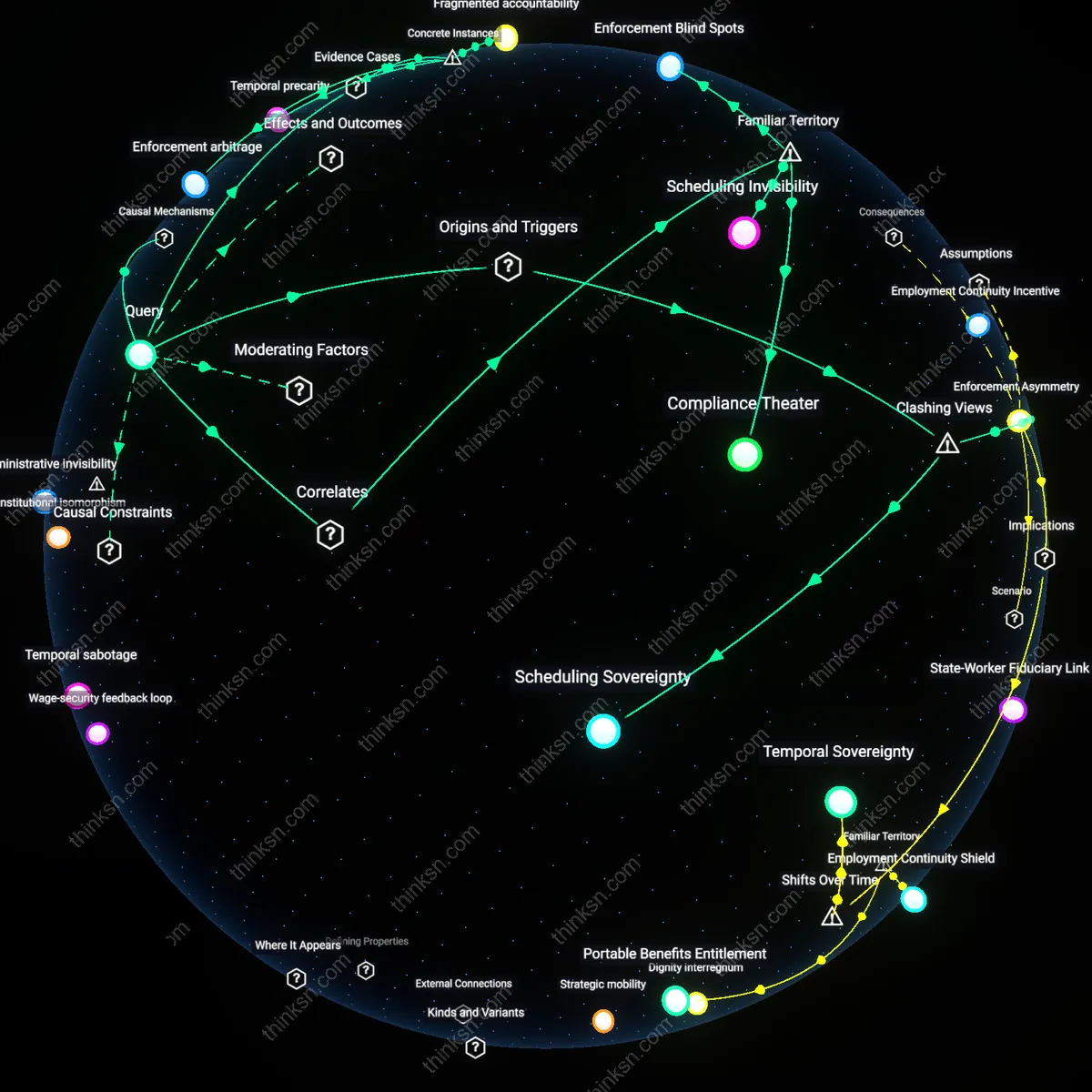
Analysis reveals 6 key thematic connections.
Key Findings
Institutional Temporality Misalignment
After-school care programs close early on holidays because their operational calendars are structurally tied to public school schedules, not family labor schedules, privileging educational bureaucracy over caregiving continuity. School districts control facility access, staffing contracts, and funding flows that bind after-school programs to the same holiday closures as classrooms, even though parental work calendars follow private-sector or service-industry rhythms. This misalignment reveals how institutions governing children's time operate autonomously from those governing adult labor, making care a residual function of schooling rather than a coequal social infrastructure. The non-obvious insight is that the closure pattern is not a failure of coordination but a feature of institutional segmentation — education and labor systems evolve independently, so their junctions naturally fracture under real-world demands.
Contractual Care Fragility
After-school care programs close early on holidays because their staffing and funding rely on fragmented contractual arrangements that lack continuity provisions for nonschool days, turning care into a conditional add-on rather than a stable service. Federally subsidized 21st Century Community Learning Centers, for example, must align with school calendars to maintain compliance, while part-time aides are often not compensated for holiday hours, making operation on those days legally and financially impermissible. This exposes the constructed fragility of care provision — it is not underfunded per se, but engineered to deactivate during temporal 'voids' where no single entity assumes responsibility, revealing a systemic preference for bounded, school-aligned interventions over durable, family-centered support.
Funding Calendar Rigidity
After-school programs shut down early on holidays because their funding streams—often tied to state education budgets or federal grants like 21st Century Community Learning Centers—are allocated per instructional day, not calendar year. Operators cannot legally access per-diem reimbursements for non-instructional days, making continued operation financially unsustainable without supplemental appropriations. The dynamic emerges from rigid public finance rules that treat youth programming as an academic adjunct rather than a social infrastructure. What’s overlooked is that the fiscal model, not demand or capacity, determines availability, even when families need care most.
Contractual misalignment
After-school programs should adopt joint service-level agreements between school districts and municipal childcare providers to standardize holiday operations. School-based programs operate under education contracts that default to academic calendars, while municipal childcare contracts serve continuous care needs; this mismatch leaves no party financially or legally responsible for holiday coverage. By aligning contracts around shared attendance metrics and workforce availability—not academic schedules—responsibility for continuity becomes codified, shifting accountability from goodwill to obligation. This exposes how administrative boundaries, not funding shortages, govern availability.
Infrastructure invisibility
Municipalities should mandate the integration of after-school facilities into public building occupancy grids, similar to libraries or recreation centers, to ensure utilities and security services remain active on holidays. Most after-school programs rely on school buildings but lose access not due to staffing or demand, but because custodial and security contracts deactivate facilities on non-instructional days, cutting heat, lighting, and entry. Treating the physical plant as shared civic infrastructure would maintain operability independent of academic calendars. This reveals that spatial access, not pedagogy or staffing, is the unseen gatekeeper of continuity.
Labor fungibility
Districts should reconfigure support staff roles—such as cafeteria workers or bus aides—into hybrid, cross-trained positions that can staff after-school programs on holidays when their primary duties are suspended. On early-dismissal days, bus drivers are idle after morning routes, and cafeteria workers are off-schedule despite available kitchen space; yet after-school programs cannot legally or contractually hire them without reclassification. Creating a unified municipal workforce pool with modular duties restores coverage without new hires. This uncovers that labor segmentation, not labor scarcity, constrains holiday operations.