When Is Amyloid PET Imaging Worth the Cost for High-Risk Families?
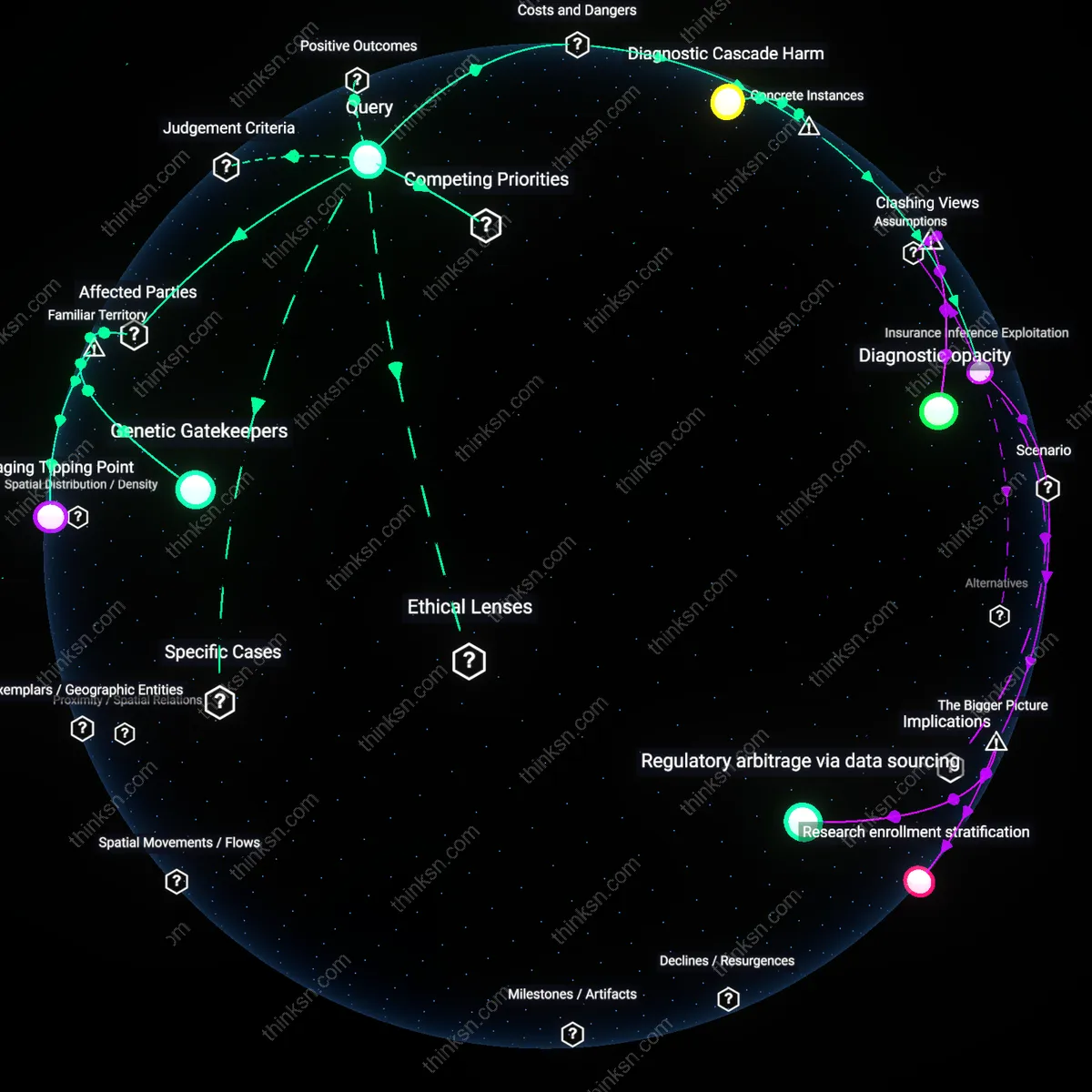
Analysis reveals 6 key thematic connections.
Key Findings
Genetic Gatekeepers
Routine amyloid PET imaging becomes justified when a first-degree relative carries a pathogenic variant in PSEN1, PSEN2, or APP, triggering clinical guidelines for presymptomatic testing. This threshold activates a cascade involving genetic counselors, neurologists, and at-risk family members who navigate disclosure, psychological burden, and surveillance—systems structured around Mendelian inheritance patterns that confer near-certainty of disease. Despite public associations of Alzheimer’s with memory loss and aging, the non-obvious reality is that familial risk justification hinges not on family history alone but on confirmed autosomal dominant mutations, which are rare yet create moral and logistical obligations for healthcare systems to manage predictive information carefully.
Imaging Tipping Point
Amyloid PET scans are justified when multiple affected relatives across two generations manifest early-onset dementia, typically before age 65, creating a household pattern that overrides population-level cost concerns. In such families, primary care providers and memory clinics shift from symptom-based to risk-stratified evaluation models, where repeated cognitive assessments and brain imaging serve both diagnostic calibration and emotional validation for anxious kin. What eludes common understanding—despite widespread familiarity with Alzheimer’s as an inevitable aging outcome—is that routine imaging here functions less as a medical necessity and more as a ritualized anchor, providing tangible proof of vigilance to relatives steeped in anticipatory grief.
Insurance Threshold
The use of amyloid PET imaging is deemed justified not by biological risk alone but when private or public insurers—such as Medicare or large employer-sponsored plans—codify coverage rules linking reimbursement to documented familial clustering and cognitive biomarkers. These institutions become de facto arbiters of medical necessity, transforming vague genetic concern into reimbursable protocol only when actuarial models predict high diagnostic yield. The underappreciated dynamic is that public associations of Alzheimer’s prevention with personal responsibility collapse at the institutional level, where payment policies silently define what constitutes 'sufficient' familial risk, effectively rationing access despite clinical availability.
Diagnostic Cascade Harm
Routine amyloid PET imaging in asymptomatic individuals with a family history of Alzheimer’s, such as those enrolled in the Dominantly Inherited Alzheimer Network (DIAN), has triggered clinically unwarranted interventions despite uncertain predictive value, because positive scans often lead to immediate statin prescriptions, experimental drug enrollment, or psychiatric referrals even when cognitive decline is years away. This cascade operates through the structural inertia of clinical systems that interpret biomarker positivity as diagnostic rather than probabilistic, transforming risk into active treatment pathways without proven benefit—revealing how early imaging converts latent vulnerability into iatrogenic burden under the guise of prevention.
Insurance Inference Exploitation
After the A4 Study (Anti-Amyloid Treatment in Asymptomatic Alzheimer’s) released biomarker data on cognitively normal elders with elevated amyloid, private long-term care insurers in the U.S., including OneAmerica, began informally adjusting risk models using geographic participation rates as proxies for unmeasured amyloid burden, leading to premium increases in communities near trial sites like Duke University despite no individual testing. The dynamic emerges from data shadowing—where research participation patterns become liability indicators in unregulated insurance spaces—demonstrating how preventive imaging enables actuarial overreach beyond the clinic.
Clinical inertia latency
Routine amyloid PET imaging becomes justified only when the delay between genetic risk confirmation and clinical intervention exceeds the window in which early pathology modification is possible. This threshold is determined not by the accuracy of the scan but by the gap between when at-risk individuals receive genetic results and when preventive therapies can be initiated within existing neurology care pathways, such as academic memory clinics in major medical centers. Most analyses focus on test sensitivity or drug efficacy, but overlook how systemic clinical inertia—where patients stall in counseling, referral loops, or eligibility screening—erodes the value of early detection. When this latency surpasses six months, amyloid PET rarely alters management in time to justify cost, making its preventive justification contingent on care system responsiveness rather than biological risk level.