Is a Defined-Benefit Pension Irrelevant for Modern Retirement?
Analysis reveals 7 key thematic connections.
Key Findings
Political substitution
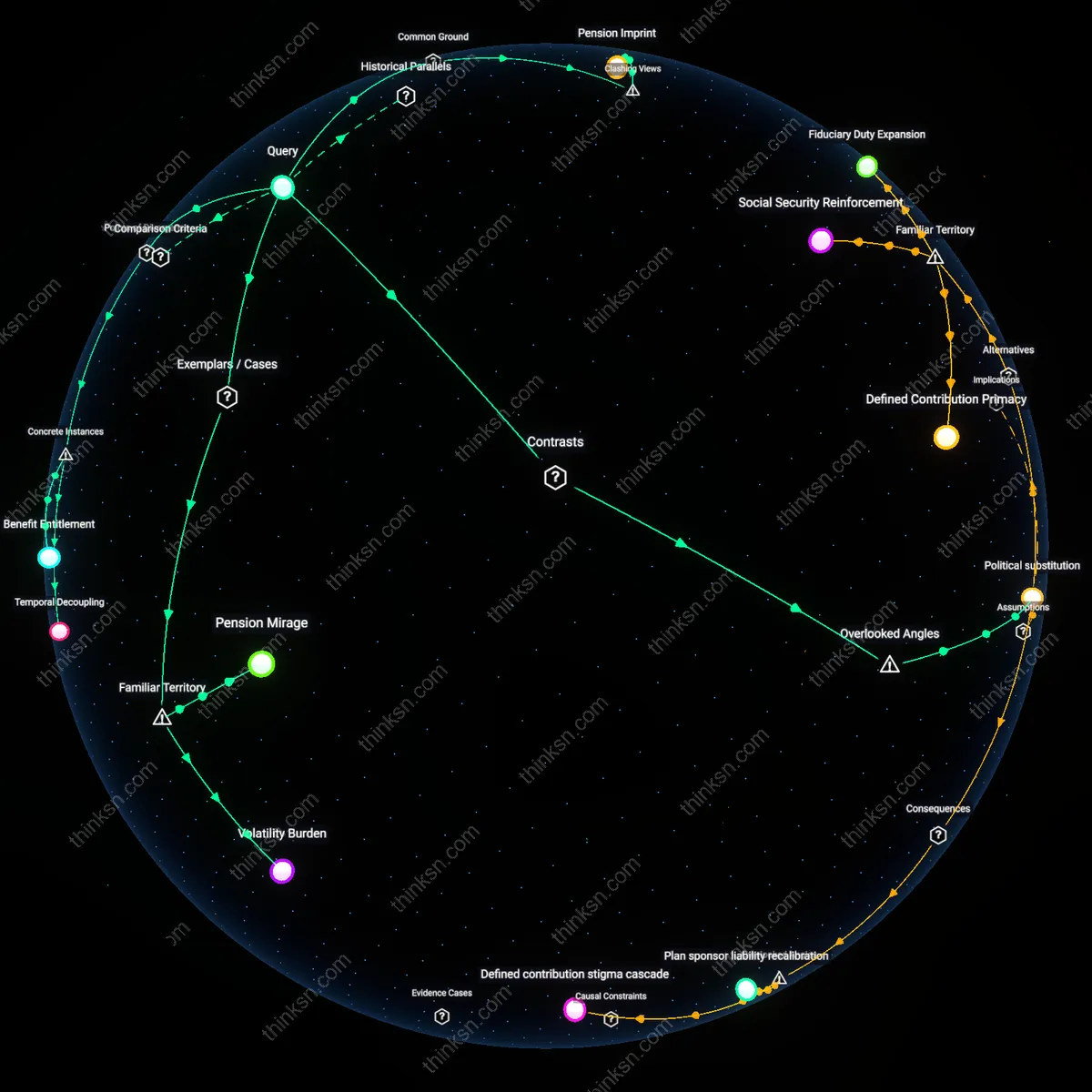
A 401(k)-reliant individual cannot treat defined-benefit pensions as irrelevant because the political legitimacy of private retirement systems depends on the continued existence of public-sector pensions as symbolic anchors for the promise of retirement security. When defined-benefit systems erode—such as in Detroit or Puerto Rico—it weakens the collective belief in long-term income guarantees, triggering demands for federal intervention, Social Security expansion, or guaranteed minimum withdrawals that reshape 401(k) policy. This feedback loop is rarely modeled in personal finance planning, yet it alters regulatory risk, tax treatment, and product innovation timelines. The non-obvious insight is that private retirement viability is politically parasitic on public pension symbolism, not actuarially linked but institutionally co-dependent.
Pension Imprint
A retirement strategy based on a defined-benefit pension actively shapes 401(k) decision-making by embedding institutional temporal logics into individual behavior. Defined-benefit systems condition employees to trust centralized, longevity-protected income streams, and when displaced to 401(k) plans, workers carry forward expectations of guaranteed duration and risk pooling—even though these are absent in defined-contribution frameworks. This transfer occurs through employer-sponsored financial education, payroll integration, and regulatory design that mimic pension-like structures (e.g., target-date funds as 'default trajectories'), making the pension model a hidden architect of personal savings behavior. The non-obvious friction is that pension logic doesn’t vanish when the pension does—it persists as a cognitive and procedural scaffold, distorting how individuals interpret autonomy and responsibility in self-directed saving.
Risk Reattribution
The shift from defined-benefit pensions to 401(k) savings does not eliminate pension logic but repositions its core mechanism—intergenerational risk absorption—onto financial markets and individuals. In defined-benefit plans, longevity and market risks are collectively borne by employers and pooled across workers; in 401(k) systems, these same risks are reattributed to individuals but remain interdependent through asset pricing, as mass 401(k) withdrawals during downturns amplify systemic volatility. The defined-benefit infrastructure—once embodied in employer liability—now operates diffusely through indexed fund flows and retirement consumption patterns, revealing that pension-style risk pooling hasn’t been abolished but privatized and financialized. The dissonance lies in recognizing that personal savings strategies are not autonomous acts of prudence but contingent responses to a redistributed, latent collective risk architecture.
Benefit Entitlement
A defined-benefit pension guarantees a fixed retirement income based on salary and tenure, as seen in the Federal Employees Retirement System (FERS), where civilian federal workers receive a calculated payout irrespective of market performance, making the design of personal investment discipline in 401(k)s analytically secondary to entitlement structure—this shift from individual asset accumulation to institutional obligation redefines retirement security as access to a public or corporate promise, not portfolio management skill.
Temporal Decoupling
When General Motors restructured in 2009, it offloaded its legacy pension obligations to the PBGC while continuing to sponsor new 401(k) plans for future workers, demonstrating that defined-benefit schemes bind retirees to an employer’s historical solvency and labor compact, whereas 401(k) savers are disembedded from past agreements and instead subject to lifelong accrual volatility—this temporal split reveals retirement security as either a negotiated, closed-loop promise or an open-ended personal burden.
Pension Mirage
A defined-benefit pension strategy is irrelevant to 401(k) reliance because it presumes lifetime income guarantees from an employer, a reality for unionized public-sector workers like California teachers in CalSTRS but not for most private-sector employees. The mechanism operates through employer-sponsored annuitization, which eliminates longevity risk—something 401(k) holders must self-insure against. This contrast highlights how the dominant cultural image of retirement—stable, predictable checks—masks the financial improvisation now required by the majority, making the pension model a psychological reference point rather than a practical blueprint.
Volatility Burden
Retirement planning based on a defined-benefit pension fails to address the market exposure inherent in 401(k) accounts, as seen in the 2008 downturn when individuals like those invested in Target Date Funds through Vanguard lost over 30% of their balance in a single year. The shift from institutional risk-bearing to individual risk-management creates a psychological and financial load centered on timing, diversification, and drawdown sequencing—factors absent in pension models. The familiar refrain of 'watching your portfolio crash' captures a lived stress that pensioners never face, revealing how personal savings strategies turn market stability into a personal liability.