Who Wins When Senior Leaders Mentor Instead of Innovate?
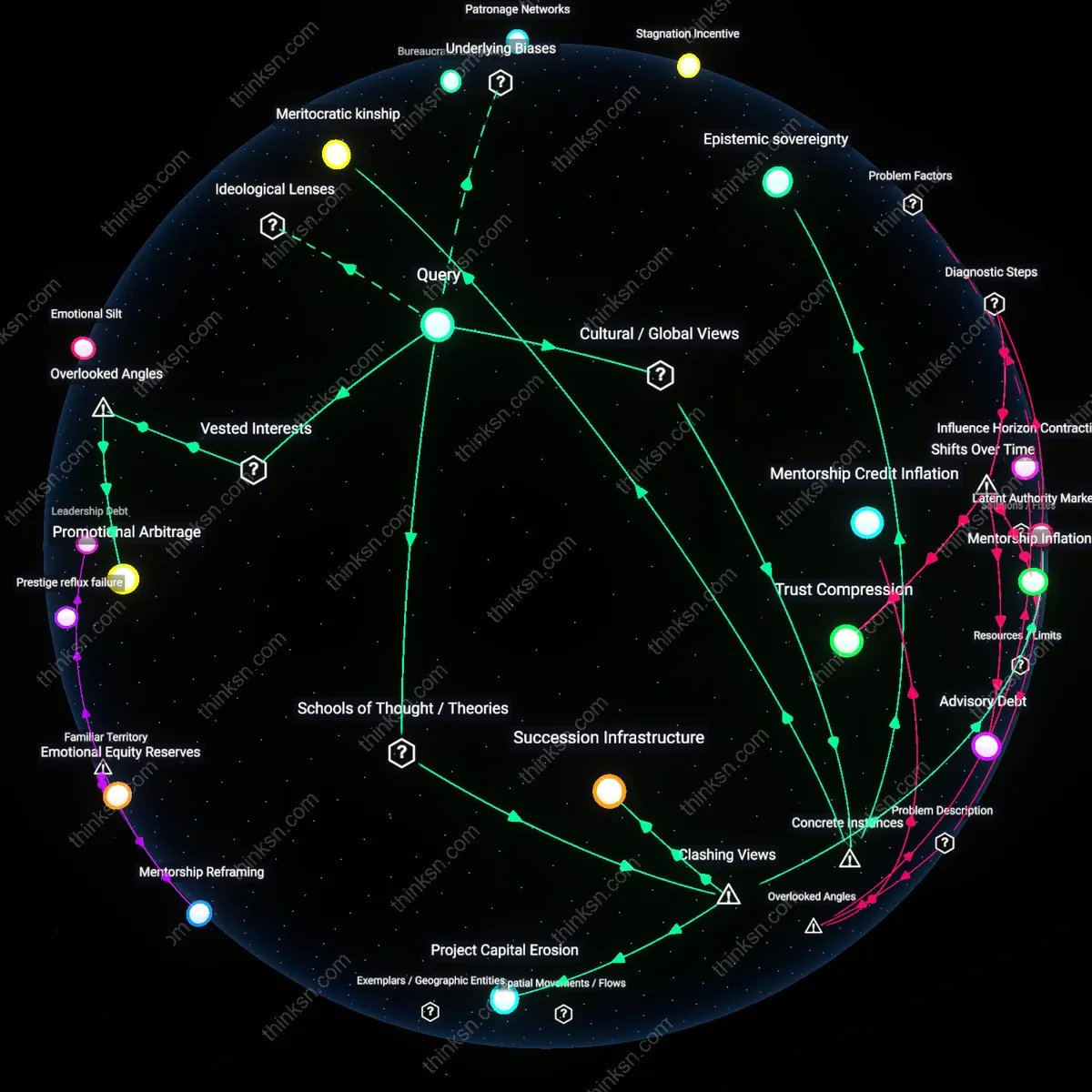
Analysis reveals 7 key thematic connections.
Key Findings
Succession Infrastructure
Senior staff prioritizing mentorship over new projects most benefits mid-level professionals in matrixed organizational environments, because it shifts resource allocation toward skill transfer rather than innovation outputs, activating embedded succession pathways that circumvent formal promotion systems. This dynamic operates through informal sponsorship networks that replicate leadership prototypes, revealing how power is conserved not through hierarchical authority but through patterned reproduction of behavioral capital—what appears as developmental support functions as selective lineage building. The non-obvious implication is that mentorship becomes a covert mechanism of gatekeeping, privileging those already aligned with dominant cultural logics rather than creating open developmental access.
Project Capital Erosion
External stakeholders—particularly funders and regulatory bodies—benefit most when senior staff deprioritize new projects in favor of mentorship, because sustained personnel development reduces organizational volatility and increases long-term compliance predictability, which stabilizes risk profiles for external oversight systems. This occurs through the substitution of visible innovation with institutional memory accumulation, favoring audit-friendly continuity over disruptive initiative-taking, a shift that serves regulatory efficiency more than internal growth. Contrary to the intuitive view that mentorship aids junior talent, the structural effect is to diminish project-based capital available to emerging staff, thereby reinforcing power among oversight institutions that reward risk aversion over experimental agency.
Latent Authority Markets
Junior staff with peripheral network access benefit most from senior mentorship prioritization, because mentorship functions as a non-official currency in promotion-adjacent decision environments where formal performance metrics are ambiguous or saturated. In environments like research universities or policy institutes, where advancement depends on endorsement rather than output alone, time with senior figures becomes a scarce tradeable asset that generates influence without requiring positional authority. This reveals that power is not held solely through project control or rank, but through the ability to convert attention into allegiance—a shadow economy where mentorship is not development but investment in loyalty derivatives.
Intergenerational stewardship
In post-1990s Bhutanese civil service reforms, senior officials consciously deprioritized infrastructure expansion projects in favor of structured mentorship programs rooted in Drukpa Buddhist principles of wise service, ensuring that younger bureaucrats were trained not only in technical functions but in ethical restraint and long-term societal balance; this shift, institutionalized under the fourth King Jigme Singye Wangchuck’s Gross National Happiness framework, favored generational continuity over rapid modernization, revealing how non-Western statecraft can reconfigure organizational power around temporal responsibility rather than productivity. The core mechanism—embedding mentorship as a form of karmic accountability—redirects influence from project-based visibility to quiet transmission of values, making junior officers the primary beneficiaries while elevating the moral authority of retiring elders. This underappreciated dynamic reveals that in cultures where leadership is seen as transient stewardship, power is legitimized through withdrawal rather than accumulation.
Meritocratic kinship
At Japan’s Panasonic Corporation during the 1970s–80s, senior engineers deliberately halted the launch of new product divisions to personally mentor mid-level designers in the tradition of *shokunin kishitsu* (craftsman ethics), a practice informed by Confucian-adjacent ideals of moral hierarchy and filial loyalty within occupational lineages; this prioritization elevated protégés into executive roles at a faster rate than project-based performers, restructuring internal power around relational seniority rather than innovation output. The mechanism—treating workplace mentorship as a surrogate familial bond—obscured formal hierarchy while reinforcing it through emotional debt, allowing elder staff to maintain influence beyond retirement. What remains underrecognized is that in East Asian organizational cultures, mentorship is less a developmental tool than a symbolic act of adoption, where loyalty supersedes efficiency in determining succession.
Epistemic sovereignty
During Nigeria’s post-independence university reforms (1960–1980), senior academics at the University of Ibadan, many trained in Britain, rejected externally funded research initiatives in favor of establishing apprentice-style tutorial systems rooted in Yoruba *ìwà pẹlẹ* (gentle character) ideals, where knowledge transmission was conditioned on ethical maturity rather than speed or novelty; junior scholars, particularly those from marginalized ethnic groups, became the primary beneficiaries, gaining access to networks of authority typically reserved for colonial-era elites. This created a shadow curriculum that recalibrated power away from Anglophone academic publishing metrics toward communal validation of wisdom. The underappreciated insight is that in African academic institutions decolonizing knowledge, mentorship becomes an act of cultural reclamation, where the slow transfer of insight asserts autonomy from global epistemic hierarchies.
Promotional Arbitrage
Mid-level managers benefit most when senior staff prioritize mentorship over new projects, because sustained developmental sponsorship increases their chances of upward mobility without expanding the executive tier. This dynamic operates through internal promotion pipelines, where mentorship functions less as skill transfer and more as tacit vouching—creating a bottleneck economy where access to senior advocates becomes the scarce resource. The non-obvious mechanism is that mentorship, when elevated over scalable initiatives, renders promotion a zero-sum game mediated by personal allegiance rather than performance, which reinforces hierarchy without increasing organizational capacity. This shifts power to those who gatekeep visibility into executive networks, not just strategic vision.