Why Renters Pay Despite Legal Habitable Housing Standards?
Analysis reveals 8 key thematic connections.
Key Findings
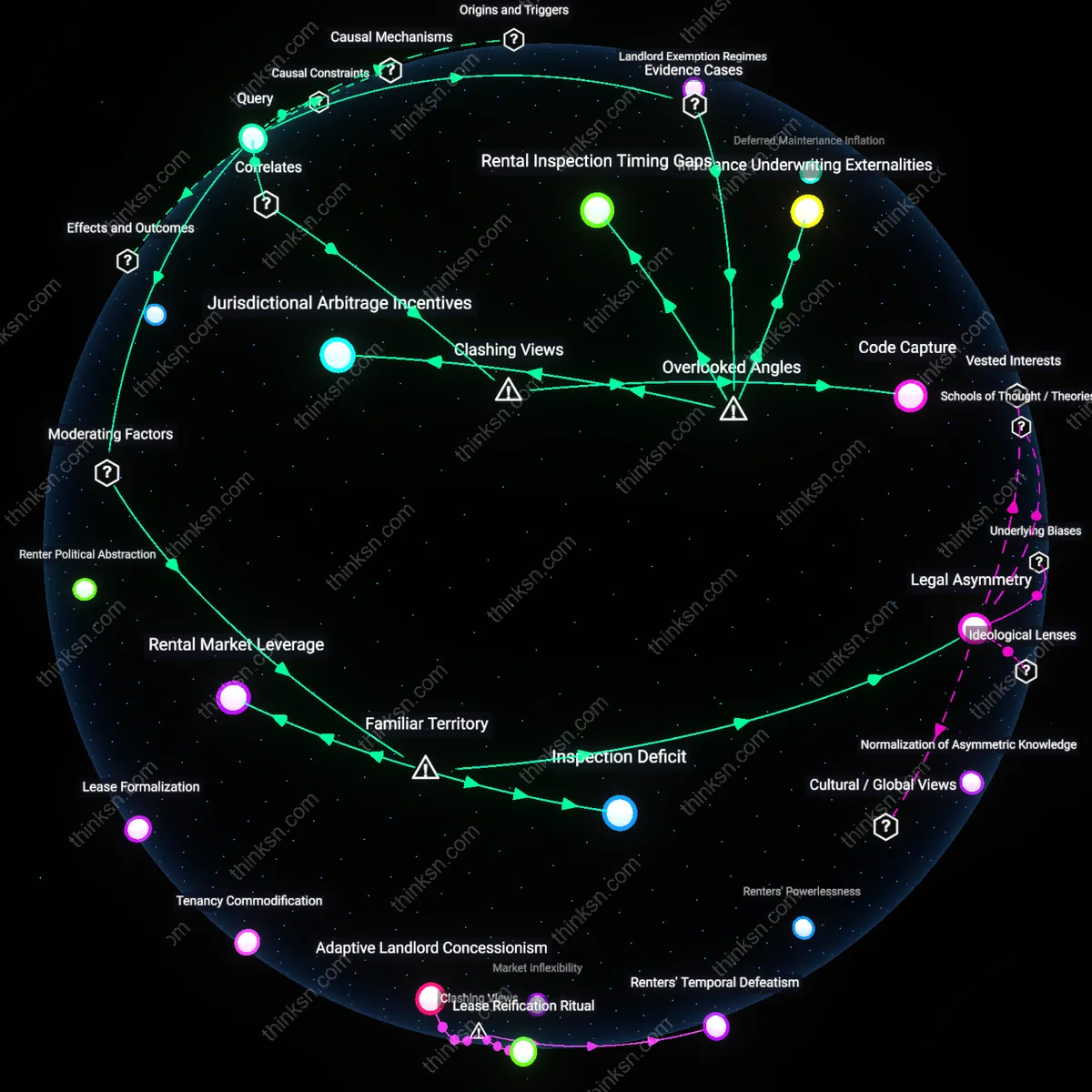
Legal Asymmetry
Landlords can enforce 'as-is' clauses because courts prioritize contract law over habitability codes when tenants haven't explicitly proven uninhabitable conditions. This happens in jurisdictions where lease agreements are treated as binding even if they limit landlord duties, as long as the property meets a minimal threshold of structural integrity at move-in—meaning code violations must be actively documented to override contractual terms. What’s underappreciated is that most tenants assume habitability laws automatically invalidate unfair clauses, but the burden of proof and legal standing fall on them to trigger enforcement, creating a procedural gap where private agreement dominates public standard.
Inspection Deficit
Tenants bear repair costs under 'as-is' clauses because routine housing inspections are rarely conducted in single-family rentals, allowing visible or known defects to be framed as tenant-acknowledged at occupancy. In cities like Houston or Atlanta, where rental units aren’t subject to preemptive habitability audits, landlords can legally treat the tenant’s signature as consent to existing conditions, even if those conditions later deteriorate. The overlooked reality is that the absence of state-driven verification routines transforms 'as-is' clauses from disclaimers into de facto waivers—what feels like consumer choice masks systemic non-observation.
Rental Market Leverage
Landlords impose 'as-is' terms because in high-demand housing markets like San Francisco or Miami, competition for units gives landlords overwhelming bargaining power, making tenants accept unfavorable clauses to secure housing. This dynamic operates through supply scarcity, where the immediate need for shelter outweighs long-term repair risk in lease negotiations, effectively neutralizing statutory protections that assume equal negotiation footing. The non-obvious consequence is that habitability laws become situational—they protect only those able to walk away from a lease, turning legal rights into de facto privileges of market position.
Litigation Asymmetry
Landlords impose 'as-is' clauses because tenants rarely litigate habitability violations, making enforcement of state standards depend more on individual legal capacity than statutory intent. Low-income renters in cities like Cleveland or Memphis seldom challenge repair disputes in court due to time costs, legal intimidation, or fear of eviction retaliation, allowing landlords to exploit enforcement gaps even where laws are strong. This dynamic reveals that statutory habitability rests on an unspoken assumption of symmetrical legal engagement, when in reality power lies with those who control litigation risk. The non-obvious insight is that law functions less through written rules than through the uneven distribution of legal endurance.
Code Capture
'As-is' clauses persist because housing inspection regimes are often administered by municipal agencies that prioritize code compliance over habitability enforcement, effectively narrowing 'livability' to structural checkboxes rather than ongoing maintenance duties. In cities such as Baltimore or Oakland, budget-limited code enforcement units respond only to reported violations and rely on visual inspections that miss chronic system failures, enabling landlords to treat 'as-is' terms as risk-free disclaimers. This exposes how regulatory frameworks can be captured by procedural minimalism, where adherence to inspection rituals substitutes for genuine accountability. The underappreciated point is that habitability standards are weakened not by absence of law but by its ritualized, auditable narrowness.
Jurisdictional Arbitrage Incentives
Landlords in cities like Kansas City exploit disparities between municipal housing codes and weaker county-level enforcement in unincorporated areas to reclassify properties just outside city limits, where 'as-is' clauses face fewer habitability challenges. This spatial end-run around stricter urban regulations depends not on outright illegality but on deliberate property re-zoning to fall under less resourced, more permissive jurisdictions—revealing how jurisdictional fragmentation, not just landlord-tenant law itself, enables evasion of implied warranty of habitability. The overlooked mechanism is not legal ambiguity but the strategic geographic mobility of property classification, which most analyses ignore because they assume jurisdictional boundaries are fixed and neutral.
Rental Inspection Timing Gaps
In jurisdictions like Philadelphia, where rental property inspections are triggered only by tenant complaints rather than proactive audits, landlords can legally invoke 'as-is' clauses because no official record of pre-occupancy defects is ever generated, shielding them from retroactive habitability enforcement. The absence of a formalized baseline inspection at lease inception creates a procedural blind spot that severs the causal link between visible disrepair and legal liability—even when that disrepair predates the tenant’s arrival. This procedural lacuna is rarely addressed in policy debates, which focus on the content of lease clauses rather than the missing evidentiary infrastructure that would make habitability violations actionable.
Insurance Underwriting Externalities
Major property insurers like FM Global exclude routine deterioration from coverage but require landlords to maintain 'as-is' leasing practices to avoid assumptions of warranty, effectively outsourcing repair cost risk to tenants through contractual language dictated by risk models insurers never disclose. Because insurance underwriting guidelines silently shape lease contract standards across property management firms—from individual landlords using template services like Avail to REITs—the shift in repair liability is not merely legal but actuarial, with habitability standards undermined by invisible risk-transfer protocols embedded in insurance contracts that regulatory bodies do not audit. This creates a shadow regulatory system where financial risk modeling, not housing law, governs repair obligations.