When Zero-Tolerance Policies Backfire on Crime Reduction?
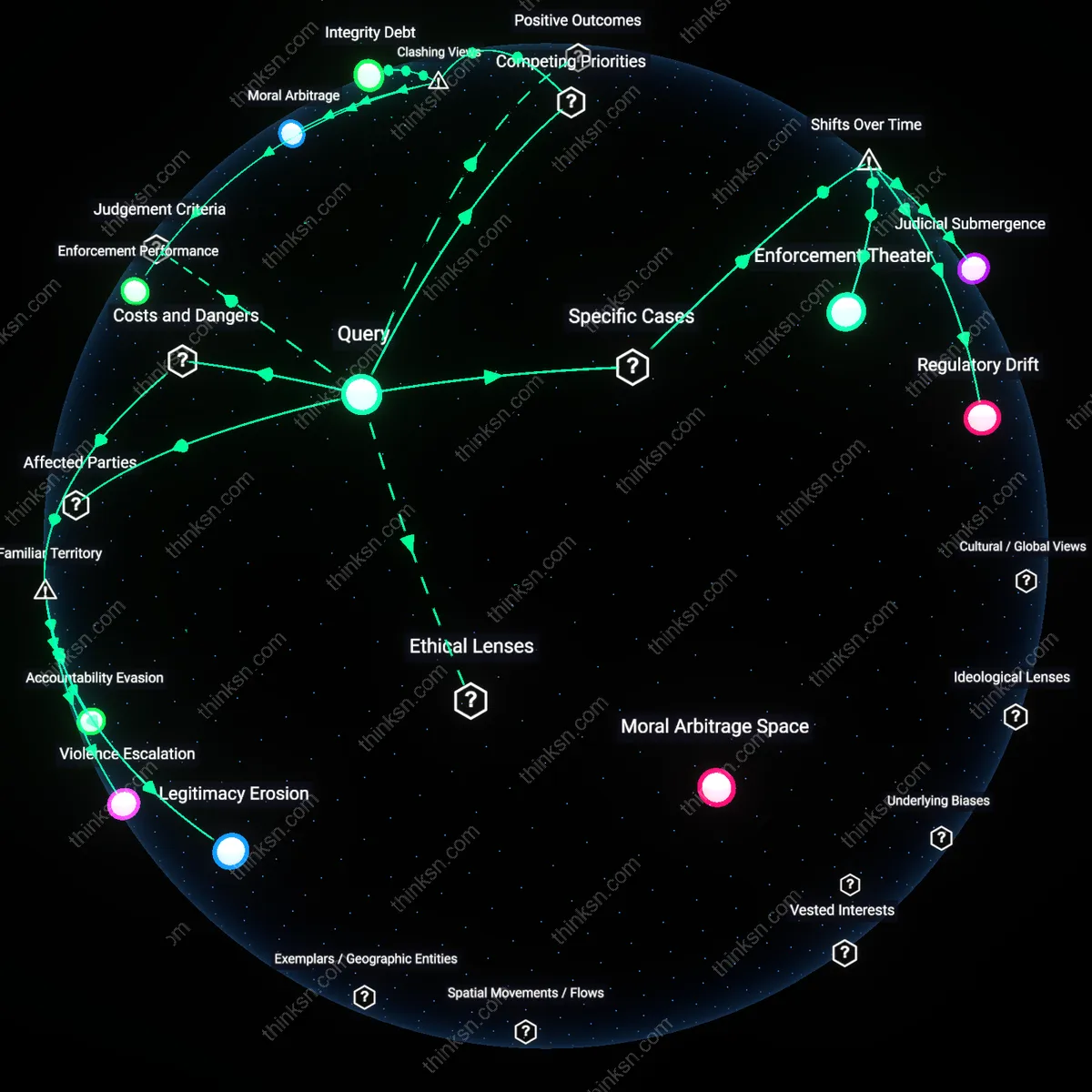
Analysis reveals 9 key thematic connections.
Key Findings
Educational disinvestment
Zero-tolerance policies become counterproductive when applied in U.S. public schools, as seen in the post-1994 Gun-Free Schools Act expansion in urban districts like Philadelphia, where mandatory suspensions for minor infractions disproportionately expelled Black and Latino students, diverting them from classrooms into juvenile justice pathways; this institutional substitution of education with punishment creates a systemic feedforward loop in which schools function less as learning environments and more as surveillance gateways, undermining long-term public safety by weakening human capital development in marginalized communities—an outcome rarely acknowledged in crime-prevention debates.
Police legitimacy erosion
Zero-tolerance policing becomes counterproductive when deployed in high-density, low-income neighborhoods as in New York City’s 1990s ‘broken windows’ enforcement, where pervasive misdemeanor arrests for turnstile jumping or loitering, while intended to deter serious crime, instead severed trust between residents and police; this breakdown in community cooperation degraded intelligence sharing and witness participation, weakening the very mechanisms that effective law enforcement relies on, revealing that order-maintenance tactics can compromise long-term crime control by alienating the populations they are meant to protect.
Corporate moral hazard
Zero-tolerance policies become counterproductive when implemented in regulatory domains like the 2010 Deepwater Horizon drilling operations, where BP and Transocean operated under a compliance-based safety regime that punished individual procedural violations while insulating executive decision-making from liability; in this setting, rigid enforcement of narrow rules created a false sense of systemic control, allowing organizational risk to accumulate unchecked at the managerial level, demonstrating how zero-tolerance can mask systemic negligence by displacing accountability onto low-level actors.
Moral displacement
Zero-tolerance policies become counterproductive when they shift moral responsibility from systemic institutions to individual behavior under utilitarian governance frameworks. Police departments in cities like New York and Chicago, operating under Broken Windows theory, justify aggressive misdemeanor enforcement as a net producer of public safety, yet this logic externalizes the ethical cost of criminalization onto marginalized communities, allowing policymakers to appear responsive without addressing root causes like housing insecurity or underfunded education. The non-obvious outcome is that the state discharges its ethical obligation through procedural rigor—arrest quotas, visible policing—while deepening social inequity, a dynamic sustained by political incentives that reward optics over structural reform.
Legal overreach feedback
Zero-tolerance policies become counterproductive when judicial discretion is systematically curtailed, triggering a feedback loop of prosecutorial escalation under the due process framework. In mandatory minimum jurisdictions like those in the U.S. federal system, minor drug offenses automatically invoke severe sentencing, which inflates prison populations and forces prosecutors to leverage harsh penalties for plea bargaining, distorting case outcomes irrespective of intent or context. This dynamic reveals how rigid legal doctrines, designed to ensure fairness through consistency, instead empower gatekeepers to exploit systemic rigidity, thereby undermining legitimacy and fueling public distrust in rule-of-law institutions.
Community resilience erosion
Zero-tolerance policies become counterproductive when sustained policing saturation in neighborhoods like those in Baltimore or Ferguson depletes informal social control mechanisms essential for endogenous crime reduction. When youth, particularly Black and Brown adolescents, are disproportionately subject to stop-and-frisk or school-based arrests, community trust in authority erodes, weakening the very networks—families, schools, faith groups—that deter criminal behavior through relational accountability. The non-obvious systemic effect is that state-imposed order actively dismantles grassroots norm enforcement, producing a paradox where heightened formal control generates greater disorder by displacing local capacity for self-regulation.
School-to-prison pipeline
Zero-tolerance policies in U.S. public schools, such as those enforced in Los Angeles Unified School District in the early 2000s, became counterproductive when minor disciplinary infractions like classroom disruption triggered automatic suspensions or police involvement, shifting authority from educators to law enforcement. This mechanism transformed school environments into de facto extensions of the criminal justice system, particularly impacting Black and Latino youth, and cultivated a direct institutional pathway from education to incarceration. The non-obvious insight under the familiar lens of school safety is that policies marketed as crime prevention can manufacture criminal identities among youth precisely by treating normative adolescent behavior as deviant, thereby amplifying long-term societal harm despite negligible deterrence effects.
Mandatory minimums backlash
The U.S. federal sentencing regime during the 1980s and 1990s, particularly under the War on Drugs, became counterproductive when zero-tolerance enforcement of mandatory minimum sentences led to mass incarceration of nonviolent offenders, overwhelming prison systems and diverting law enforcement resources from serious crime. Judges lost discretion, prosecutors gamed charging practices, and public trust eroded as communities saw disproportionate punishments for low-level offenses, undermining deterrence through perceived injustice. The familiar framing of 'tough on crime' masked the system’s declining marginal returns, revealing that rigid application of punitive rules can corrode legitimacy more than it consolidates order.
Prohibition-era criminal capital
The imposition of zero-tolerance alcohol prohibition in American cities like Chicago during the 1920s became counterproductive when the complete criminalization of a widely desired good enabled organized crime networks, such as Al Capone’s syndicate, to capture black-market profits and reinvest in corruption and violence. By removing legal avenues for distribution, the policy elevated the economic value of illicit operations, empowering criminal entrepreneurs whose power grew directly from the severity and universality of enforcement. The intuitive association of strict laws with public safety collapses here, as the vacuum created by zero tolerance didn't eliminate behavior but rather professionalized its violation, generating more systemic danger than the behavior itself.