Early Colon Cancer Detection vs. Procedure Risks at 45?
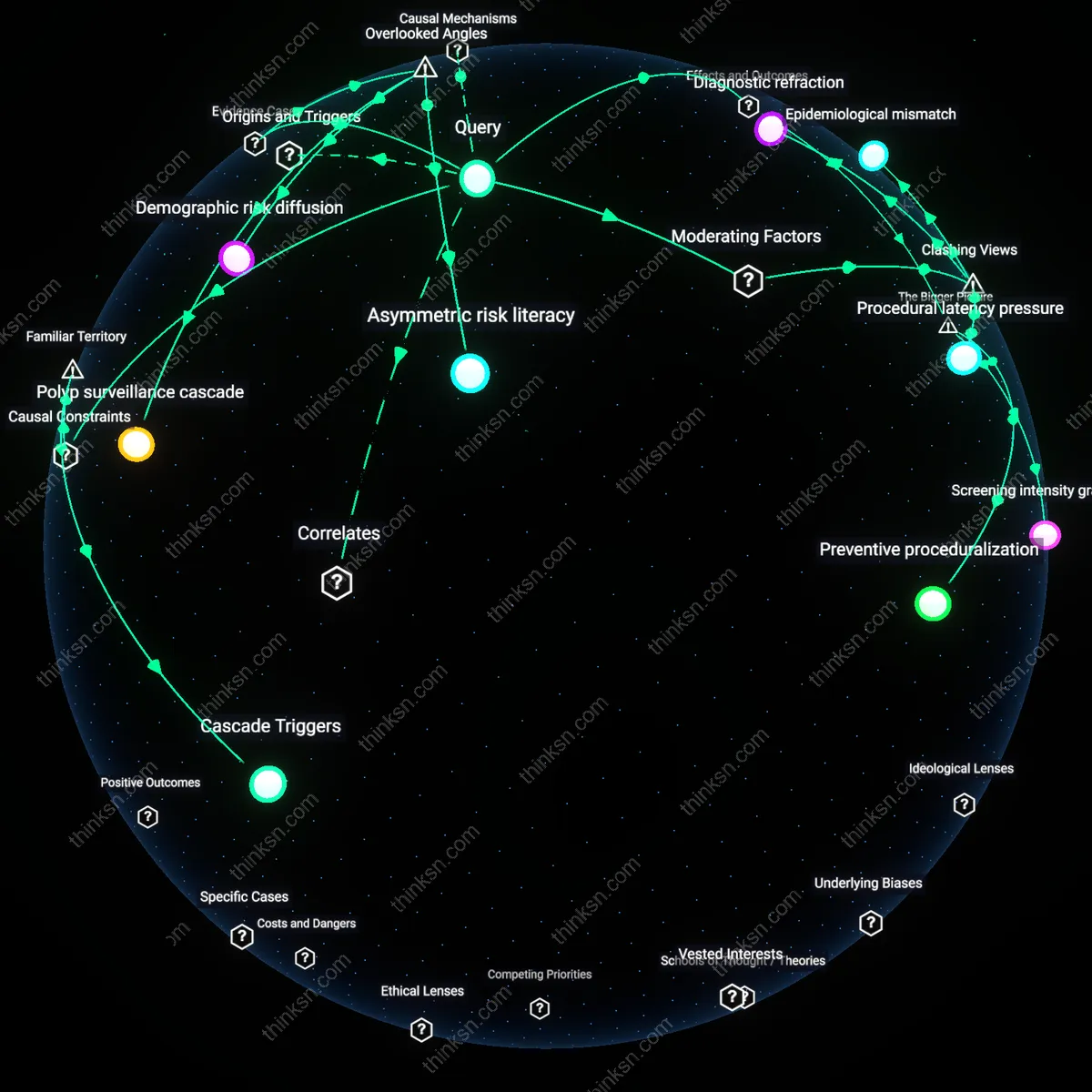
Analysis reveals 10 key thematic connections.
Key Findings
Screening intensity gradient
Expanding colonoscopy eligibility to age 45 increases cancer detection because earlier initiation extends surveillance into a pre-symptomatic phase when adenomas are more easily identified and removed, thereby advancing diagnosis timelines across the population; this shift is amplified by standardized guidelines adopted by health systems like the U.S. Preventive Services Task Force, which drive primary care protocols and insurance coverage. The same expansion exposes biologically low-risk individuals—whose probability of malignancy is minimal over the next decade—to invasive procedures whose risks (perforation, bleeding, sedation complications) remain constant regardless of individual risk, creating a population-level tradeoff where systemic early detection gains are counterbalanced by iatrogenic harm in healthy people. What is underappreciated is that the uniform application of age-based thresholds masks heterogeneity in risk trajectories, effectively turning preventive care into a volume-driven activity where procedure rates rise independently of clinical urgency, thus institutionalizing a screening intensity gradient that scales harm and benefit unevenly across risk strata.
Risk dilution effect
Lowering the initiation age for colonoscopies redistributes a fixed pool of clinical attention and procedural resources across a larger, younger cohort in which the prevalence of precancerous lesions is significantly lower, thereby diluting the positive predictive value of each screening event and increasing the absolute number of low-yield colonoscopies performed. This dilution intensifies downstream burdens on endoscopy units, pathologists, and follow-up care systems, which must now process more false positives and incidental findings in otherwise healthy individuals, inadvertently increasing complication rates not due to technical failure but because low-benefit screenings inherently carry higher relative risk per life-year gained. The systemic consequence is a recalibration of cost-benefit ratios at the population level, where public health gains in high-risk subgroups are partially offset by unnecessary interventions in low-risk populations—an outcome driven not by clinical misjudgment but by the structural imperatives of risk-averaged policy design operating without personalized stratification tools.
Preventive proceduralization
Colonoscopy screening at age 45 becomes embedded in routine care through clinical automation—the reflexive scheduling of procedures based on age thresholds rather than individualized risk assessment—enabled by electronic health record alerts, physician incentives aligned with screening metrics, and patient expectations shaped by public health messaging. This proceduralization transforms colonoscopy from a targeted intervention into a standardized ritual of adulthood, decoupling its use from dynamic risk evaluation and increasing complications through sheer repetition in anatomically and physiologically normal colons where technical challenges are minimal but cumulative risks are not. The underrecognized consequence is that prevention itself becomes systemically operationalized as volume-based compliance, privileging adherence to guidelines over nuanced clinical judgment, thereby generating complications not as outliers but as expected outputs of a machine calibrated for coverage, not precision.
Diagnostic refraction
Lowering the colonoscopy screening age to 45 redirects medical attention toward anatomically normal but surveilled bodies, transforming low-risk physiological variation into pathologized anomalies through intensified mucosal inspection; this mechanism operates primarily in outpatient gastroenterology networks where procedural volume incentives amplify lesion overcalling, thereby increasing complication rates not due to cancer prevalence but to the iatrogenic consequences of diagnostic intensity—it is non-obvious because early detection is typically framed as uniformly beneficial, yet here surveillance itself becomes the risk factor.
Epidemiological mismatch
Expanding screening to 45-year-olds introduces a population historically excluded from risk models calibrated on older, higher-incidence cohorts, causing current guidelines to misapply hazard ratios derived from Black and low-socioeconomic urban populations to demographically divergent, lower-burden groups such as insured suburban whites; this miscalibration occurs within actuarial frameworks used by insurers and health systems to justify screening rollout, producing unnecessary interventions not because early cancer is more common, but because risk algorithms fail to stratify by social biology—it challenges the assumption that age alone is a sufficient proxy for biological vulnerability.
Procedural latency pressure
Initiating colonoscopies at 45 compresses the time between baseline screening and recommended follow-up, pressuring endoscopy units to prioritize throughput over polypectomy precision, particularly in safety-net hospitals with high patient-to-endoscopist ratios; this dynamic elevates complications like perforation and bleeding not because cancers are detected earlier per se, but because procedural tempo undermines tissue assessment rigor in low-yield cases—it reveals that system capacity, not clinical need, governs complication rates in expanded screening regimes.
Cascade Triggers
Lowering the screening age activates diagnostic cascades in individuals who would otherwise remain undiagnosed and asymptomatic for years, simply because modern endoscopy detects polyps that might never progress to cancer. In real-world clinical settings like community gastroenterology clinics, this leads to interventions—polypectomies, biopsies, repeat procedures—that are technically successful but introduce avoidable complications such as bleeding or perforation in people who derived no survival benefit. What most overlook in the common portrayal of colonoscopy as a static ‘check-up’ is that it is a dynamic intervention that initiates downstream medical activity; the procedure itself becomes a causal agent of harm in low-risk cases, not due to operator failure but as a built-in feature of diagnostic momentum.
Asymmetric risk literacy
Lower health numeracy in socioeconomically marginalized populations causes routine early colonoscopies to be interpreted as universally beneficial, despite individual risk profiles, amplifying complications in low-risk subgroups who are more likely to undergo invasive follow-up due to misperceived threat. In regions like the rural Mississippi Delta, where baseline colorectal cancer mortality is high but primary care access is fragmented, public health campaigns promoting earlier screening often fail to differentiate between population-level benefit and individual risk, leading to over-participation among low-risk patients who trust the recommendation as uniformly protective. This dynamic reveals how risk communication gaps—not screening technology or procedure frequency—are central drivers of unintended harm, an aspect typically omitted in guidelines that assume uniform patient interpretation of screening advice.
Polyp surveillance cascade
The detection of diminutive, indolent adenomas during early colonoscopies in low-risk 45-year-olds triggers mandated surveillance intervals that inherently increase procedural exposure and complication risk over decades, even when the initial finding poses negligible cancer threat. At institutions like Kaiser Permanente Northern California, where electronic health record algorithms automatically schedule follow-up colonoscopies based on minor polyp findings, young patients enter locked care pathways that disregard emerging evidence that some small polyps may never progress. This iatrogenic trajectory—where the system’s adherence to protocol generates harm more than the procedure itself—exposes how quality metrics rewarding compliance with surveillance intervals inadvertently incentivize long-term risk accumulation in individuals initially screened out of clinical necessity.
Demographic risk diffusion
When screening guidelines shift downward in age without tight phenotypic stratification, the inclusion of vast cohorts of low-risk individuals—such as healthy, non-smoking, normal-BMI African American women under 50—dilutes the positive predictive value of colonoscopy findings, increasing false positives and unnecessary interventions despite earlier cancer detection in a small high-risk subset. In metropolitan screening programs like those in Minneapolis-Saint Paul, where early adoption of the 45-year threshold led to a 60% rise in colonoscopies among low-risk white-collar workers, complication rates from perforation and bleeding rose disproportionately not because of procedural incompetence but because low disease prevalence magnifies the harm-to-benefit ratio per intervention. This effect illustrates how epidemiological shifts in screening onset redistribute procedural risk across populations irrespective of biology, a systems-level trade-off rarely modeled in preventive policy.