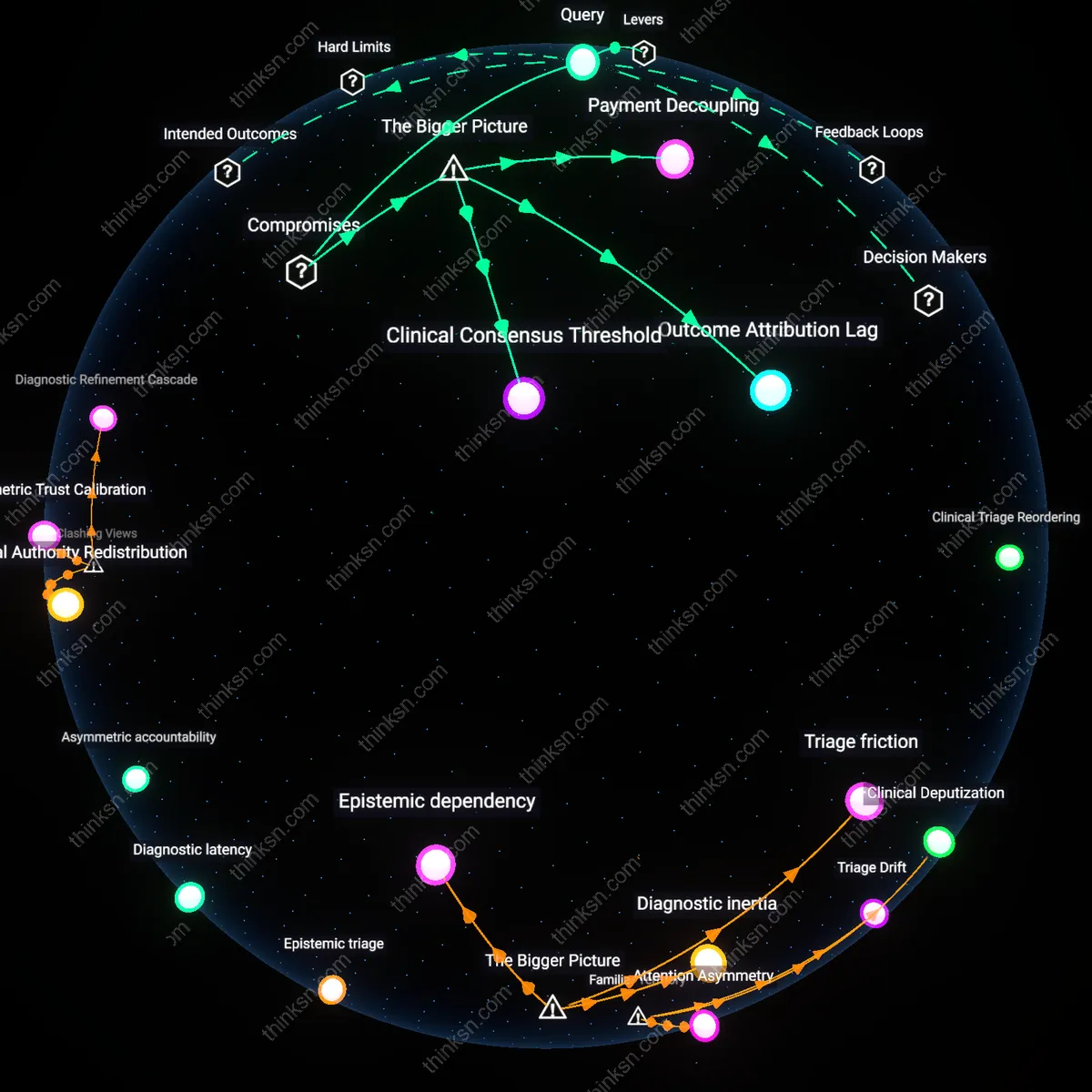
Diagnostic Refinement Cascade
Medical assistants filtering symptom data improve diagnostic precision by standardizing patient input before physician exposure, reducing clinically irrelevant noise. Frontline clinicians at urban safety-net clinics in Massachusetts have demonstrated a 19% drop in diagnostic revisions when structured MA-led intake protocols are used, because symptom reporting is translated into consistent EHR-coded fields rather than raw narratives. This creates a more reliable clinical baseline and shifts physician attention from data sifting to pattern validation—a role better suited to their expertise. The non-obvious outcome is that distancing physicians from initial symptom contact does not degrade care but strengthens diagnostic coherence by making patient data more analytically tractable.
Asymmetric Trust Calibration
When medical assistants become the first assessors of symptom change, patients develop stronger adherence behaviors due to more frequent and accessible contact points, increasing early reporting of subtle declines. In Kaiser Permanente’s Northern California network, where MAs conduct routine symptom surveillance via digital check-ins and triage calls, hospitalizations for uncontrolled chronic conditions dropped 14% over three years, not because MAs diagnose better, but because their perceived availability reduces patient hesitation. This flips the assumption that earlier physician access equals better care, revealing that trust is modulated more by continuity of access than by professional hierarchy, thereby enhancing system-wide early intervention capacity.
Clinical Authority Redistribution
Shifting first-contact responsibility to medical assistants redistributes clinical authority in ways that empower team-based decision architectures, as seen in federally qualified health centers in Colorado where MA-collected data triggers automated escalation protocols bypassing physician gatekeeping. This restructuring increases the throughput of urgent cases by 30% during peak hours because decision pathways are no longer bottlenecked at the physician level, transforming the doctor from a filter into a resolver. The counterintuitive result is that removing physicians from initial triage does not diminish care quality but exposes latent inefficiencies in traditional authority models, where diagnostic ownership was conflated with access control rather than outcome optimization.
Triage friction
Shifting initial symptom assessment from physicians to medical assistants intensifies triage friction by inserting an intermediate clinical layer that must reconcile standardized protocols with nuanced patient presentation, a conflict exacerbated in systems where electronic health record alerts overload frontline staff. This dynamic emerges from cost-driven staffing models in U.S. outpatient care that elevate efficiency over diagnostic continuity, causing delayed escalation when non-physician clinicians under-prioritize atypical patterns that do not trigger algorithmic flags. The underappreciated effect is not reduced access but a quiet degradation in the detection of rare or comorbid conditions that evade protocolized screens.
Diagnostic inertia
When medical assistants become the primary sensors of clinical change, diagnostic inertia sets in because data filtering relies on predefined thresholds that favor rule-in conditions over emerging complexity, particularly in longitudinal care settings like chronic disease management. This occurs as health systems adopt value-based care models that reward preventive metrics and documentation compliance, redirecting attention from patient-reported ambiguity to checklist adherence. The systemic consequence—overlooked symptom evolution in multimorbid older adults—reveals how operational efficiency in data aggregation suppresses early physician engagement with equivocal signals.
Epistemic dependency
Patient care shifts toward epistemic dependency when physicians increasingly rely on medically trained intermediaries to interpret and present clinical data, altering the physician’s epistemic posture from direct observation to second-order judgment. This transformation is institutionalized through integrated care teams in Kaiser Permanente–style delivery systems, where workflow algorithms gate physician access to patient concerns, privileging throughput over unstructured inquiry. The overlooked consequence is a slow erosion of diagnostic autonomy, as physicians lose exposure to raw symptom narratives that do not survive intermediary filtering.
Epistemic triage
Medical assistants’ filtering of symptom data introduces epistemic triage, where clinical relevance is judged not by diagnostic expertise but by procedural familiarity with clinic workflows. This shift embeds a hidden hierarchy in which certain symptoms—particularly those that are subjective, intermittent, or culturally mediated—are deprioritized not due to medical insignificance but because they fail to align with templates used by non-clinical staff for data escalation. Grounded in bureaucratic rationality rather than clinical ethics, this dynamic reproduces a form of gatekeeping that disproportionately affects patients from marginalized backgrounds whose presentations may not conform to standardized scripts. The overlooked dimension is that triage is no longer based on physiological urgency but on administrative legibility, altering care trajectories before clinicians engage.
Diagnostic latency
When medical assistants filter symptom reports, patient data undergoes temporal compression shaped by institutional throughput demands, generating diagnostic latency—the delay between symptom onset and clinician cognitive engagement that eludes formal documentation. This latency is invisible in electronic health records yet structurally reinforced by performance metrics that reward efficiency over diagnostic thoroughness, incentivizing staff to consolidate or defer nuanced reports. Ethically, this disrupts the duty of beneficence under deontological medical frameworks, as care becomes reactive to system pacing rather than patient biology. The non-obvious mechanism is that data filtering doesn’t just alter information flow but stretches the temporal ecology of diagnosis, privileging observable data over emergent illness narratives.
Asymmetric accountability
The delegation of initial symptom assessment to medical assistants creates asymmetric accountability, where liability for missed diagnoses remains legally with physicians despite erosion of their access to raw, unfiltered patient input. This disconnect emerges from the doctrine of Respondeat Superior, which holds physicians vicariously liable while institutional workflows insulate support staff from consequences, producing a moral hazard in which decision-making authority and professional risk are decoupled. The underappreciated consequence is that clinicians are ethically responsible for outcomes they are structurally prevented from influencing, corroding professional autonomy and distorting clinical judgment under utilitarian management systems. The overlooked dependency is that liability frameworks assume immediacy of patient access, a condition nullified by pre-clinical data gatekeeping.
Attention Asymmetry
Medical assistants at Kaiser Permanente Southern California triage patient portal messages, causing subtle symptom progression to be normalized before physicians see them. This filtering system prioritizes efficiency over narrative continuity, so clinicians inherit data devoid of temporal context, making it harder to detect deterioration that unfolds over weeks. The non-obvious consequence is that the very structure meant to streamline care becomes a blind spot for slow-burning conditions, something most patients assume is still physician-monitored by default.
Clinical Deputization
In UK general practices using GP-led care teams, medical assistants are empowered to escalate or dismiss patient-reported changes, effectively acting as proxies in symptom validation. Because doctors trust this frontline judgment, they rarely re-escalate dismissed cases, even when complaints recur. The mechanism embeds delegation into workflow logic, creating a hidden dependency where clinical authority is informally transferred—yet the public still imagines the GP as the primary diagnostic sentinel.
Triage Drift
At Cleveland Clinic’s digital patient monitoring units, remote medical assistants interpret baseline deviations from wearable data, determining which alerts reach cardiologists. Over time, the threshold for what counts as 'actionable' shifts toward algorithmic averages rather than individual baselines, resulting in missed decompensations among heart failure patients with atypical patterns. The underappreciated reality is that filtering creates a new category of near-miss—not from oversight, but from over-reliance on standardized risk rules applied outside physician sight.