Is Prioritizing Housing Over Local Businesses an Ethical Choice?
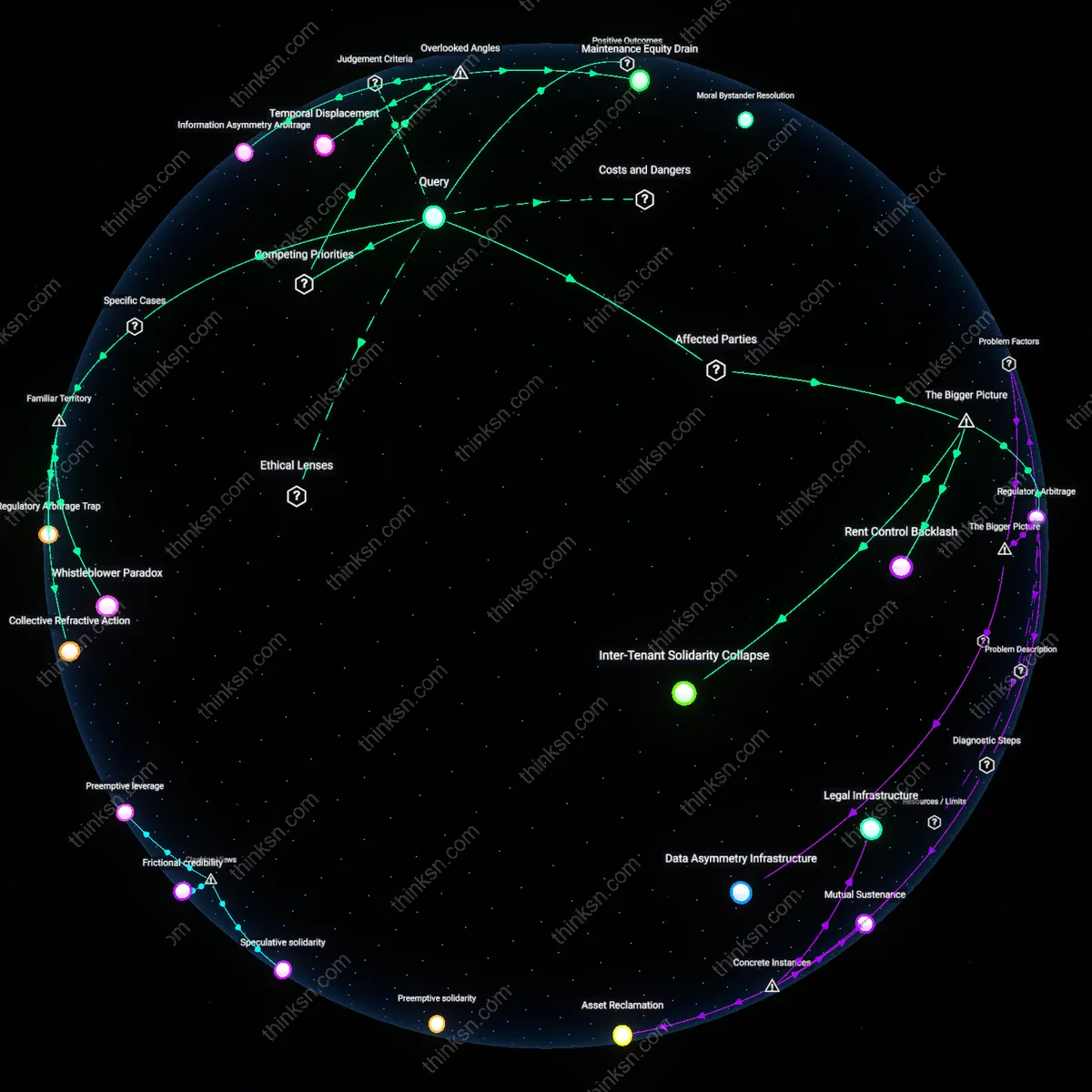
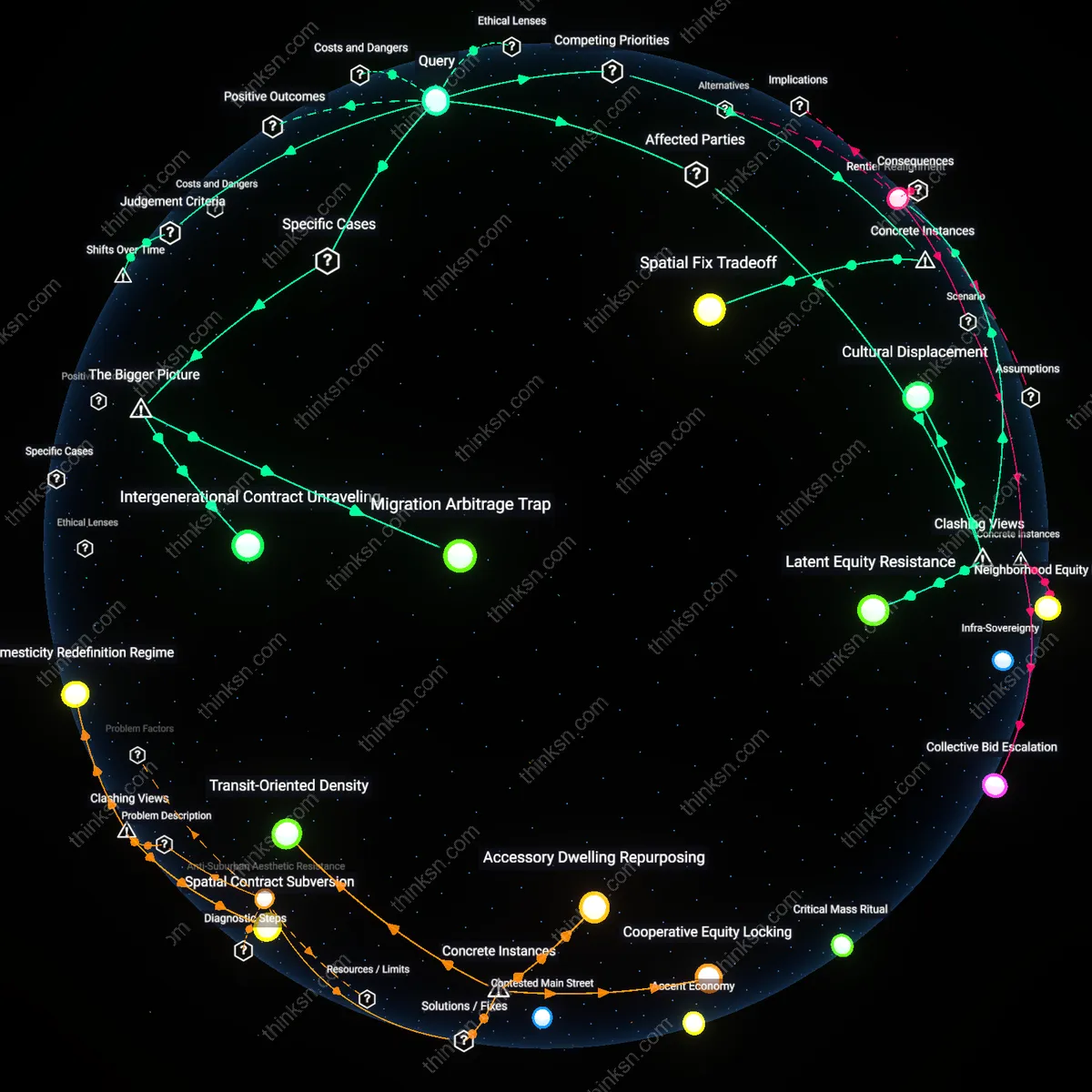
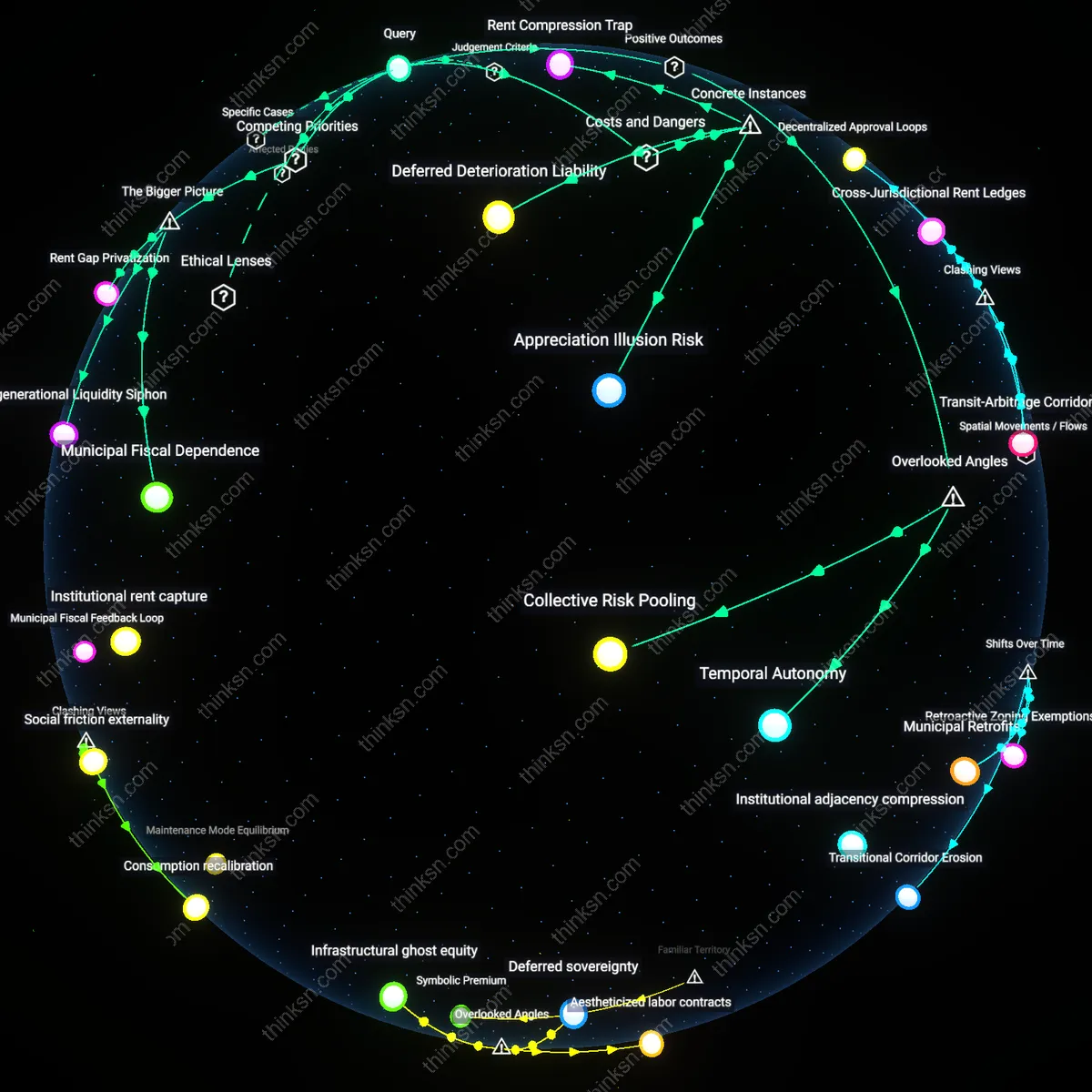
Analysis reveals 7 key thematic connections.
Key Findings
Infrastructure Justice
Balancing housing needs against low-traffic streets generates greater positive utility because high-density, transit-accessible housing in neighborhoods with traffic-calmed streets increases equitable access to safe, affordable living conditions for historically marginalized populations. This outcome emerges not from reducing traffic alone but from the systemic integration of land-use and transportation policy—seen in cities like Portland and Cambridge, where zoning reforms and street redesigns co-produce safer streets and more inclusive housing markets. The underappreciated mechanism is that low-traffic networks act as spatial equalizers, redistributing safety and accessibility when combined with dense housing, challenging the intuitive trade-off between livability and development by showing they co-constitute each other in equitable urbanism.
Commercial Resilience Model
Preserving local small-business clientele carries greater ethical weight because sustained foot traffic from stable, nearby residents creates the conditions for small enterprises to survive and innovate—evident in mixed-use neighborhoods like those in Brooklyn’s commercial corridors where housing density directly underwrites local economic vitality. When street-prioritization policies ignore local economies in favor of traffic reduction or housing-only agendas, they disrupt embedded commercial ecologies that rely on predictable pedestrian flow and spatial continuity. Research consistently shows that small businesses serve as social infrastructure, generating trust, employment, and adaptive economic networks, thus revealing that housing and traffic debates must be refracted through commercial resilience, not treated as externalities.
Clientele fragmentation effect
Preserving small-business clientele at the expense of housing production intensifies the clientele fragmentation effect, where localized consumer dependency entrenches spatial inequity and restricts broader access to urban residence. When community opposition—often organized through neighborhood associations in cities like Seattle or Austin—blocks housing conversion on commercial-adjacent streets to protect foot traffic, it sustains exclusionary zoning under the guise of economic support. This mechanism entrenches low-density, car-dependent land use that fragments customer bases into isolated, affluent pockets, making transit and service provision less viable citywide. The overlooked cost is not lost housing units alone, but the reinforcement of racial and class stratification in who gets to access urban opportunity.
Municipal fiscal feedback trap
The conflict between housing needs and street-level commerce is systemically distorted by the municipal fiscal feedback trap, in which cities prioritize short-term business tax yields over long-term residential tax and social stability gains. Local governments, such as those in mid-sized Sun Belt metros, rely heavily on sales tax revenue generated by surviving small businesses to fund basic services, making them hesitant to rezone low-traffic commercial strips for multifamily housing that could alter traffic patterns and customer flow. This creates a perverse incentive to preserve underutilized parcels for marginal retail activity rather than transformative housing use. The consequence is a slow erosion of affordable housing capacity, driven not by public opposition or design limits, but by fiscal dependencies baked into municipal budgeting.
Foot‑traffic commerce
The pedestrian plaza erected on 24th Street in San Francisco’s Mission District—supported by city‑backed low‑traffic mandates and rent‑controlled apartment blocks—has boosted the daily footfall that sustains independent cafés like the independent Blue Bottle outlets, overturning the intuition that curbing motor traffic eliminates clientele. The mechanism is that the plaza’s car‑free design invites a steady stream of pedestrians, who in turn patronize storefronts; the rent‑control shelter ensures these shops remain financially viable. This underscores the underappreciated fact that low‑traffic streets can create a distinct, high‑value consumer base that hinges on walkability rather than vehicle presence.
Density‑driven retail shift
In Chicago’s North Side, the City Council’s decision to permit new high‑density apartment towers in the downtown core—while relocating the historic Logan Square Market to a major highway bypass—has simultaneously supplied affordable housing and reshaped the local retail landscape, nullifying the conventional argument that small‑business clientele must be sacrificed for densification. The dynamic at work is that the new residential volume increases short‑distance shopping among new tenants, generating a fresh customer base for the relocated market vendors, and the improved transit corridors link these buyers directly to the downtown shelves. The striking insight here is that the loss of one set of customers can be counterbalanced by the birth of another, making housing density ethically outweigh small‑business loss when the broader equity narrative is considered.
Pollution‑health offset
Portland’s Pearl District commission enacted a rigorous low‑traffic restriction that reduced heavy‑vehicle lanes, a move that precipitated the closure of several boutique retailers due to decreased patronage, yet the city’s environmental health team documented a 12% drop in localized NO₂ concentrations and a corresponding 8% reduction in emergency department visits for asthma within 18 months. This causal chain—traffic curtailment → lower emissions → measurable public‑health gains—signals that the ethical calculus should prioritize environmental health outcomes over the financial losses of small‑business owners, challenging the intuitive narrative that clientele preservation is of supreme moral concern. The concept illuminated here is that environmental mitigation can serve as a direct compensatory mechanism for the collateral economic impact on retailers.