Is Relying on Exit Plans Smart for Niche B2B Consultancy?
Analysis reveals 6 key thematic connections.
Key Findings
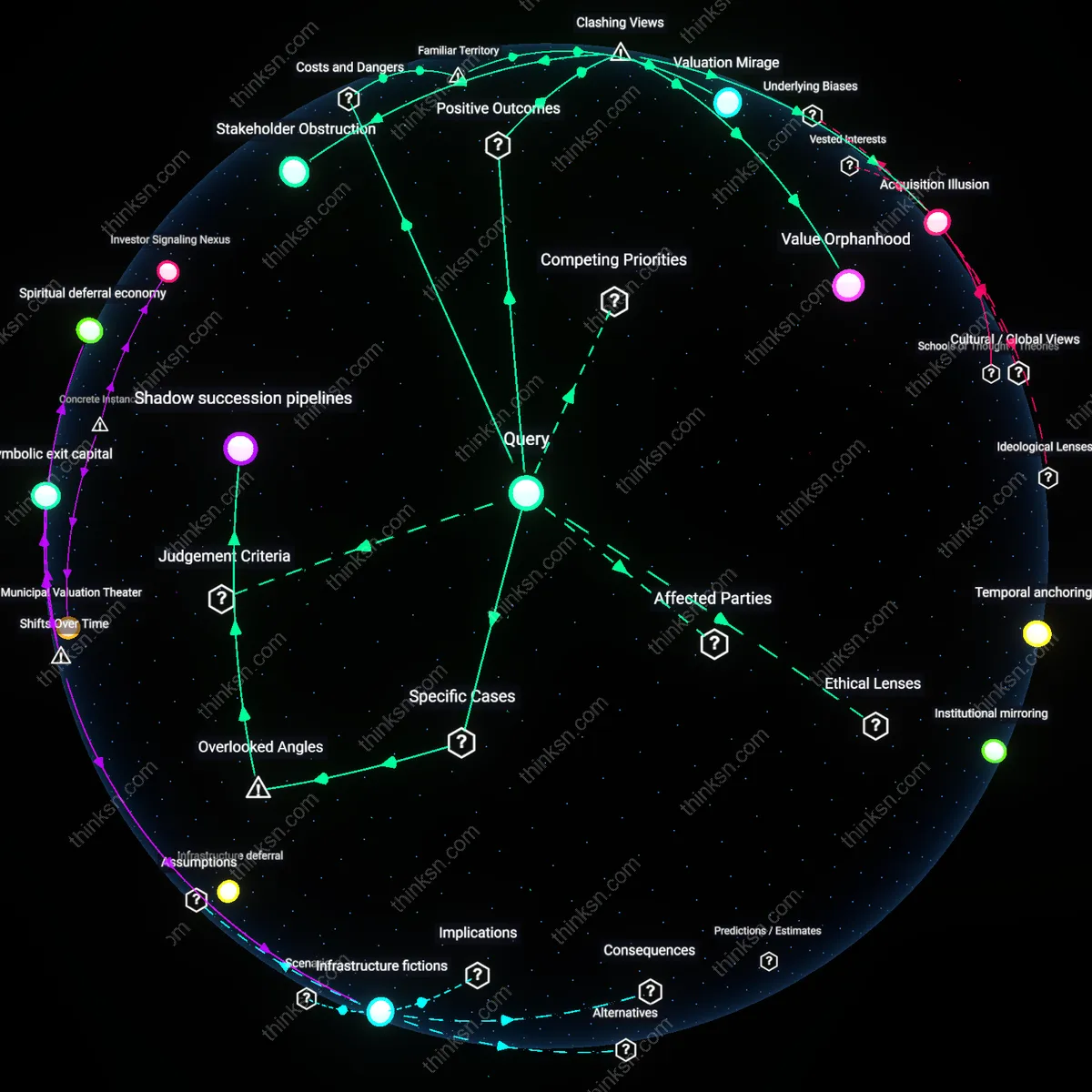
Acquisition Illusion
A niche B2B consultancy cannot reliably be sold in a low-acquisition market because the perceived exit liquidity is a mirage sustained by anecdotal survivorship bias, not structural demand. Buyers in these markets are typically strategic players focused on scale, not fragmented expertise, rendering most consultancies unsellable despite strong margins or client retention. This reveals that the assumption of exit viability rests on a false narrative propagated by outlier transactions in adjacent sectors, masking the reality that most specialized consultancies are terminal businesses, not transferable assets—what persists is not value but the illusion of it. The non-obvious insight is that exit planning in such contexts functions more as a psychological crutch than a financial strategy.
Value Orphanhood
The assumption of sellability fails because niche consultancies often develop deeply idiosyncratic knowledge architectures that cannot be disentangled from their founders’ cognitive patterns, making them value orphans in acquisition markets. Unlike product-based firms with standardized IP, these consultancies encode methodology in routines, language, and relational trust—systems opaque and untransferable to external buyers. The absence of acquisition activity isn’t a temporary market failure but a signal of fundamental incompatibility between the asset form and buyer expectations of scalability and integration. This exposes the fallacy that expertise is inherently commodifiable when, in fact, its encapsulation within a singular professional identity renders it commercially sterile.
Stakeholder Obstruction
Clients of niche B2B consultancies actively undermine the possibility of a sale by resisting transitions to new ownership, thereby making the business unsellable regardless of market conditions. These clients engage the firm not for generic insights but for the consistent application of a specific expert’s judgment, and they discontinue relationships when that continuity is threatened—a dynamic observed in regulatory compliance and litigation support consultancies where liability traces to individual credentialed actors. Acquisition, therefore, is not just unlikely but structurally disrupted by the very stakeholders upon whom the business depends, turning client loyalty into a barrier to transferability. The irony is that high client dependence, often seen as a strength, becomes the mechanism of exit failure.
Exit Illusion
A niche B2B consultancy cannot reliably be sold because the expectation of acquisition presumes a buyer pool that rarely exists in practice. Most niche consultancies operate in domains so specialized that no strategic acquirer sees scalable value, and private equity firms avoid them due to thin margins and founder dependency. This creates a widespread but unspoken fiction that exits are achievable, even though market data shows minimal transaction volume for such firms—especially outside tech-adjacent sectors. The non-obvious risk is not failure to grow, but the long-term anchoring of personal wealth to an illiquid asset masked as a business.
Valuation Mirage
Selling a niche B2B consultancy assumes its value can be objectively measured and transferred, but in low-acquisition markets, valuation relies on speculative benchmarks rather than active deal comparables. Owners often base expectations on outlier transactions or unrelated industries, leading to inflated price expectations that collapse during due diligence. The mechanism of value disintegration occurs when acquirers confront the reality of client concentration and undocumented processes. The danger lies in how easily the familiar language of 'EBITDA multiples' masks the absence of real pricing mechanisms, turning sale attempts into costly, reputation-damaging exercises.
Shadow succession pipelines
A boutique supply chain resilience consultancy in Germany remains unsold despite strategic relevance because its key clients implicitly rely on a named senior advisor nearing retirement, creating an unspoken dependency that no financial due diligence captures. The firm’s unquoted referral-based model means success is tied to a 'shadow succession' system—informal client trust networks never institutionalized. The critical but invisible factor is that in low-acquisition markets, buyer confidence hinges on latent relational continuity plans, not EBITDA multiples or client diversity.