When Prestige Hinders Personal Fulfillment?
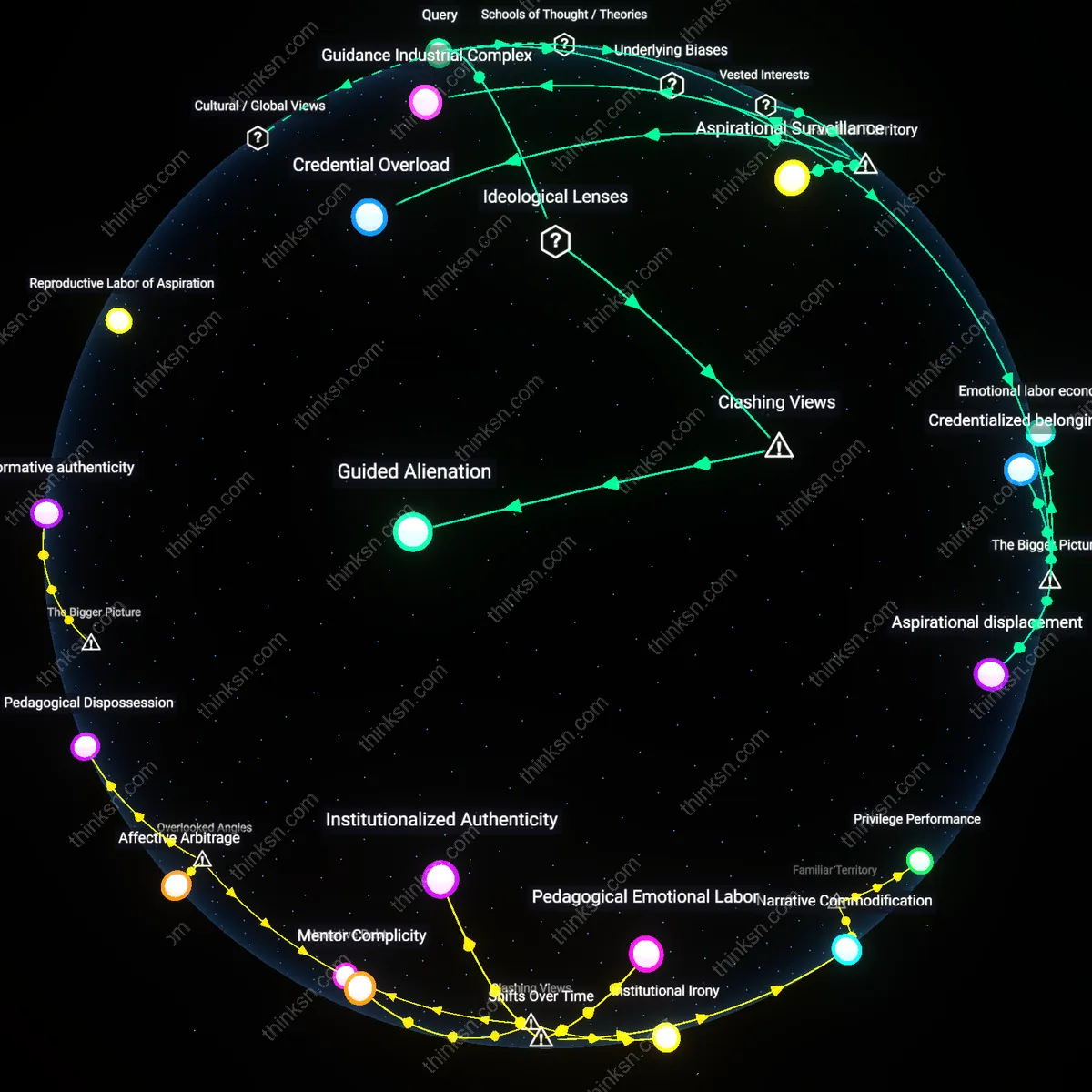
Analysis reveals 10 key thematic connections.
Key Findings
Deferred experimentation
Pursuing a prestigious title suppresses engagement in personally fulfilling work by locking individuals into long-term identity investments that make mid-course exploration socially and psychologically irreversible. High-status trajectories—such as tenure-track academia, elite legal partnerships, or C-suite pipelines—demand early, full commitment and penalize lateral or regressive moves, not just financially but reputationally; this creates a hidden cost where the mere availability of lower-status, intrinsically motivating work becomes irrelevant because actors cannot publicly access it without violating expectations of linear progression. What’s overlooked is that fulfillment often requires iterative trial and error in diverse contexts, yet prestige systems reward endurance in a single role, effectively disabling the social permission to experiment later in life—especially in cultures that equate career shifts with failure. This constraint isn’t about resources or time but about the social illegibility of reinvention after symbolic capital has been accrued.
Institutional horizon compression
Prestige-chasing narrows the temporal frame within which meaningful work is recognized, rendering personally fulfilling but long-horizon projects invisible to those embedded in rank-driven systems. In fields like biomedical research or policy elites, success is measured by short-cycle outputs (publications, media mentions, promotions), which trains individuals to dismiss or undervalue contributions that mature over decades—such as community-based healing practices, craft traditions, or ecological stewardship—that lack immediate metrics of distinction. What’s typically missed is that the internalization of compressed time horizons doesn’t just alter behavior; it reshapes what counts as real or serious work, making it cognitively invisible rather than merely unattractive. Thus, people don’t reject fulfilling work—they become unable to perceive it as work at all.
Cultural capital mismatch
The pursuit of prestigious titles undermines engagement in less status-oriented work when dominant institutions gatekeep resource distribution through symbolic validation systems that devalue nonconforming forms of contribution. In sectors like the arts or social innovation, funding bodies and media outlets prioritize pedigree—alumni networks, accolades, institutional affiliations—over situated impact or relational labor, rendering invisibility a material consequence for those opting out. As a result, individuals capable of deep community work face eroded access to infrastructure unless they perform legibility to elite arbiters. The overlooked mechanism is not individual ambition but the systemic misalignment between how value is created and how it is recognized, enforced by intermediaries who reproduce hierarchies through ritualized distinction.
Aspirational extraction
Prestige-seeking impedes personally fulfilling work when global labor markets commodify symbolic achievement as a proxy for human capital, enabling wealth-concentrated regions to extract talent from peripheral communities through status-laden career pipelines. Programs like elite graduate fellowships or international corporate fast tracks draw high-potential individuals from under-resourced regions with promises of title and mobility, disrupting local knowledge ecosystems by incentivizing exit over embedded service. These individuals, once distanced, face symbolic and material disincentives to return to less visible but contextually vital roles. The systemic driver is not personal choice but the gravitational pull of transnational status economies that convert local potential into globally mobile credentials, depleting communities of relational expertise under the guise of individual advancement.
Career compromise
Pursuing a prestigious title often forces individuals to prioritize institutional validation over intrinsic motivation, leading them to abandon roles with deeper personal meaning. In systems governed by meritocratic hierarchies—such as academia or law—success is measured by rank, credentials, and elite affiliation, which pressures individuals to follow well-trodden paths rather than explore alternative vocations that may offer greater fulfillment. This mechanism, embedded in Weberian bureaucratic rationality, replaces personal vocation with positional achievement, making disengagement from meaningful work a systemic outcome rather than an individual choice. What’s underappreciated in popular discourse is how deeply the myth of 'climbing' obscures the moral cost of abandoning less prestigious but socially vital roles.
Status displacement
The pursuit of prestigious titles displaces engagement in care-based or community-centered work by redefining social worth through market-centric metrics. In neoliberal labor regimes, policy and cultural narratives equate prestige with economic productivity and visibility, which devalues roles in caregiving, arts, or activism—despite their personal significance—because they lack scalable recognition. This operates through ideological framing that privileges autonomy and competition over interdependence and service, a logic reinforced by capitalist political economy. The unacknowledged consequence is that people internalize this hierarchy, mistaking status for purpose, and thus recast personal fulfillment as secondary to social proof.
Moral deferral
Seeking a prestigious title functions as an ethical deferral, where individuals postpone meaningful contribution until status is secured, often indefinitely. Under utilitarian governance models—where outcomes are weighed against efficiency and scale—professionals in medicine, law, or public service are encouraged to 'gain influence first, give back later,' embedding delay as rational strategy. This dynamic, prevalent in elite graduate training, replaces immediate ethical action with long-term promise, weakening grassroots engagement and reinforcing centralized power. Rarely recognized is how this narrative absolves individuals of present responsibility, transforming aspiration into moral alibi.
Tenure Trap
Academic researchers in elite U.S. universities increasingly prioritize tenure-track publication over public scholarship because institutional reward systems equated prestige with impact factor, a shift crystallized in the post-1980 corporatization of higher education; this mechanism diverted intellectuals from community-engaged work not because they lacked desire but because promotion increasingly required citation metrics over civic outcomes. The non-obvious insight is that the pursuit of scholarly influence was once compatible with public-facing work—mid-20th-century figures like C. Wright Mills bridged both—but the tightening of disciplinary gatekeeping after the Cold War made prestige a zero-sum credential, revealing how academic freedom eroded not under state pressure but through internal status escalation.
Startup Mirage
Silicon Valley entrepreneurs abandoned bootstrapped, niche ventures for venture-backed scalability after the late 1990s dot-com boom because access to capital became synonymous with professional legitimacy, transforming entrepreneurial identity from craft to conquest; this shift prioritized exit strategies over sustainable service. The underappreciated dynamic is that pre-bubble startups often operated as lifestyle businesses with deep user alignment—like early open-source collectives—but the influx of institutional venture capital reframed failure tolerance as a status proxy, revealing how the glamorization of disruption displaced quieter forms of innovation.
Curator's Dilemma
Museum curators in major Western art institutions since the 1990s increasingly favor artist-celebrities over marginal voices not due to personal bias but because donor-driven expansion eroded curatorial autonomy, shifting exhibition value from interpretive depth to attendance-driven prestige; this transition aligned cultural stewardship with celebrity economics. What is rarely acknowledged is that pre-1980s curatorial practice, while elitist, allowed for idiosyncratic programming based on scholarly conviction—but as museums competed with entertainment industries, the curator’s role mutated from archivist to brand manager, revealing how public trust was reconfigured into audience metrics.