How Cryptocurrency Volatility Shapes Marital Asset Division?
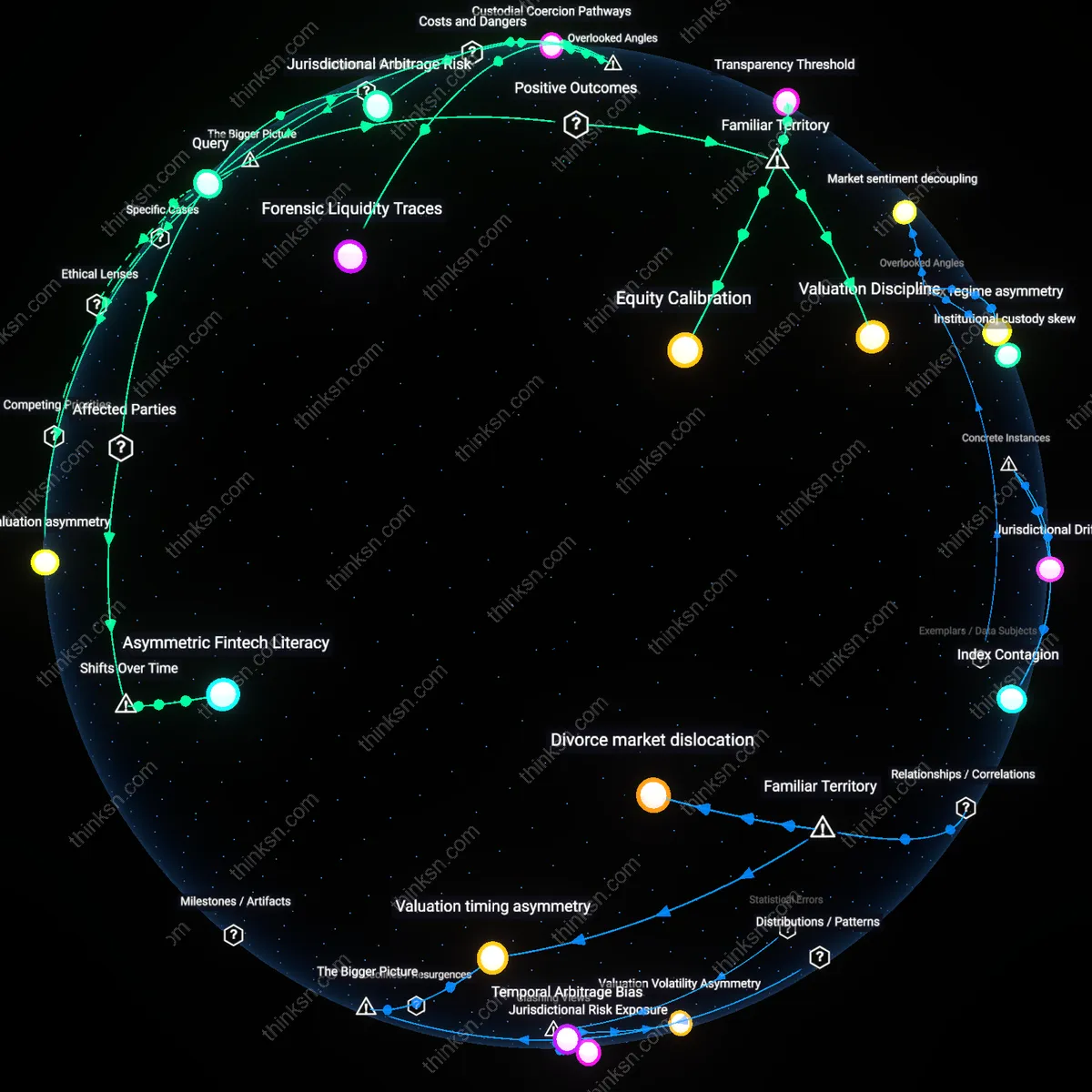
Analysis reveals 9 key thematic connections.
Key Findings
Judicial Valuation Lag
Cryptocurrency volatility forces family courts to rely on static valuation snapshots that fail to capture asset behavior between acquisition and divorce proceedings, disadvantaging spouses who lack technical fluency. Courts in jurisdictions like New York and California increasingly depend on third-party forensic accountants to fix values at specific dates—such as the date of separation—yet this legal fiction ignores the systemic price swings inherent in holding cryptocurrencies, privileging those who understand market timing or custody mechanics. The practice emerged prominently after 2017, when retail crypto adoption surged but judicial infrastructure did not, exposing a temporal misalignment between legal procedures and digital asset dynamics that now entrenches inequity under the guise of procedural fairness.
Asymmetric Fintech Literacy
The shift from traditional marital assets like real estate or retirement accounts to volatile, self-custodied cryptocurrencies after 2013 has amplified power imbalances between spouses differently positioned in relation to fintech knowledge. In dual-income households where one partner manages investments—often the husband in heteronormative cases—growing use of non-custodial wallets and decentralized exchanges enables unilateral control over valuation timing and liquidity events, rendering the other spouse dependent on disclosures that are opaque by design. This marks a departure from the transparency assumed in community property regimes, where equitable division relied on accessible, institutionally verified balances, and reveals how the erosion of shared financial visibility has reconfigured spousal agency in asset division.
Valuation asymmetry
Cryptocurrency volatility creates unequal asset division because fluctuating market prices during legal proceedings enable informational advantages to dictate outcomes. Divorce mediators and courts often rely on static valuation points—such as filing date or trial date—while real-time price swings mean spouses with technical access or earlier liquidation capacity can extract disproportionate value, particularly when one party lacks crypto literacy. This dynamic embeds inequity into settlements not through intent but through timing arbitrage enabled by decentralized, unregulated markets—making justice contingent on technological accessibility rather than financial transparency. The non-obvious insight is that legal systems treat assets as stable for procedural convenience, but crypto disrupts this assumption, privileging those who can anticipate or influence volatility timing.
Transparency Threshold
High cryptocurrency volatility forces real-time valuation during divorce proceedings, compelling courts to adopt blockchain analytics tools like those from Chainalysis or Elliptic to trace asset flows. This creates a de facto transparency threshold where hidden or understated holdings become harder to conceal, benefiting both parties by anchoring negotiations in verifiable data rather than estimates. While the public associates crypto volatility with risk, the underappreciated outcome is that this same instability disrupts informational asymmetry—a common friction point in asset division—thereby leveling the negotiating field.
Valuation Discipline
Spouses with crypto assets must engage forensic accountants or blockchain-savvy financial experts to timestamp valuations at precise moments, such as the date of separation, due to extreme price swings. This mandatory discipline introduces a more rigorous, evidence-based approach to marital asset assessment, replacing rough approximations with auditable records. Although lay discourse frames volatility as an obstacle, its constructive effect is the institutionalization of timing precision in financial disclosure, a practice that raises the evidentiary standard across divorce finance.
Equity Calibration
Cryptocurrency volatility exposes the inadequacy of fixed-amount settlements, pushing divorcing couples toward structured crypto-division frameworks like percentage-based splits or time-locked disbursements. These adaptive mechanisms recalibrate equity by preserving proportional fairness regardless of post-division price movements, aligning long-term outcomes with initial intent. Contrary to the common narrative that volatility undermines fairness, it actually incentivizes the design of dynamic settlement models that better honor equitable distribution principles in digitally diversified portfolios.
Forensic Liquidity Traces
Cryptocurrency volatility enables hidden patterns of asset dissipation that evade traditional forensic accounting in divorce proceedings because rapid price swings obscure the timing and intent behind transfers, creating plausible deniability for spouses moving wealth; this mechanism operates through blockchain’s pseudonymity combined with exchange-level data gaps, where minor wallet movements during high-volatility periods appear as market losses rather than deliberate withdrawals, a risk rarely considered in family court valuations. The non-obvious element is that volatility doesn’t just complicate valuation—it actively camouflages behavioral signals, transforming price noise into a concealment infrastructure.
Jurisdictional Arbitrage Risk
Cryptocurrency volatility incentivizes spouses to delay divorce filings in anticipation of price surges, thereby distorting procedural fairness by introducing speculative timing advantages that favor the party with ongoing control over digital wallets; this dynamic manifests in transnational marriages where one partner resides in a crypto-unfriendly jurisdiction and the other in a lax regulatory zone, creating an asymmetric window for unilateral liquidation ahead of legal scrutiny. The overlooked danger is not valuation volatility itself, but how it warps litigation timing into a high-stakes options market, where legal rights are de facto renegotiated by market momentum rather than equitable principles.
Custodial Coercion Pathways
Extreme cryptocurrency volatility can weaponize technical dependency in marital breakdowns, where the technically proficient spouse uses access barriers—such as encrypted keys or volatile multisig setups—to extract concessions during asset division, leveraging the other’s fear of total loss amid price swings; this operates through the intersection of emotional pressure and technical gatekeeping, where even temporary inaccessibility can be framed as irreversible financial risk, compelling unequal settlements. The underrecognized cost is that volatility amplifies power imbalances not through value changes alone, but by transforming technical control into coercive leverage during negotiation windows when time sensitivity is artificially heightened.