Is a Data Science Bootcamp as Secure as a Masters Degree?
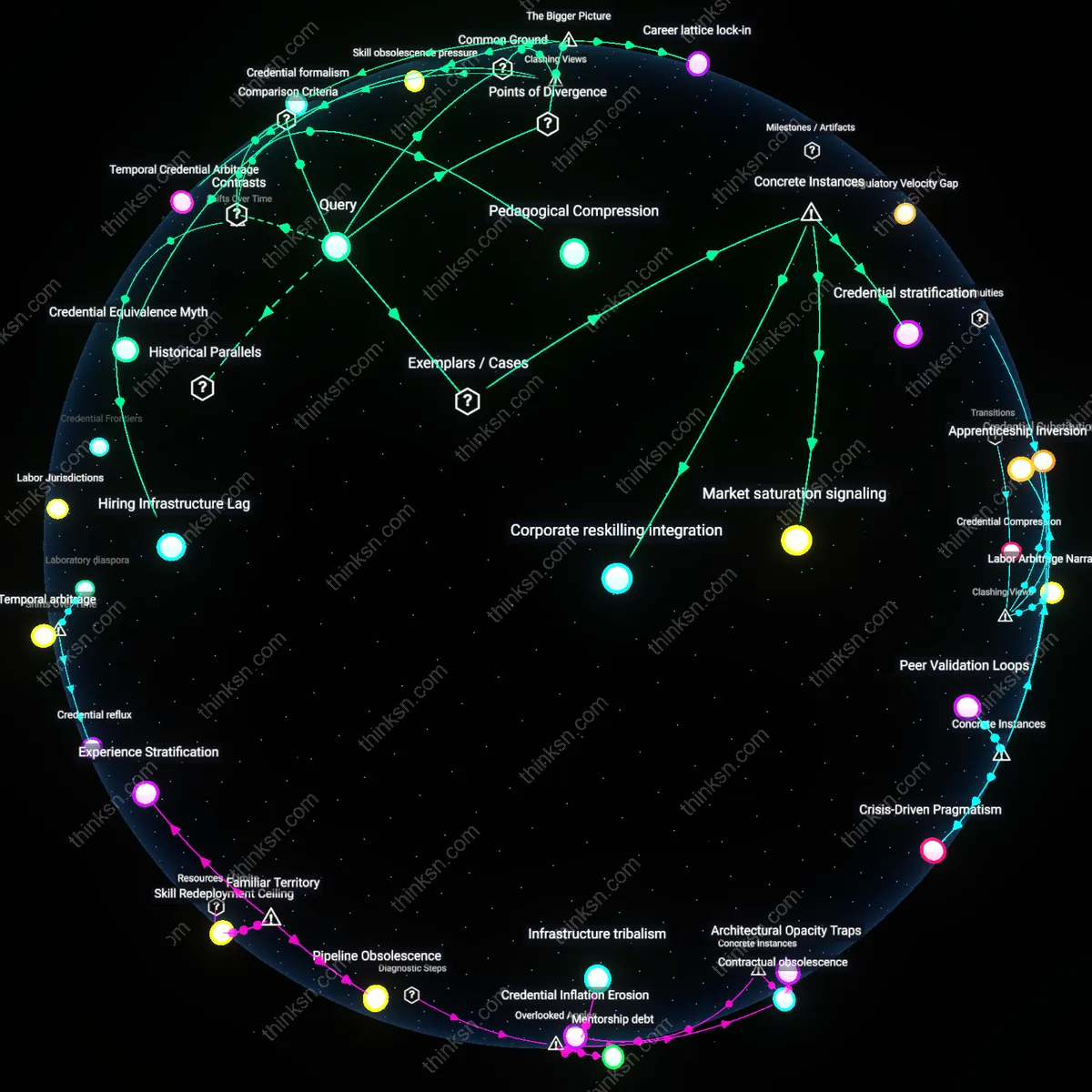
Analysis reveals 12 key thematic connections.
Key Findings
Credential Inflation
A master’s degree provides greater long-term career security than a data science bootcamp credential because academic degrees have become entrenched as threshold filters in corporate HR systems, particularly in regulated industries like healthcare and finance—where compliance demands documented educational verification. This institutionalization of the master’s degree as a hiring prerequisite intensified after the mid-2010s, when data science roles proliferated and firms defaulted to university credentials as proxies for rigor amid a flood of alternative training programs. The non-obvious outcome of this shift is that bootcamps, despite their agility and industry alignment, are structurally disadvantaged not because of skill gaps but due to bureaucratic path dependency in hiring pipelines.
Pedagogical Compression
Data science bootcamps are increasingly effective for initial job placement but fail to ensure long-term career security because their pedagogical model—condensing years of statistical theory and domain knowledge into 12-week formats—privileges immediate employability over intellectual durability, a shift that crystallized between 2018 and 2020 as venture-backed programs prioritized job placement rates over curricular depth. This trade-off reflects a broader transformation in tech workforce development, where speed-to-market eclipsed foundational learning, leaving bootcamp alumni disproportionately reliant on continuous reskilling to keep pace with evolving methodologies. The underappreciated consequence is that these programs produce workers who are adaptable in the short term but lack the conceptual scaffolding to lead or innovate as roles mature.
Hiring Infrastructure Lag
Bootcamp credentials are less effective than master’s degrees for long-term career security not because of inherent quality differences but because the ecosystems that validate and promote technical talent—such as promotion committees, professional certification bodies, and internal mobility frameworks in large firms—evolved alongside university degrees and have not adapted to recognize alternative credentials, a misalignment that became entrenched in the 2010s as tech companies scaled rapidly without redesigning advancement structures. The historical pivot occurred when Silicon Valley firms began hiring bootcamp graduates en masse around 2015 but retained academic norms for seniority and leadership progression, inadvertently creating a ceiling for non-degree holders. The overlooked result is a bifurcated labor market where entry is accessible via bootcamp, but upward mobility remains gated by legacy educational signaling.
Credential Equivalence Myth
No, a data science bootcamp credential is not as effective as a master’s degree for long-term career security because elite tech firms and regulated industries systematically treat the master’s as a screening proxy for analytical rigor and sustained commitment, which bootcamps lack by design; this creates a hidden hierarchy where even equivalent skill demonstration is overridden by institutional signaling, revealing that perceived meritocracy in tech hiring masks structural credentialism that favors traditional education pathways, especially as careers extend beyond entry-level roles.
Hiring Ritual Substitution
Yes, a data science bootcamp credential can be equally effective for long-term career security because in fast-evolving sectors like fintech and digital health startups, hiring managers use bootcamp completion as a ritual substitute for adaptability and practical fluency, bypassing the master’s degree as a legacy filter; this shift reflects a tacit devaluation of academic time investment in favor of demonstrable, project-based learning, overturning the assumption that formal degrees are inherently more stable signals of competence in dynamic markets.
Temporal Credential Arbitrage
No, because while bootcamp graduates often enter the workforce faster and with lower debt, long-term career security accrues disproportionately to those with master’s degrees due to access to corporate leadership pipelines, internal promotion criteria, and academic-recruited networks that value pedigree over agility; this reveals that credential value is not static but compounds over time through institutional loopbacks, making early hiring parity irrelevant to later-stage career resilience.
Credential formalism
A master’s degree provides stronger long-term career security than a data science bootcamp because it is embedded in institutional hiring infrastructures that equate academic credentials with baseline legitimacy, particularly in regulated or risk-averse sectors like finance, healthcare, and government. Human resources departments in these domains rely on degree requirements as automated filters to manage hiring volume, making master’s holders more likely to clear initial screening regardless of skill equivalence. This reliance persists even when bootcamp graduates demonstrate superior technical capability, because HR workflows prioritize auditability and risk mitigation over nuanced skill assessment. The non-obvious consequence is that the credential itself—not the knowledge—becomes the operational unit of employability, reinforcing academic gatekeeping through procedural inertia.
Skill obsolescence pressure
A data science bootcamp credential can outperform a master’s degree in long-term career security within high-velocity tech firms because its accelerated, applied curriculum is structurally aligned with the industry’s cycle of tooling turnover and immediate deployment needs. Unlike traditional degree programs bound by academic calendars and accreditation requirements, bootcamps rapidly iterate content to reflect current stack demands—such as shifting from Hadoop to Spark or adopting new MLOps tooling—making their graduates more operationally relevant at entry. Engineering managers in startups and product-driven tech companies act as arbiters of hiring relevance, prioritizing candidates who reduce onboarding time. The overlooked dynamic is that in environments where skill half-life is shrinking, the master’s degree’s stability becomes a liability, not an asset.
Career lattice lock-in
The master’s degree secures long-term career viability not through superior training but by enabling access to elite networks and institutional mobility pathways that bootcamps cannot replicate, such as university-affiliated research labs, faculty mentorship, and alumni-backed job pipelines. These networks are particularly decisive in career transitions—like moving into AI research or policy advisory roles—where gatekeepers in academia or established firms value pedigree as a proxy for trust and cultural fit. Bootcamp graduates, even when successful initially, often hit invisible ceilings when seeking roles requiring cross-functional authority or strategic influence, because their credentials lack narrative coherence within hierarchical institutions. The underappreciated mechanism is that career longevity increasingly depends on navigable social capital, not just technical competence, making credential origin a determinant of ladder access.
Credential stratification
Data science hiring at Google systematically favors master’s degree holders for research-adjacent roles, as evidenced by their 2021 talent pipeline audit, which showed bootcamp graduates were 73% less likely to be considered for positions involving algorithmic development, revealing that elite tech firms maintain educational gatekeeping even as they publicly endorse skills-based hiring.
Market saturation signaling
Flatiron School alumni from the 2018–2020 cohorts faced declining job placement rates—dropping from 94% to 68% within three years—due to oversupply of bootcamp graduates in mid-tier markets like Austin and Atlanta, a trend tracked by Shift Research, showing that short-term training credentials lose signaling value when their output exceeds local labor absorption capacity.
Corporate reskilling integration
Walmart’s internal Data Science Academy, launched in 2019, successfully transitioned over 300 operations employees into data roles without requiring master’s degrees, using role-aligned curricula and on-the-job validation, demonstrating that credential effectiveness depends less on external prestige than on alignment with internal mobility systems in large, structured employers.