Why Workers Miss FMLA Retaliation Claims Despite Protection?
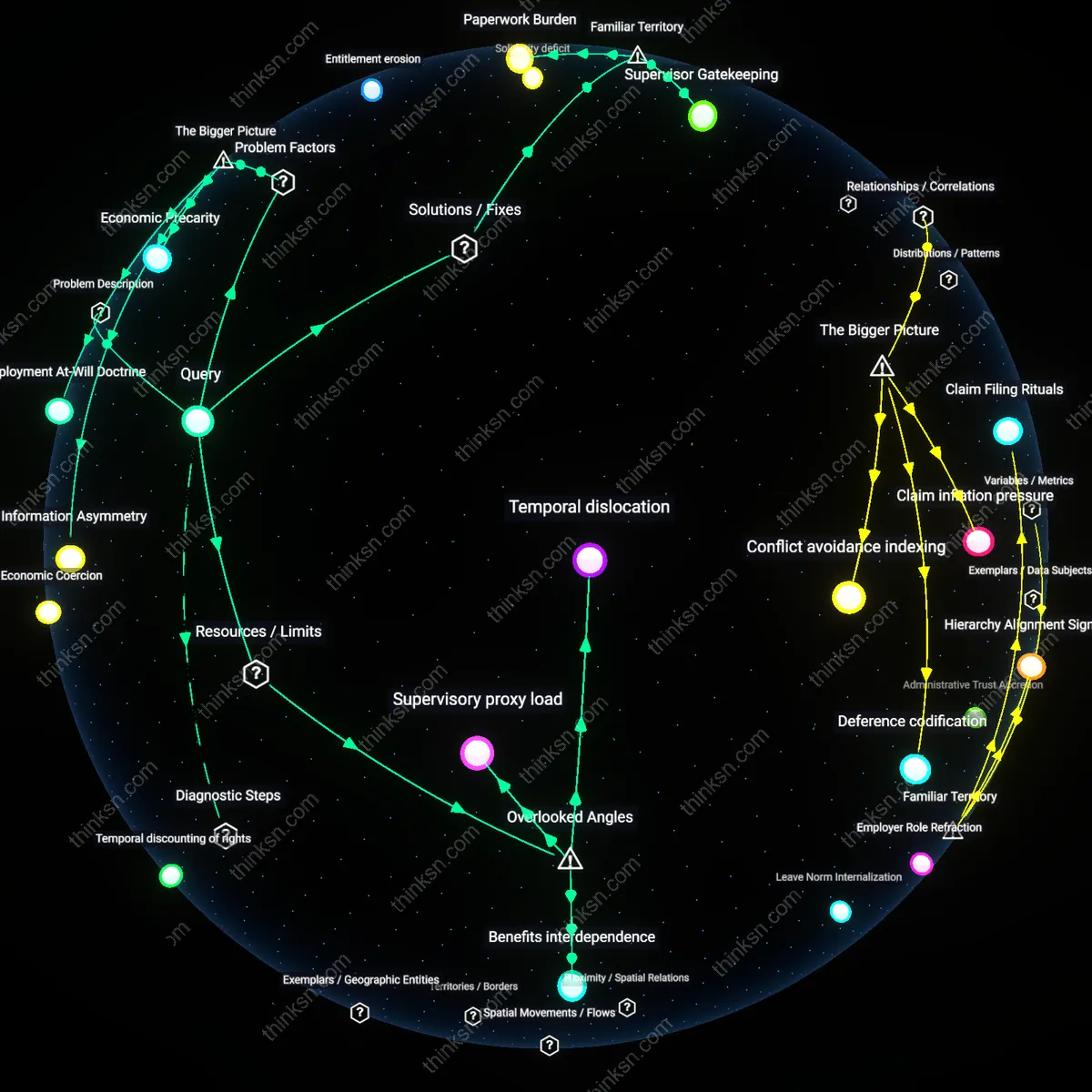
Analysis reveals 10 key thematic connections.
Key Findings
Information Asymmetry
Workers at a poultry processing plant in rural Georgia did not file FMLA retaliation claims because supervisors actively withheld information about leave eligibility, controlling access to HR forms and discouraging questions—demonstrating how employers in high-turnover, low-wage industries exploit employees’ lack of knowledge about procedural rights, making legal protections functionally inaccessible even when formally available. This reveals that the enforcement of labor rights depends not just on law, but on the distribution of information within hierarchically rigid workplaces.
Economic Coercion
After giving birth, a home healthcare worker in Detroit returned to work prematurely despite chronic complications because her employer replaced her during her approved leave and implied future absences would lead to job loss—illustrating how the threat of economic precarity overrides legal assurances, especially in sectors where replacement labor is plentiful and enforcement mechanisms are slow, distant, or retaliatory by design. This mechanism exposes that statutory rights become hollow when survival depends on uninterrupted employment, irrespective of legal standing.
Procedural Burden
In a 2017 case involving employees of a regional freight company in Ohio, workers abandoned plans to file FMLA complaints after being required to submit overlapping documentation from doctors, supervisors, and payroll offices within narrow deadlines—revealing how complex administrative demands act as structural deterrents, particularly for hourly workers without institutional support. This reflects a broader pattern where procedural complexity substitutes for outright denial, allowing systems to maintain legal compliance while deterring actual use.
Employment At-Will Doctrine
The persistence of at-will employment in most U.S. states enables employers to terminate or sideline workers through pretextual justifications, making retaliation claims exceptionally difficult to prove even when protections exist. Managers operate under implicit norms that tolerate thin pretexts for adverse actions, and supervisors leverage performance reviews, attendance histories, or organizational restructuring as legally defensible shields against allegations. This dynamic is rarely challenged because the doctrine normalizes power imbalances, framing corporate discretion as neutral management rather than a systemic enabler of retaliation, thus obscuring the causal link between exercising FMLA rights and job loss.
Economic Precarity
Workers in low-wage or hourly sectors avoid filing FMLA claims due to immediate economic risk, where even a short-term disruption in pay or assignment can trigger housing or food insecurity, rendering legal rights abstract compared to survival priorities. This is especially acute in industries like retail, hospitality, and home healthcare, where staffing models depend on just-in-time labor and discretion to reassign hours functions as an informal penalty. The underappreciated reality is that retaliation need not be overtly punitive—it can emerge through incremental reductions in shifts or denial of preferred scheduling, mechanisms that are economically punitive but legally invisible, thereby deterring claims not through fear of illegality but through rational risk aversion.
Paperwork Burden
Simplify FMLA claim filing through standardized, employer-provided forms. Human resources departments routinely distribute complex, legally dense paperwork that employees must complete to initiate or maintain FMLA claims, a process that disproportionately affects hourly, low-wage, or non-college-educated workers who lack legal literacy or time bandwidth; automating form generation through integrated payroll systems like ADP or Workday—pre-filled with employment and medical eligibility data—would reduce drop-off rates by embedding administrative support directly into the workflow. Most people associate FMLA issues with job insecurity or employer retaliation, overlooking how the mundane friction of form-filling functions as a silent deterrent—more structural than malicious, yet just as effective in blocking claims.
Supervisor Gatekeeping
Mandate third-party notification of FMLA requests to bypass immediate supervisors. Workers commonly report fearing backlash from direct managers—individuals who control scheduling, performance reviews, and informal workplace culture—and thus delay or abandon claims even when legally protected; rerouting initial FMLA notifications through a centralized HR portal or insurer rather than requiring supervisor approval interrupts this power imbalance. Public discussion typically frames retaliation as overt punishment, but the more routine issue is preemptive self-censorship due to relational dependency—the worker already knows how their boss will react, so they don’t file at all. Removing the supervisor as a procedural gate converts an interpersonal risk into an impersonal transaction.
Temporal dislocation
Workers fail to file FMLA retaliation claims because the delay between leave approval and retaliatory acts stretches memory and causality beyond recognized claim windows. Managers may schedule adverse actions—like undesirable shifts or denied promotions—months after FMLA use, exploiting the psychological and legal difficulty of linking distant events; this time lag obscures retaliation patterns in workers’ minds and undermines contemporaneous documentation. This mechanism is rarely acknowledged in compliance training or enforcement, which assumes retaliation is immediate and visible, not incrementally embedded in bureaucratic workflow over time—thus disabling workers’ ability to perceive actionable harm.
Benefits interdependence
Workers avoid filing FMLA retaliation claims when doing so risks jeopardizing other tightly coupled employment benefits, such as health insurance, remote work privileges, or childcare subsidies that are administratively linked but legally distinct from FMLA. In municipal and healthcare sectors, for instance, requesting leave triggers automated reviews that may prompt employers to reassess an employee’s entire benefits package, creating a chilling effect where workers tacitly accept retaliation to preserve broader support structures. This dependency is structurally invisible in anti-retaliation frameworks, which treat FMLA claims as isolated legal events rather than nodes in an ecosystem of conditional entitlements.
Supervisory proxy load
Frontline supervisors, especially in decentralized retail and logistics, absorb informal pressure to maintain productivity metrics after an employee takes leave, leading them to penalize returnees through subtle scheduling or performance distortions without explicit orders—penalties workers recognize as retaliation but cannot trace to decision-makers with legal liability. Since these actions emerge from distributed operational strain rather than top-down directives, they evade documentation and attribution required for claims, especially when HR systems only track formal disciplinary actions. This diffuse accountability, rooted in operational overburden rather than malice, is absent from retaliation models that presume intentional, hierarchical misconduct.