How Should Courts Plan for Custody When Relocation Is Constant?
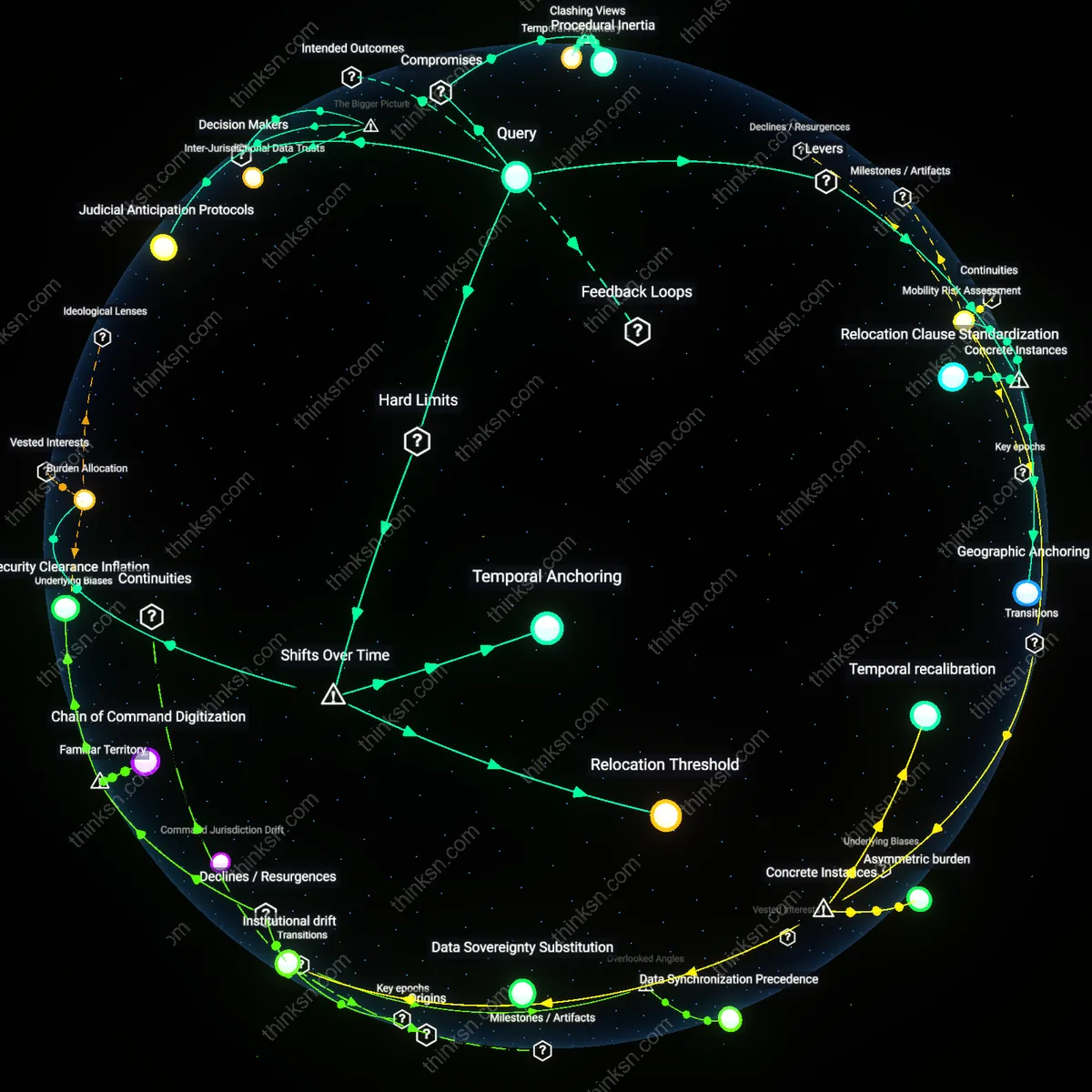
Analysis reveals 11 key thematic connections.
Key Findings
Relocation Threshold
Courts must set a fixed geographic boundary beyond which a parent’s move triggers automatic reevaluation of custody, because mobility patterns since the 1990s—fueled by job market fluidity and digital labor—have destabilized static parenting frameworks. This mechanism operates through state-specific family court rules, such as those in California’s Uniform Child Custody Jurisdiction and Enforcement Act (UCCJEA) implementations, which now embed distance-based triggers for modification hearings. What is underappreciated is that this shift marks a departure from mid-20th century assumptions of residential stability, replacing moral judgments about parental fitness with spatial quantification as the primary regulatory tool.
Temporal Anchoring
Courts should embed milestone-based review points into initial parenting plans—such as a child’s entry into kindergarten or adolescence—because the historical shift from rigid custodial awards to developmental-stage-sensitive jurisprudence since the 1980s reframed children’s needs as temporally dynamic. These anchor points function within court-ordered mediation cycles, requiring reassessment not at the parent’s initiative but according to a pre-established timeline tied to the child’s age, as seen in evolving practices in Minnesota’s district courts. This approach reveals how family law has moved from treating custody as a one-time decision to managing it as a time-structured process, making the child’s developmental trajectory the central scheduling authority.
Burden Allocation
Courts must assign the legal and evidentiary burden of relocation justification to the mobile parent at the outset of custody proceedings, because the late-20th century expansion of dual-income households and long-distance job mobility transformed relocation from an exceptional event into a foreseeable conflict vector. This condition operates through pre-trial parenting plan submissions, where jurisdictions like Colorado require anticipated moves beyond 50 miles to be accompanied by third-party evidence of necessity, such as employment contracts or housing records. The non-obvious implication is that this shift inverts traditional neutral posture, preemptively treating mobility not as a personal right but as a disruption requiring anticipatory justification—marking a doctrinal transition from balance to burden.
Relocation Clause Standardization
Courts should embed court-ordered relocation notice protocols with defined thresholds for distance and frequency directly into initial parenting plans, as demonstrated by Minnesota’s statutory requirement under Minn. Stat. § 518.175, which mandates 60-day advance notice and geographic restrictions unless waived. This mechanism compels proactive planning by conditioning future mobility on judicial review or mutual consent, embedding enforceable procedural barriers that prevent unilateral disruption of custody—revealing that standardization of notice and distance triggers in court decrees acts as a preventive institutional safeguard rather than a reactive remedy.
Mobility Risk Assessment
Courts should require employment-linked mobility audits during custody hearings when one parent holds a job with high relocation risk, such as in military or oil industry contracts, modeled on the U.S. Department of Defense’s Family Care Plan requirement for service members undergoing deployment. By mandating documented child care continuity plans in high-mobility professions, courts can operationalize anticipatory risk adjustment in parenting time allocation—showing that integrating occupational mobility profiles into judicial evaluations transforms custody planning from static scheduling to dynamic risk-informed decision-making.
Geographic Anchoring
Courts should establish jurisdictionally bounded custody zones centered on a child’s school district or primary residence, as practiced in Colorado’s 'home base' precedent in In re Marriage of Ciesluk (2005), where the court restricted parental relocation beyond a 50-mile radius absent compelling justification. This lever uses spatial jurisprudence to stabilize custodial logistics by legally tethering parenting plans to fixed geographic nodes, demonstrating that court-imposed territorial constraints function as infrastructural anchors against destabilizing mobility.
Judicial Anticipation Protocols
Family courts should mandate mobility impact assessments during initial custody determinations to proactively adjust parenting plans. Judges, supported by court-appointed child welfare experts, can require documentation of each parent’s relocation history and employment mobility patterns, integrating this into best-interest evaluations under existing state family codes—such as California’s Section 3011—where continuity of stable environments is prioritized; this institutionalizes foresight within discretionary decision-making, making courts not just reactive arbiters but preemptive architects of stability. What is underappreciated is that courts possess latent authority to operationalize predictive behavioral data without legislative changes, transforming episodic custody disputes into systemic risk mitigation through procedural design.
Parental Mobility Licensing
State legislatures must authorize family courts to impose conditional relocation privileges in initial parenting orders, tied to demonstrable stability benchmarks. By creating a legal mechanism akin to a ‘mobility license’—where a parent seeking frequent moves must prove minimal disruption to the child’s education, health, and social ties through verifiable records—lawmakers enable courts to bind future conduct within the original decree, leveraging the state’s parens patriae authority to preempt instability. The non-obvious insight is that custody enforcement often fails not from poor rulings but from unenforceable expectations; attaching administrative conditions to mobility reshapes parental incentives through credible downstream penalties, shifting behavior before disruption occurs.
Inter-Jurisdictional Data Trusts
Interstate judicial coordination through shared custody mobility databases can trigger automatic review clauses in parenting plans when relocation thresholds are met. State courts, operating under the Uniform Child Custody Jurisdiction and Enforcement Act (UCCJEA), can activate protocols with regional partners—such as those in the Interstate Compact on Child Custody and International Parental Kidnapping—that flag repeated cross-district moves and prompt mediation or plan modification before acrimony escalates. The overlooked dynamic is that jurisdictional fragmentation enables custody by attrition; a shared data infrastructure turns isolated rulings into a continuous governance system, where information flow becomes the regulatory mechanism that sustains enforceable co-parenting frameworks.
Procedural Inertia
Courts should delay finalizing custody terms until relocation patterns are empirically observable, requiring provisional arrangements that bind both parties during an evidence-gathering period. This approach treats geographic instability as a behavioral trait revealed over time, not an anticipated intent, and leverages temporary parenting plans with neutral third-party monitoring—such as family courts in King County, Washington’s 12-month “transitional custody” docket—that convert into permanent arrangements only after mobility stabilizes. By refusing to preemptively adjudicate based on stated intentions, courts avoid optimizing for administrative finality at the cost of factual accuracy, exposing how standard risk assessments wrongly equate future mobility with proven disruption when the greater harm lies in locking in arrangements that preclude reevaluation.
Temporal Asymmetry
Courts should assign asymmetric custody durations—granting the relocating parent extended but infrequent visitation blocks while preserving the stability of the child’s school-term routine with the non-relocating parent—thereby accommodating mobility without fragmenting daily continuity. This model, piloted in Minnesota’s District 4B, treats time, not space, as the primary resource to be allocated, allowing the mobile parent to maintain influence through concentrated engagement (e.g., six-week summer custody) while insulating the child from transitional friction during academic periods. It defies the dominant spatial logic of custody—which assumes equal access requires geographic parity—revealing that equal parental impact does not require equal frequency, and that optimizing for logistical symmetry actively undermines developmental consistency.