Six-Month Threshold: Why Hospice Enrollment Timing Matters?
Analysis reveals 5 key thematic connections.
Key Findings
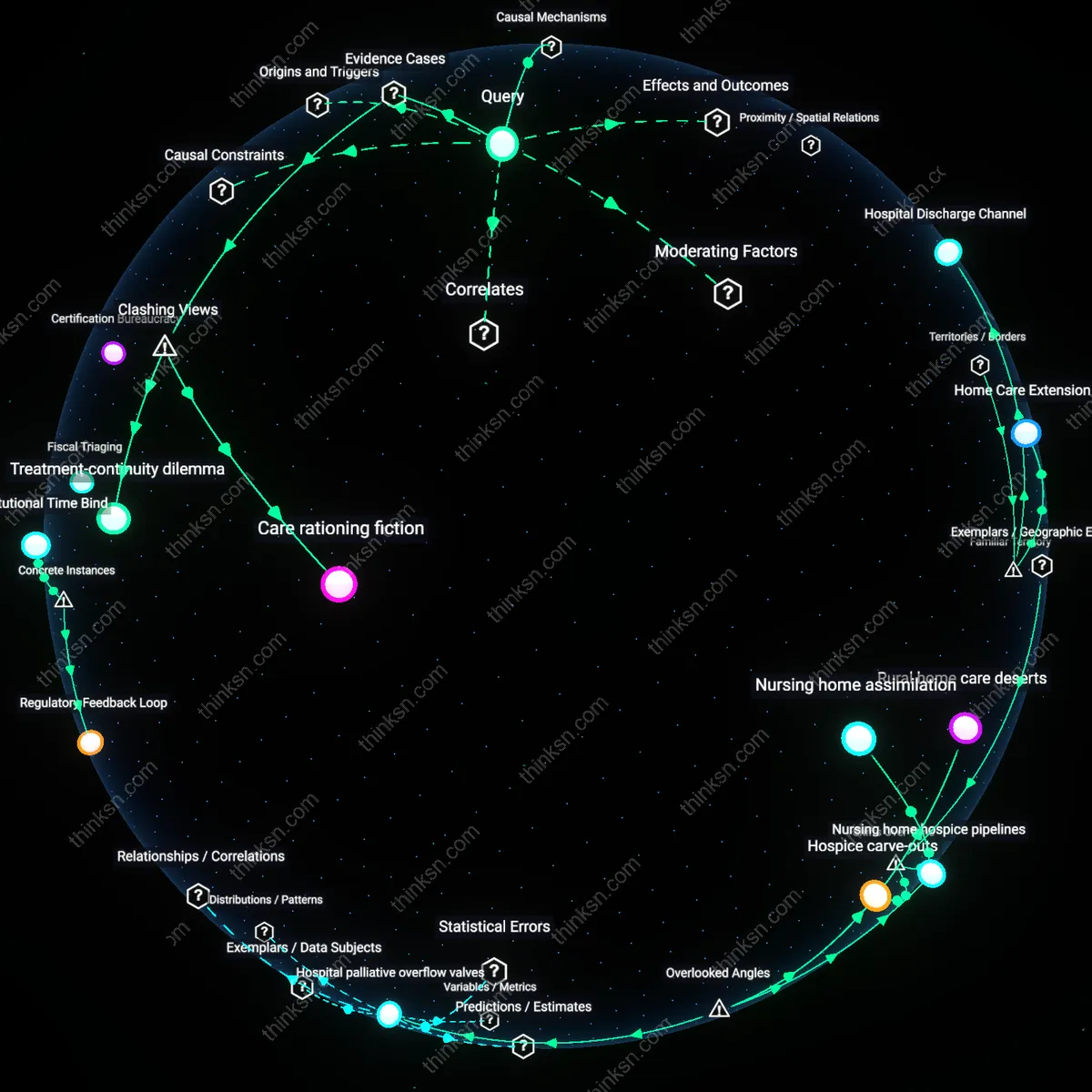
Certification gatekeeping
The Medicare six-month rule causes physicians to delay hospice referrals by acting as a de facto gatekeeper due to clinical uncertainty and professional risk aversion. Physicians, particularly in hospitals and oncology settings, interpret the requirement as a high-stakes binary judgment, fearing premature certification could jeopardize reimbursement or invite regulatory scrutiny, thus they withhold referrals until decline is unmistakable. This mechanism reflects how a policy designed to ensure appropriate use becomes a behavioral bottleneck, revealing that the rule’s administrative rigor unintentionally compresses clinical discretion into a single, high-threshold decision point—what is underappreciated is that the gatekeeping function emerges not from the rule’s wording but from its interaction with malpractice concerns and institutional incentives.
Temporal misalignment
The six-month requirement distorts the timing of hospice enrollment by forcing a prognostic prediction that mismatches the trajectory of non-cancer illnesses like heart failure or dementia. Unlike cancers with more predictable decline, these conditions involve cyclical deterioration, making it difficult for clinicians to confidently certify eligibility until very late in the disease course. This systemic misalignment between bureaucratic time (fixed, linear eligibility windows) and biological time (non-linear, episodic decline) generates downstream delays in access, exposing how the rule privileges diseases with clear prognostic arcs—what is rarely acknowledged is that the misalignment isn’t just clinical but structural, rooted in Medicare’s original hospice design around terminal cancer patterns.
Administrative prognosis
Hospice enrollment is driven less by clinical judgment than by Medicare's administrative demand for a six-month prognosis, which forces physicians to perform speculative futurecasting under pressure to align with billing rules. At institutions like the University of California, San Francisco Medical Center, oncologists report certifying terminal status not because they can predict death but because the hospice benefit requires it for access to palliative resources, turning prognosis into a bureaucratic compliance act rather than a medical assessment. This shift reveals how reimbursement structures reshape clinical language and timing, making the physician an agent of program eligibility rather than prognostic authority.
Care rationing fiction
The six-month rule functions not as a guideline but as a covert rationing mechanism that delays hospice referral until patients are too near death to benefit, as seen in the precipitous rise of hospice enrollments in the final seven days of life among Medicare Advantage plans in Florida and Arizona. Providers delay certification not due to uncertainty but to avoid forfeiting curative billing streams, exposing how the rule enables cost containment under the guise of clinical caution. This contradicts the assumption that late enrollment stems from emotional resistance, revealing instead a systemic economic disincentive masked as prognostic prudence.
Treatment-continuity dilemma
Patients and families interpret the six-month certification as a declaration of treatment abandonment, causing rejection of hospice even when medically appropriate, as observed in rural Tennessee clinics where withdrawal of chemotherapy is culturally conflated with physician surrender. The requirement thus acts as a symbolic threshold that disrupts perceived continuity of care, pushing families to seek marginal interventions rather than accept palliative focus. This shows the rule’s influence is not merely procedural but semiotic—its power lies in what it signifies, not what it mandates, upending the view that access barriers are purely logistical or informational.