Funding Chasm
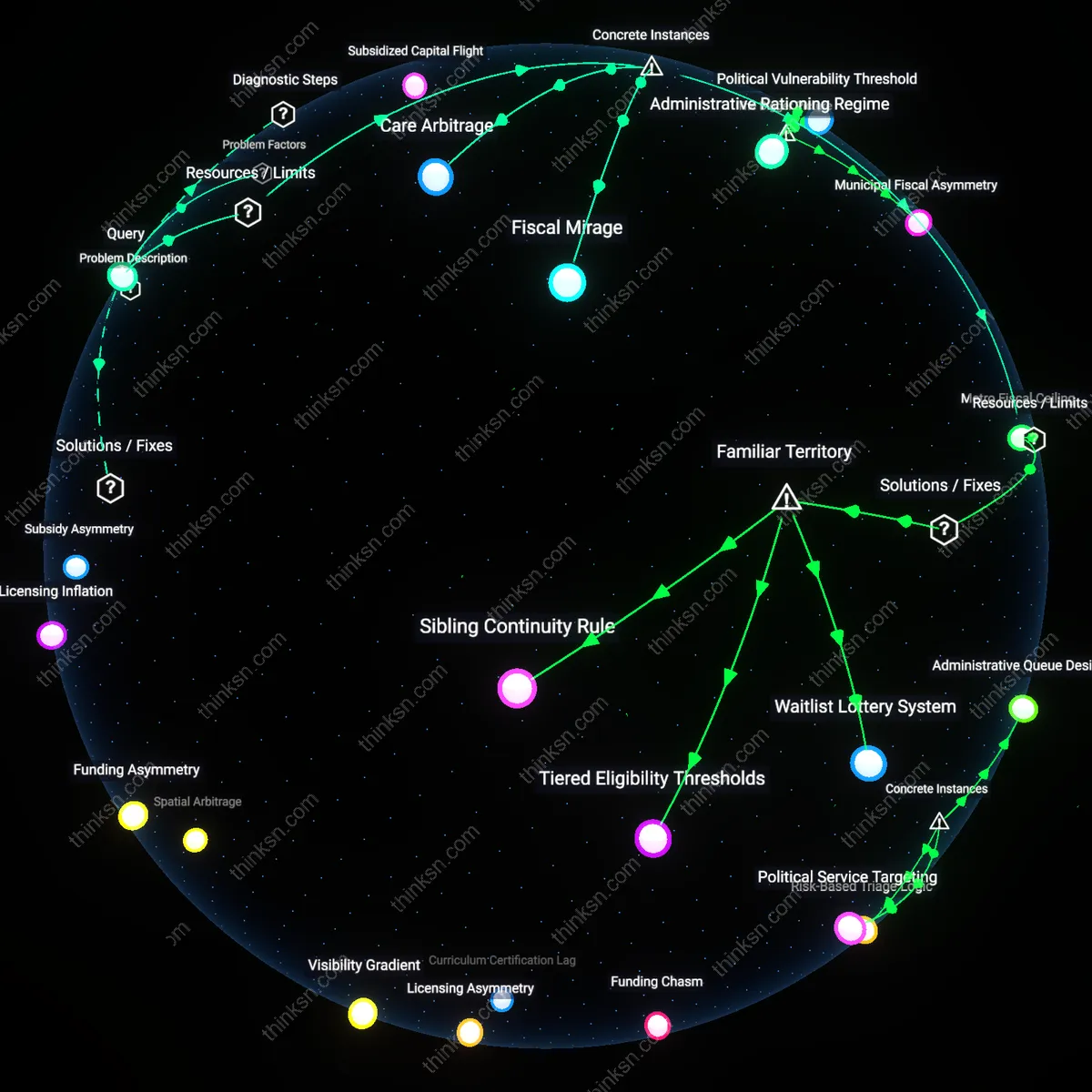
Corporate daycares benefit from economies of scale and centralized budgeting, leading to higher reported expenditures per child that correlate with licensed staff ratios and facility standards. Communities repeatedly observe that big-brand centers appear in wealthier neighborhoods with polished environments, reinforcing the belief that superior inputs directly explain cost differences. The non-obvious truth underneath this familiar pattern is that government subsidies and tax structures amplify these disparities—not by accident, but through funding formulas that disproportionately reward corporate compliance over community capacity, making the cost gap appear merit-based when it is structurally reinforced.
Licensing Asymmetry
Licensing requirements act as a filter that systematically disadvantages community-based providers attempting to scale, even when their service quality matches corporate peers. Most people associate official regulation with safety and consistency, trusting that licensed facilities meet a uniform bar—this familiarity obscures how application costs, inspection frequency, and paperwork burdens fall more heavily on small operators without administrative back offices. The underappreciated point is that the licensing system itself creates a statistical distribution where community centers cluster just below thresholds to avoid compliance overhead, making their lower funding appear voluntary rather than coerced by procedural design.
Visibility Gradient
Corporate daycares dominate public perception because their branding, location, and recruitment shape what families find through online searches or real estate listings, creating the illusion that higher cost equals default quality. The familiar association—clean buildings, professional websites, tuition reimbursement partnerships—masks the reality that many community providers offer comparable services with less visibility due to exclusion from municipal referral networks and digital directories. The overlooked mechanism is not differences in actual service depth but uneven access to institutional channels that determine who gets seen, turning obscurity into a functional economic barrier despite parallel capabilities.
Funding Asymmetry
The cost difference between corporate and community-based daycares is strongly correlated with unequal access to capital, where corporate providers systematically secure lower-cost financing due to creditworthiness and scale, enabling investment in efficiency and brand-driven demand that community-based providers cannot match. This correlation is reinforced by municipal zoning and subsidy distribution systems that inadvertently privilege multi-site operators through streamlined approvals, making the relationship between ownership structure and operational cost self-amplifying. The non-obvious implication is that licensing barriers are less decisive than financial architecture—capital flows, not regulatory complexity, are the binding constraint. Downstream, this entrenches a two-tier system where community providers serve residualized populations despite comparable service quality, revealing how market concentration in early childhood education is financially engineered rather than operationally justified.
Licensing Inflation
The cost gap expands not because corporate daycares offer superior services but because licensing frameworks are structured around facility-scale compliance, inadvertently taxing community-based providers through per-site administrative and infrastructure costs. Since regulations often mandate facility-wide features (e.g., separate outdoor play areas, staff-to-room ratios per building) that cannot be shared across locations, small operators absorb disproportionate fixed costs per child, a burden magnified when public funding ties reimbursement to costly compliance rather than outcomes. What is underappreciated is that these rules emerge from safety and equity intentions but are co-opted by market actors to justify premium pricing—corporate chains absorb compliance costs across clusters, repositioning them as 'quality markers' rather than baseline requirements. This transforms regulatory equivalence into a price wedge, illustrating how risk-minimizing policy becomes a de facto entry barrier.
Licensing Geography
Differences in state-level zoning regulations for facility size directly inflate infrastructure costs for community-based daycares in urban areas, making compliance disproportionately expensive compared to corporate chains that can cluster centers in lower-regulation zones. Municipal variance in square-foot-per-child mandates—such as New York City’s 35 sq ft minimum versus rural Maine’s 20—forces small providers to lease more expensive space or reduce enrollment, widening the cost gap independently of service quality. This overlooked spatial stratification in licensing enforcement reveals how local land-use policy, not funding access or pedagogy, distorts operational parity, skewing comparative analyses that assume uniform regulatory burden.
Insurer Shadow Pricing
Workers’ compensation insurance premiums for community-based daycares are systematically marked up due to risk pooling under small nonprofit associations, whereas corporate chains self-insure or negotiate group rates through national brokers, creating a hidden cost differential unrelated to actual safety records. In Ohio, for example, home-based providers in federally recognized networks pay 22% more per covered employee than corporate counterparts with identical claims histories, distorting the baseline cost structure before services are delivered. This non-obvious transfer of risk costs through private insurance architecture undermines the assumption that funding disparities alone explain affordability gaps.
Curriculum Certification Lag
Community-based daycares face multiyear delays in adopting state-subsidized curricula due to retroactive reimbursement cycles, forcing them to absorb interim material and training costs that corporate equivalents pass through vendor contracts. In California’s QRIS system, only 38% of Black-led community programs achieved full curriculum certification within two years of eligibility, versus 76% of corporate affiliates using pre-negotiated Bright Horizons partnerships. This residual delay cost—originating in asymmetric access to credentialing pipelines—introduces a temporal tax on equity, recalibrating how we interpret apparent service-level disparities.
Subsidy Asymmetry
The 1996 welfare reform expansion of federal childcare block grants to states systematically privileged large-scale providers with established infrastructure, enabling corporate daycares like KinderCare to absorb regulatory compliance costs that smaller community-based providers in cities such as Detroit or Oakland could not, making funding access—rather than service quality—the decisive cost driver. As public reimbursement rates stagnated while corporate chains leveraged economies of scale post-1996, the gap in operational viability widened despite equivalent licensing standards, revealing how structural eligibility criteria embedded in federal-to-state funding flows produce cost divergence even without service differentiation.
Credential Inflation
After California’s 2005 childcare staffing regulations mandated associate degrees for lead teachers—a policy adopted incrementally across urban centers like Los Angeles and San Diego—corporate centers could draw from centralized HR systems and training pipelines to meet requirements, while community-based providers relying on experienced but non-degreed elders or bilingual caregivers faced closure or cost pass-throughs. This shift exposed how licensing regimes, initially framed as quality equalizers, became mechanisms of exclusion only after credentialing standards were weaponized in accreditation processes, turning human capital policy into a silent cost multiplier that disproportionately burdened grassroots providers.
Spatial Arbitrage
When New York City rezoned Manhattan’s Hudson Yards in the 2010s to include privately operated, state-subsidized childcare slots, developers like Related Companies leveraged public land leases and tax abatements to offset operational costs that standalone community centers in the Bronx lacked, creating a two-tier system where proximity to real estate capital—not pedagogical offerings—determined cost structure. The post-2010 urban redevelopment era transformed physical location into a hidden subsidy vector, revealing how zoning decisions and public-private development deals, not service content, became central to cost divergence between nominal equivalents.