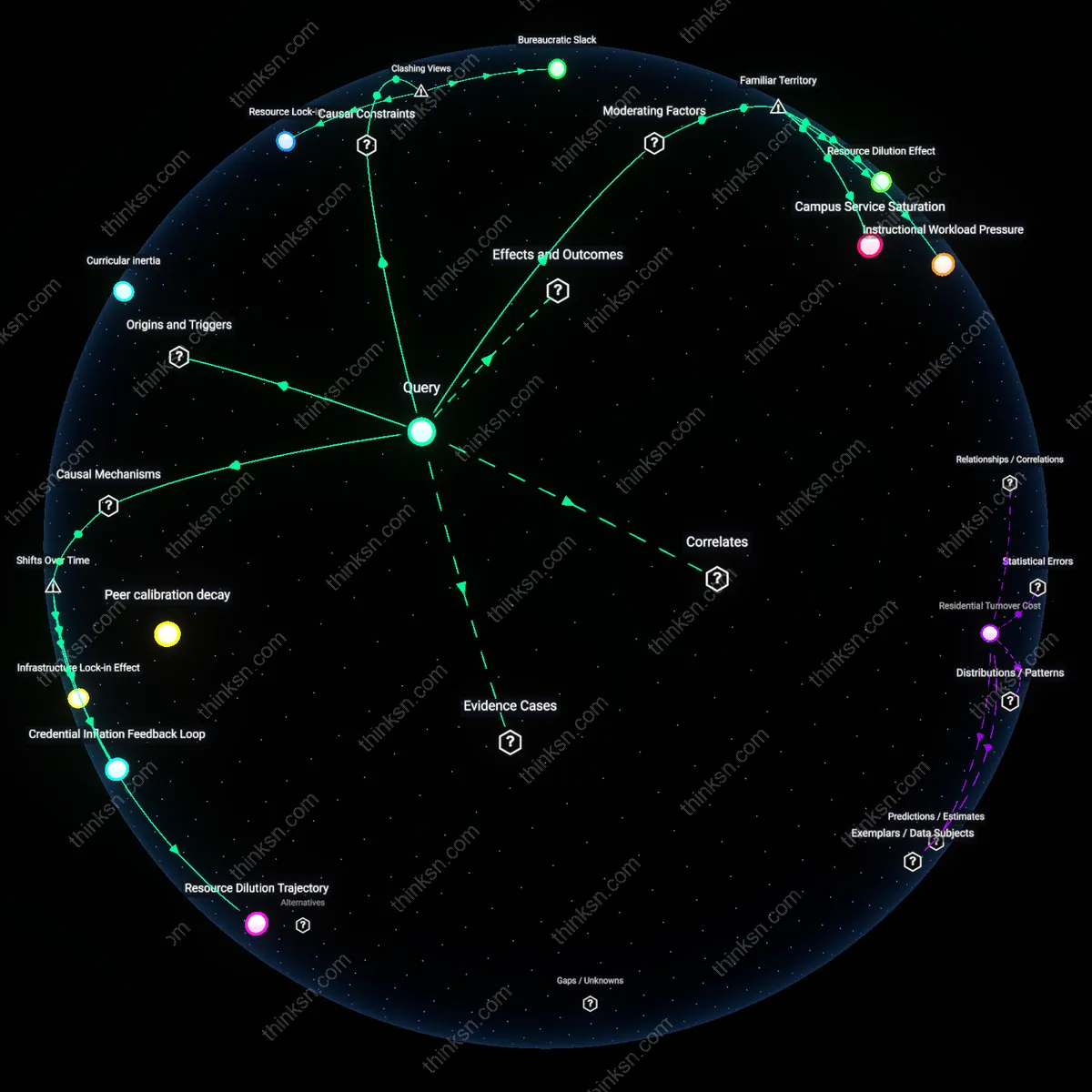
Expanding Enrollment: Does Quality Suffer for Current Students?
Analysis reveals 12 key thematic connections.
Key Findings
Curricular inertia
Expanding enrollment at a public university degrades educational quality for current students by freezing curriculum design in outdated configurations due to fixed faculty workloads and accreditation timelines. As student numbers rise, departments rely on existing course templates and syllabi to scale instruction, even when those materials are misaligned with emerging fields or pedagogical advances, because redesign requires time and approval cycles that lag behind enrollment shifts. This institutional drag—where curricular updates move on multi-year academic calendars while enrollments shift annually—means growing cohorts are served by increasingly obsolete educational frameworks, a dynamic rarely accounted for in capacity planning. The overlooked mechanism is not just resource dilution but the temporal misalignment between administrative rhythm and educational relevance.
Peer calibration decay
Increased enrollment reduces educational quality for current students by eroding the precision of peer assessment networks that undergird high-level learning in seminars, labs, and collaborative projects. In tightly enrolled programs, students develop fine-grained understandings of each other’s intellectual styles, enabling nuanced feedback, efficient group work, and competitive motivation—all of which depend on relational density. When enrollment expands, these peer networks thin, degrading the quality of informal learning scaffolds that faculty cannot replicate. This deterioration of epistemic peer calibration is invisible in metrics like class size or funding ratios but fundamentally alters the cognitive environment, revealing that educational quality depends not only on inputs but on the topology of student interaction.
Infrastructure latency
Enrollment growth compromises educational quality for current students by overloading non-classroom institutional systems—such as advising, mental health services, and laboratory equipment scheduling—that have fixed response capacities and long lead times for expansion. At universities like Ohio State or UC Davis, these backline operations are managed through legacy IT systems and bureaucratic protocols that cannot scale rapidly, causing delays in academic guidance, worsening student stress, and bottlenecks in degree progress. Because quality is experienced in these moment-to-moment interactions rather than in lecture halls alone, the delayed modernization of support infrastructure creates a 'service shadow' where expanded access undermines the coherence of the educational experience. The critical underappreciated factor is that scalability is not uniform across institutional functions.
Resource Dilution Trajectory
Expanding enrollment without proportional increases in instructional resources reduces per-student access to faculty and academic support, degrading educational quality for current students. This mechanism emerged decisively after the 1980s, when public disinvestment in higher education shifted cost-bearing to institutions, which responded by growing enrollments to maintain revenue—transforming student-faculty ratios from stable to strained across state university systems. The non-obvious insight is that quality erosion is not an accidental byproduct but a structurally incentivized outcome of fiscal substitution, where declining state appropriations are counterbalanced by operational expansion under fixed budgets.
Credential Inflation Feedback Loop
Rapid enrollment growth normalizes degree attainment, prompting students and employers to treat additional credentials as baseline requirements, thereby increasing pressure on universities to scale further. This shift crystallized in the 2000s with the massification of higher education, where expanded access—originally intended to promote equity—became a driver of competitive credentialism, altering institutional priorities from depth of learning to throughput efficiency. The overlooked consequence is that educational quality for current students diminishes not through immediate resource loss but via a redefinition of academic rigor, as curricula adapt to accommodate larger cohorts chasing devalued outcomes.
Infrastructure Lock-in Effect
Enrollment expansion locks universities into legacy systems of course delivery and assessment designed for scalability, displacing seminar-based and mentorship-intensive pedagogies that defined mid-20th century public education. This transition accelerated after 2010, as budget-constrained administrations adopted digital platforms and standardized gen-ed requirements to manage growing class sizes, privileging administrative efficiency over academic customization. The underappreciated shift is that quality degradation is not simply about crowding but about the irreversible institutional entrenchment of industrialized teaching models, which displace the very mechanisms through which deep learning was historically sustained.
Resource Dilution Effect
Yes, expanding enrollment at a public university risks reducing educational quality for current students because increased student numbers strain fixed resources like classroom space, faculty office hours, and lab equipment. As more students compete for the same infrastructure, per-student access diminishes, particularly in high-demand majors where lab time or seminar seats are limited. The non-obvious insight is that this dilution occurs even when the university maintains student-faculty ratios through adjunct hiring—because hands-on learning depends on physical capacity, not just headcount ratios, making lab bottlenecks or library congestion the real constraint.
Instructional Workload Pressure
Yes, expanding enrollment threatens educational quality because faculty are expected to teach larger sections or additional courses without proportional support, eroding time for mentorship, feedback, and curriculum development. In departments that lack contingency plans for growth—like engineering or computer science—tenure-track faculty are often reassigned to teaching over research, weakening course innovation and student engagement. The underappreciated reality is that educational quality degrades not from class size alone, but from the invisible drain on faculty capacity to respond individually, which students associate with academic rigor and belonging.
Campus Service Saturation
Yes, expanding enrollment risks lowering educational quality because student-facing services such as academic advising, counseling, and career support operate at capacity even before growth, and scaling them lags behind enrollment increases. When thousands of new students enter a system designed for fewer, wait times for mental health appointments or transfer advising grow, directly impacting retention and academic performance. What's rarely acknowledged in public debate is that declining service responsiveness hits current students hardest—since they lose priority access to shrinking appointment slots and peer mentorship programs now redirected to onboarding newcomers.
Resource Lock-in
Expanding enrollment at a public university does not reduce educational quality because fixed capital infrastructure—like classroom seats, laboratory equipment, and faculty teaching loads—acts as a regulatory bottleneck that prevents additional students from accessing services beyond system capacity. Universities must secure supplementary appropriations or reallocate existing funds to expand these constrained assets, meaning growth only proceeds when quality-preserving resources are also expanded. This reveals that budgetary and infrastructural inertia, not enrollment numbers, governs service dilution—contrary to the intuitive belief that more students automatically degrade quality.
Peer Learning Premium
Increasing enrollment enhances educational quality for current students by amplifying the density and diversity of peer-to-peer learning networks, which are causal prerequisites for high-level academic engagement in seminar-based and collaborative disciplines. In majors like computer science and political theory at institutions such as the University of California system, upper-division courses rely on critical mass to generate argumentative dynamism and project-based teamwork—more students raise the floor for intellectual exchange. This challenges the scarcity model of education, showing that in knowledge-production contexts, students are not merely consumers but inputs whose presence improves the educational good.
Bureaucratic Slack
Enrollment expansion reduces quality only when administrative systems lack the procedural flexibility to scale advising, registration, and mental health services in tandem—yet in state systems like Ohio’s public universities, centralized IT infrastructure and unionized staff contracts create delay mechanisms that decouple headcount growth from service delivery. The real bottleneck is not teaching capacity but administrative synchronization, where rigid workflow protocols prevent timely adaptation. This inverts the common faculty-centric view of quality, exposing that organizational rigidity in non-academic units poses a greater threat than student numbers.