Do Online Degrees From Elite Universities Truly Democratize Access?
Analysis reveals 6 key thematic connections.
Key Findings
Credential Stratification
Elite universities expanding online degrees without relaxing admissions standards will reproduce exclusivity, as demonstrated by MIT’s selective MicroMasters program in Supply Chain Management, which admits fewer than 10% of applicants despite being online—revealing a mechanism where digital access is gated by scarcity-inducing filters, thereby preserving elite credential value by design rather than broadening participation. The non-obvious insight is that online scalability is not inherently democratizing when quality signaling depends on artificial selectivity.
Resource Mismatch
Stanford Online’s partnership with 2U maintains identical admissions criteria to its on-campus programs, resulting in enrollments dominated by affluent professionals from urban centers like San Francisco and New York, not rural or low-income learners—exposing a mismatch between technological reach and actual accessibility when hidden costs (time, tech, fees) persist, undermining geographic and socioeconomic expansion despite digital delivery. The overlooked factor is that identical standards ignore structural disparities in preparedness and bandwidth beyond institutional control.
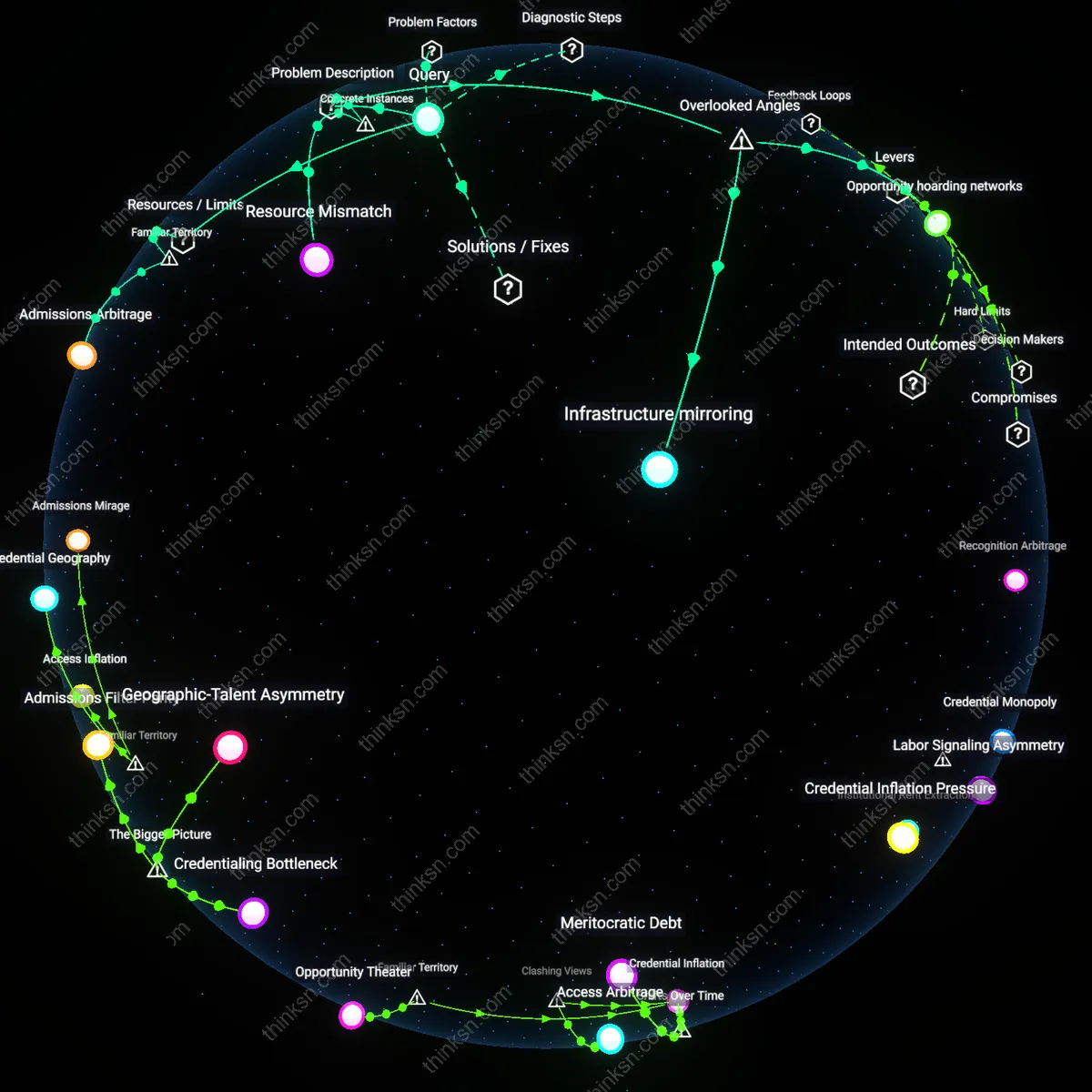
Infrastructure mirroring
Online degree expansion at elite institutions fails to democratize access because the digital learning infrastructure replicates the hidden curricula and interactional norms of elite campuses, disadvantaging students unfamiliar with academic cultural codes. This occurs through seminar-style expectations, asynchronous participation metrics, and communication styles that align with middle- and upper-class academic socialization—systems often invisible to designers but critical for success. The non-obvious insight is that pedagogical architecture, not just admission gates, enforces exclusion; equitable access requires more than lowering entry barriers, it demands decoupling learning design from class-specific behaviors embedded in elite education. Most analyses miss that the medium itself carries covert elitism.
Opportunity hoarding networks
Even with online delivery, elite universities enable existing student networks to monopolize access to internships, mentorship, and job referrals, ensuring that credential holders from privileged backgrounds retain disproportionate outcomes. The mechanism functions through exclusive alumni platforms, faculty advising bottlenecks, and co-curricular gatekeeping that remain closed to remote or non-traditional students despite identical coursework. This dynamic is overlooked because democratization debates focus on enrollment rather than outcome ecosystems; the real advantage of elite education lies not in lectures but in embedded social capital that online formats do not redistribute. Thus, the same standards perpetuate inequality not through academic rigor, but through unshared access to advancement machinery.
Credential Gatekeeping
Online degree expansion at elite universities will not democratize access if admissions standards remain unchanged because selective admissions reproduce existing social hierarchies by filtering applicants through measures like standardized test scores and legacy preferences that correlate strongly with wealth and elite schooling. These standards function as cultural and economic filters, meaning that even when instruction is scaled online, access to the credential remains restricted to those already positioned within privileged educational pipelines. The non-obvious implication under familiar discourse is that the degree’s value is not in the learning itself but in the exclusivity of admission, which maintains elite status through scarcity rather than instructional quality.
Admissions Arbitrage
Elite universities maintain their prestige by calibrating admissions to reflect scarcity, so expanding online enrollment without lowering standards effectively reserves digital access for applicants who already meet traditional markers of merit—high GPA, test scores, and extracurricular distinction—most of which are cultivated through costly enrichment resources. This means online programs become a parallel track for the same socioacademic elite, merely delivered remotely, not a diversification mechanism. The overlooked reality is that meritocratic criteria are not neutral gates but engines of continuity, reproducing advantage under the guise of fairness, thereby converting online scalability into a new form of selective arbitrage rather than inclusion.