Are Annual Lung CT Scans Worth It for Non-Smokers?
Analysis reveals 11 key thematic connections.
Key Findings
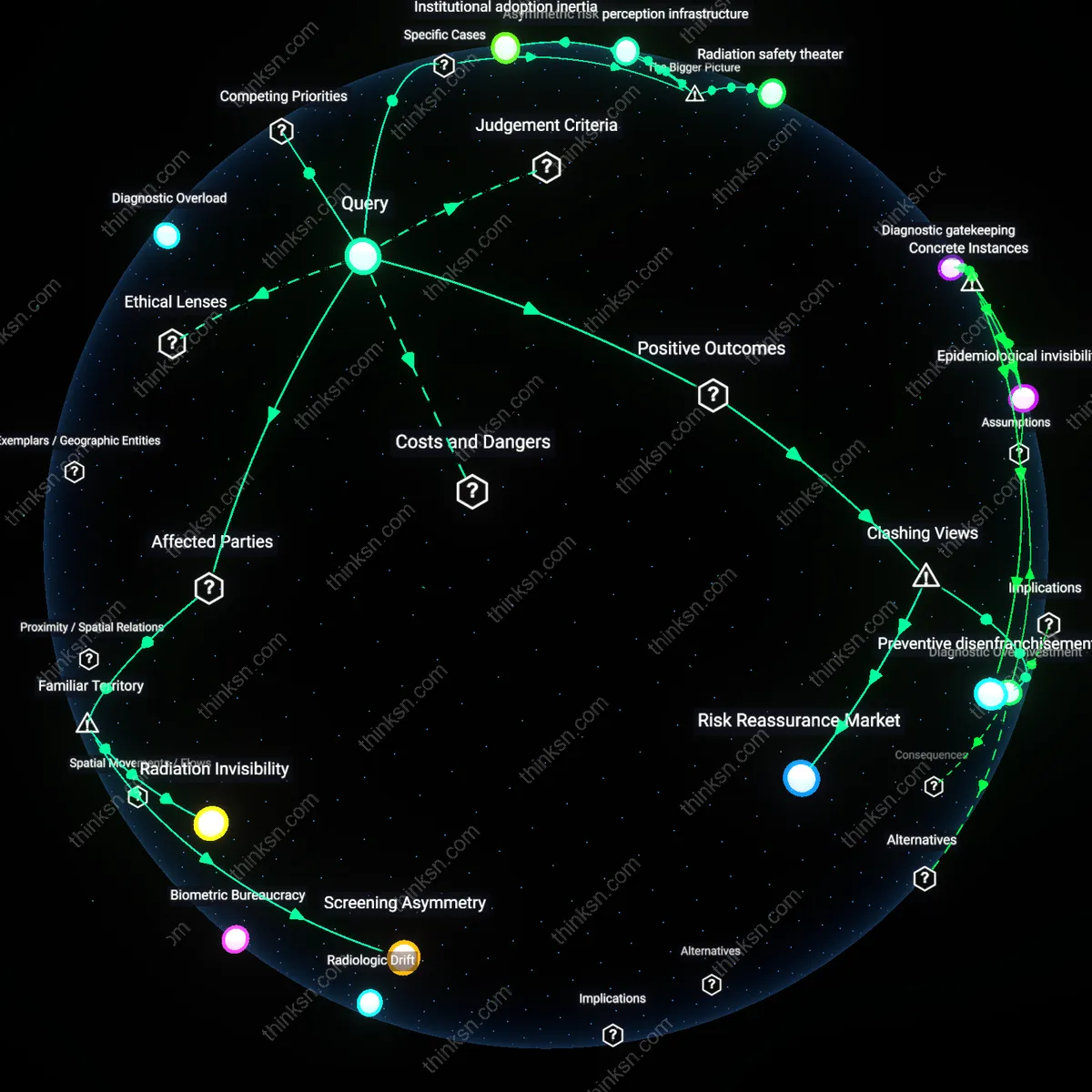
Screening Asymmetry
It is irrational for nonsmokers without risk factors to undergo annual low-dose CT scans because public health infrastructure amplifies lung cancer visibility in smokers, making incidental detection in low-risk populations feel like progress even when net harm outweighs benefit. Radiology departments, influenced by patient demand and institutional protocols optimized for high-risk cohorts, extend standardized screening pathways beyond their validated scope, mistaking availability for appropriateness. The non-obvious insight under familiar concern about ‘early detection’ is that the system rewards the act of scanning—measured as quality metric compliance—more than it tracks outcomes, creating a procedural incentive that bypasses individual risk calculus.
Radiation Invisibility
It is irrational to accept annual radiation exposure from CT scans without a smoking history because cumulative ionizing radiation operates as a silent contributor to long-term cancer risk, a hazard structurally downplayed in medical culture shaped by acute over chronic trade-offs. Oncologists, radiologists, and patients habitually credit immediate diagnostic gains while deferring radiation consequences as statistical abstractions, embedded in epidemiological models rather than tangible patient stories. The familiar belief in ‘safe’ imaging masks how linear-no-threshold risk accumulates invisibly across populations, particularly affecting younger, healthier individuals for whom latency dilutes accountability.
Anxiety Cascade
It is irrational to pursue low-dose CT scans annually without smoking history because the detection of indolent nodules frequently triggers cascading patient harm through biopsies, specialist referrals, and surveillance loops that reframe health as a state of pending threat. Primary care providers, responding to patient anxiety amplified by media-driven narratives of ‘cancer caught in time,’ become conduits for interventions that pathologize normal variation. The familiar cultural script of vigilance as virtue obscures how medical systems monetize and institutionalize worry, transforming a single scan into an identity of sustained risk-monitoring that benefits care systems more than the patient.
Diagnostic Overinvestment
It is rational for insured individuals in high-income countries to pursue annual low-dose CT scans despite negligible personal mortality benefit because the financial alignment between radiology departments, health systems, and insurer reimbursement models rewards frequent imaging. This dynamic is reinforced in the U.S. Medicare system, where LDCT lung cancer screening is codified as a covered preventive service with minimal patient cost-sharing, creating a structural incentive for providers to promote screening even among never-smokers with low baseline risk. The non-obvious reality is that rationality here is not driven by clinical need but by institutional economics that valorize procedural volume over outcome specificity.
Risk Reassurance Market
It is rational for affluent, health-anxious individuals to undergo annual low-dose CT scans without smoking history because the primary utility is not early cancer detection but the consumption of symbolic reassurance in a commercial wellness economy. In urban private clinics across cities like London and Singapore, such scans are marketed as executive health checkups, commodifying vigilance as a status good—where undergoing scans functions as a performative act of control. This reveals that medical rationality is being displaced by experiential consumption, where the perceived benefit lies in temporary relief from existential uncertainty rather than biological longevity.
Diagnostic Overload
The U.S. Veterans Health Administration's rollout of routine low-dose CT screening for lung cancer in non-smoking veterans with environmental exposures created unintended diagnostic cascades, where indeterminate nodules triggered invasive follow-ups despite low malignancy risk. This system, designed to enhance early detection, instead amplified false-positive outcomes that consumed clinical resources and induced patient harm—revealing how the pursuit of biological security through surveillance can overload medical decision-making capacity. The non-obvious insight is that population-level risk mitigation can degrade individual clinical precision when applied beyond evidence-based cohorts.
Radiation Tradeoff Horizon
Japan’s post-Fukushima thyroid screening program, which extended ultrasound surveillance to children in Fukushima Prefecture regardless of exposure level, demonstrated how radiation fear can drive imaging policies that inadvertently impose cumulative diagnostic radiation risks. Although intended to reassure the public, the program normalized frequent scans that, when scaled, produced a cohort burden of iatrogenic radiation exposure disproportionate to detected pathology. This illustrates how the political imperative for reassurance distorts risk calculus, privileging symbolic safety over long-term physiological tradeoffs in preventive medicine.
Preventive Resource Capture
The UK’s NHS decision to restrict low-dose CT screening to high-risk smokers under the Lung Health Check program excluded non-smokers despite anecdotal early-detection successes, reflecting an explicit rationing of imaging capacity to preserve equity and cost-effectiveness. By prioritizing limited radiology infrastructure for those with proven mortality benefit, the NHS allowed potential missed cases in low-risk populations to occur—demonstrating that system-wide access constraints force preventive programs to exclude biologically plausible candidates in favor of epidemiologically efficient ones. The underappreciated reality is that preventive justice often operates through deliberate omission to sustain collective utility.
Institutional adoption inertia
It is rational for individuals to pursue annual low-dose CT scans in South Korea, where national health policy expansion after 2016 unintentionally amplified overdiagnosis through publicly subsidized access, because regional cancer centers in Seoul and Busan rapidly integrated screening into routine check-ups without corresponding mortality reductions. This mechanism persists due to structural incentives in Korea’s bonus-covered preventive care model, which rewards volume of screenings over outcomes, revealing how state-backed health initiatives can entrench medical practices even when evidence for population-level benefit is weak. The non-obvious element is that rationality here stems not from individual risk assessment but from systemic alignment of provider incentives, patient expectations, and state financing.
Asymmetric risk perception infrastructure
It is rational for affluent nonsmokers in cities like San Francisco to undergo annual low-dose CT scans because private concierge clinics frame preventive imaging as a form of biosecurity, leveraging patient anxiety about late-stage cancer detection in an environment where direct-to-consumer marketing bypasses traditional gatekeeping by primary care. This dynamic is amplified by tech-sector wellness culture, which treats data-driven surveillance as inherently rational, thereby decoupling medical decision-making from epidemiological risk and attaching it to personal control paradigms. The underappreciated force here is not medical necessity but a parallel healthcare ecosystem where risk is redefined through consumer identity rather than population statistics.
Radiation safety theater
It is irrational for nonsmokers in the UK to request annual low-dose CT scans despite availability through private providers, because NHS Public Health England actively suppresses expansion of screening outside smoking cohorts by emphasizing cumulative radiation risk, a stance institutionalized through NICE guidelines that condition legitimacy on demonstrable mortality reduction in randomized trials. This creates a disciplinary regime where radiologists and GPs act as gatekeepers, prioritizing systemic risk calibration over individual preference, thereby making personal pursuit of scans socially and professionally transgressive. The overlooked mechanism is that rationality in healthcare is not just evidence-based but normatively enforced through guideline-dependent professional accountability structures.