Sabbatical Risks: Staying Relevant While Exploring New Paths?
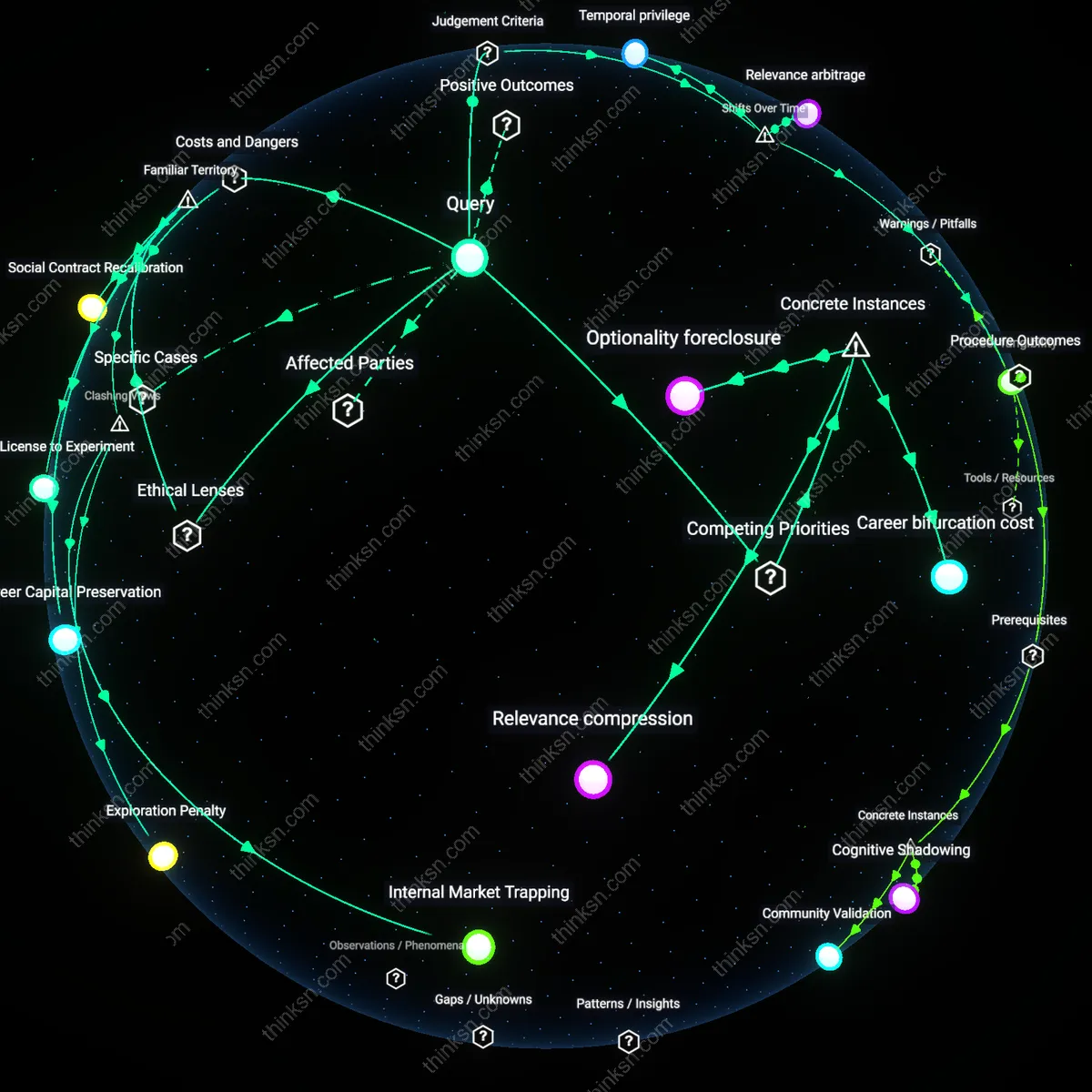
Analysis reveals 12 key thematic connections.
Key Findings
Career fungibility
A professional in their early 40s should evaluate sabbatical risk by measuring the degree to which their accumulated expertise can be abstracted and redeployed across domains, because what was once a linear, industry-locked career trajectory has, since the 2000s gig economy shift, transformed into a portfolio model where skills are increasingly treated as modular assets; this mechanism—driven by platform labor markets, the decline of corporate paternalism, and credential unbundling—means that time away is less detrimental if one’s competencies can be linguistically and technically translated into new contexts. The non-obvious insight is that market relevance now hinges not on continuous employment but on the interoperability of one’s value units across ecosystems, a condition made visible by the post-employment transition in labor.
Temporal privilege
Professionals in their early 40s must assess sabbatical feasibility through the lens of life-stage leverage, recognizing that midlife represents a narrow window where financial obligations (e.g., peak mortgage or childcare costs) intersect with pre-retirement career plasticity, a dynamic intensified by the compression of adult development timelines since the 1980s; unlike previous generations who stabilized professionally by 35, today’s knowledge workers face extended trial periods due to rapid technological obsolescence, making the early 40s a pivot point where taking time out risks falling behind in credential accumulation but also offers last-chance agency to shift fields. The underappreciated reality is that this phase embodies a historically novel form of temporal privilege—late autonomy amid accelerating career senescence—produced by the decoupling of age norms from professional progression.
Relevance arbitrage
A sabbatical decision should be framed as an arbitrage between perceived and actual market relevance, because the shift from institutional validation to algorithmic visibility since the 2010s—where professional worth is increasingly determined by digital traces, network centrality, and content signaling rather than job titles—has created a discrepancy between offline idleness and online influence; one can, for example, use sabbatical time to build public thought leadership in a new domain while technically being on leave, thus exploiting asymmetries in how relevance is now calculated across traditional HR systems and attention economies. The key insight is not that time off erodes relevance but that differential pacing of evaluation regimes allows strategic decoupling, a phenomenon emergent from the institutional lag in recognizing non-linear career investments.
Skill Obsolescence Momentum
Taking a sabbatical to explore new fields actively accelerates the erosion of core professional competencies by removing the individual from the feedback loops of technological updates, industry networking, and performance calibration; in high-velocity sectors like fintech or AI-driven services, even a six-month absence severs continuity with iterative knowledge evolution, making re-entry not just difficult but misaligned with current demand structures. This mechanism operates through the compounding nature of skill depreciation—each month off multiplies the effort required to regain parity—rendering the sabbatical not a neutral pause but an active withdrawal from the professional ecosystem, a fact rarely acknowledged in career coaching narratives that romanticize 'exploration' without measuring its operational cost. The non-obvious reality is that relevance is not suspended during absence; it decays.
Internal Market Trapping
Remaining employed continuously to preserve market relevance traps professionals in an internal labor market where perceived loyalty is rewarded over adaptability, making lateral or transformative career moves structurally harder despite surface-level stability; organizations systematically devalue external exploration by equating tenure with trust, thus penalizing those who return from sabbaticals through subtle exclusion from high-visibility projects or algorithmic filtering in internal talent systems. This dynamic functions through HR analytics platforms that quantify 'risk' as deviation from employment continuity, meaning that the very act of staying relevant today programs irrelevance tomorrow when pivot becomes necessary. The dissonance lies in exposing that the safest path—staying put—is the one that most securely locks the worker into an obsolete trajectory.
Exploration Penalty
The decision to take a sabbatical for exploration is penalized not by formal policy but by informal reputation circuits in knowledge-intensive fields like management consulting, academia, or digital product design, where gaps in résumé are interpreted as signals of diminished ambition or competence, regardless of the sabbatical's content; peers, recruiters, and former colleagues rely on heuristic judgments that conflate continuity with capability, meaning that time spent learning outside institutional validation is socially inert or even suspect. This operates through referral-based hiring systems and promotion committees that lack frameworks to assess non-linear development, reinforcing a monoculture of career pacing that treats exploration as deviation rather than investment. The overlooked damage is that the sabbatical, framed as personal growth, becomes a reputational liability in ecosystems that reward conformity over curiosity.
Career bifurcation cost
A professional in their early 40s risks irreversible divergence from their core market position by taking a sabbatical, as seen when BBC senior producer Teleri Bevan left broadcasting in the late 1990s to focus on writing Welsh cultural histories—though she later published acclaimed works, her return to media leadership roles was structurally blocked by generational succession and format shifts, revealing that extended absence triggers an unacknowledged penalty where institutional memory erases individual precedent, making re-entry dependent not on past rank but on real-time network proximity.
Relevance compression
Staying continuously employed to preserve market relevance can erode exploratory capacity, as evidenced by IBM engineers in the early 2000s who avoided sabbaticals during the pivot from hardware to cloud services, only to find their deep-system expertise rendered inert when internal mobility favored hybrid-skilled hires from external startups—a dynamic where perceived security from continuous employment accelerated skill obsolescence because organizational evolution compresses the time window in which experience retains transfer value, turning retention into a stealth de-skilling mechanism.
Optionality foreclosure
Taking a sabbatical to explore new fields eliminates access to time-sensitive advancement tracks, exemplified by mid-level executives at Andersen Consulting in 1998 who deferred promotions to pursue academic fellowships just before the firm’s explosive equity-partner expansion—at a moment when two years of continuous billing determined eligibility, their absence disqualified them from capital shares despite equivalent performance, revealing that organizational tipping points invisibly synchronize with individual decision lags, turning deliberate exploration into permanent exclusion from wealth-generating structures.
Career Capital Preservation
A professional in their early 40s should prioritize maintaining market relevance because extended absence from core industry engagement risks depreciating human capital under neoclassical labor economics. Employers value continuity and current-sector experience, which aligns with the efficiency logic of competitive markets; gaps in employment are commonly interpreted as signals of diminished productivity or obsolescence, especially in fast-evolving fields like tech or finance. The non-obvious implication is that even a purpose-driven sabbatical may be perceived ethically as a failure to uphold one’s duty of self-investment under meritocratic norms—where individual responsibility for employability overrides exploratory freedom.
Moral License to Experiment
Taking a sabbatical to explore new fields can be justified as an act of moral autonomy, consistent with Kantian deontological ethics that emphasize personal growth as an end in itself. When professionals treat this period not as idleness but as a pursuit of rational self-conception—engaging in fields to test maxims of future action—they reclaim agency from instrumental labor systems. The underappreciated insight is that sabbaticals, though often seen as privileges of elite workers, become ethically defensible when construed as experiments in duty to one’s evolving identity, challenging the familiar framing of career continuity as the default moral obligation.
Social Contract Recalibration
A mid-career sabbatical should be evaluated through the lens of reciprocal obligation in implicit employment contracts, particularly as codified in European labor models like Germany’s *Mitbestimmung* (co-determination) regime, where long-term employment presumes mutual investment between worker and firm. In such contexts, temporary withdrawal for re-skilling can be interpreted as honorably fulfilling one's part in a dynamic contract—responding to structural changes in labor demand with responsible adaptation, not shirking. The overlooked reality is that in systems valuing vocational solidarity over pure market signaling, stepping back strategically reinforces, rather than weakens, social legitimacy.