Does 4% Withdrawal Hold at Age 70 Retirement?
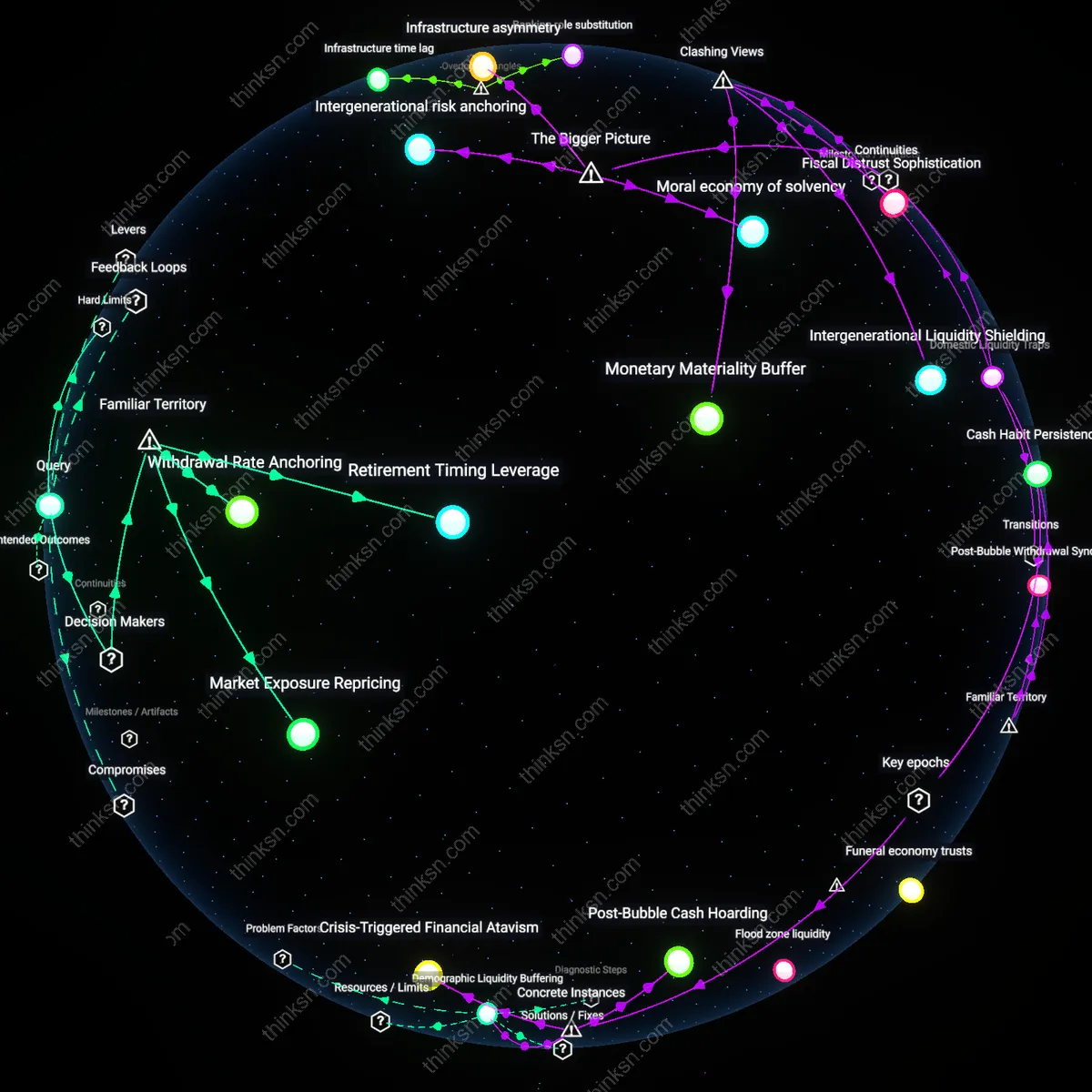
Analysis reveals 4 key thematic connections.
Key Findings
Liability Mismatch Risk
Delaying retirement to age 70 necessitates adjusting the 4% withdrawal rule because prolonged market exposure increases the risk of drawing from a depreciated portfolio during late-life downturns, as seen in Japan’s lost decade retirees who delayed retirement into the 2000s and faced near-zero equity returns; their extended market exposure without de-risking led to irreversible capital erosion upon withdrawal initiation, revealing that longevity in accumulation does not guarantee safety in distribution. This case underscores how delayed retirement can lock individuals into equity-heavy allocations beyond optimal horizons, converting supposed resilience into structural vulnerability when withdrawals finally begin.
Retirement Timing Leverage
Financial planners should adjust the 4% rule downward when retirement is delayed to age 70 because longer workforce participation amplifies compounding in tax-advantaged accounts, reducing the initial withdrawal burden relative to portfolio size. Institutions like the American College of Financial Services and advisory firms at Merrill Lynch standardize this adjustment through retirement income calculators that rebase withdrawal rates on accumulated balances and reduced longevity risk. The non-obvious insight within this familiar framework is that delaying retirement doesn’t just increase savings—it systematically alters the risk denominator in withdrawal strategies, a shift most retirees overlook when assuming a static 4% benchmark applies universally.
Market Exposure Repricing
Pension fund actuaries must recalibrate the 4% rule upward when retirement is delayed because prolonged market exposure from continued 401(k) contributions increases the statistical likelihood of equity resets before withdrawal onset. Entities like the Society of Actuaries and plan administrators at Vanguard incorporate sequence-of-returns models that treat age 70 as a risk inflection point, where extended volatility exposure demands higher buffer rates despite larger balances. What escapes common understanding is that more market years aren’t inherently safer—they concentrate risk into the transition year itself, making the first withdrawal more vulnerable than later ones, even with greater assets.
Withdrawal Rate Anchoring
Regulatory bodies such as the SEC and FINRA indirectly enforce the persistence of the 4% rule regardless of retirement age by standardizing retirement advice disclosures around fixed percentage heuristics, making adjustments for delayed retirement invisible in client-facing materials. This occurs through Form ADV and retirement readiness scorecards used by robo-advisors like Betterment and Fidelity, which maintain 4% as a cognitive anchor despite actuarial updates. The overlooked consequence is that familiarity with the number—reinforced by media, regulators, and software—creates institutional inertia, where even optimal deviations from the rule appear risky to users, preserving the 4% rate as a social construct rather than a dynamic model.
Deeper Analysis
How did Japan’s retirees in the 2000s shift their spending and investment choices as years of stagnation reshaped their retirement experience?
Domestic Liquidity Traps
Retirees’ preference for physical cash and local credit unions over diversified portfolios created micro-geographies of monetary immobilization, particularly in depopulating rural prefectures like Shimane and Akita. Elderly savers withdrew yen in bulk and stored it at home or in neighborhood cooperatives, removing it from bank-multiplier circuits and undercutting monetary stimulus. This was neither irrational nor passive, but a calibrated rejection of financialization—by sitting outside the banking system’s velocity engine, retirees unintentionally fortified a domestic liquidity trap where liquidity existed but refused to circulate, exposing a blind spot in macroeconomic models that assume hoarding equates to systemic dormancy rather than localized agency.
Fiscal Trust Erosion
Japanese retirees in the 2000s reduced discretionary spending and avoided financial risk due to eroding confidence in the state’s long-term fiscal stability. As two decades of deflation and repeated failed stimulus efforts revealed the government’s limited capacity to support social services, retirees—particularly those relying on public pensions—adjusted by prioritizing cash hoarding and low-yield domestic deposits. This behavior was not merely risk aversion but a systemic response to observable insolvency risks in public entitlement programs, mediated through household-level assessments of intergenerational fiscal burden. The non-obvious insight is that pensioners’ microeconomic choices were less about personal wealth than about their implicit forecasting of state financial fragility.
Lifetime Employment Aftermath
Retirees who exited large corporations in the 2000s redirected savings into intergenerational household transfers, reacting to the collapse of the lifetime employment model that had structured their careers. As firms curtailed senior-hiring and shifted toward leaner operations in the post-bubble economy, aging workers recognized that their adult children faced unstable labor markets, prompting strategic reallocation of retirement funds toward housing down payments and educational support. This shift operated through the intergenerational household economy, where retirees became financial anchors amid structural labor market segmentation. The significance lies in reframing retirement investment not as individual portfolio management but as kinship-based risk pooling in response to institutional disintegration.
Monetary Policy Distrust
Japan’s retirees systematically favored tangible assets like real estate and insurance endowments over equities or bonds in the 2000s due to disillusionment with monetary policy’s ability to generate growth. After years of near-zero interest rates failed to reverse deflation, older savers interpreted central bank inaction as a permanent regime shift, leading them to abandon traditional financial instruments that lost purchasing power over time. This withdrawal from formal capital markets occurred through localized trust networks and regional bank intermediaries that reinforced conservative allocation norms. The underappreciated dynamic is that long-term monetary stagnation reconfigured retirees’ temporal orientation, making them discount future returns in favor of immediate, visible asset control.
Deferred Withdrawal
Japanese retirees in the 2000s delayed traditional consumption patterns because prolonged deflation eroded returns on fixed-income assets, forcing reliance on continued labor and household co-residence with adult children. This shift reveals how the expected post-employment disengagement from economic production was replaced by a quiet extension of financial responsibility within the household unit, sustained by intergenerational cohabitation and part-time 'bridge' employment. The pivot from exit to extended participation was not driven by preference but by the structural insufficiency of pension-based retirement models under zero-interest-rate policy, exposing the invisibility of non-market labor in retirement planning.
Portfolio Compression
Retirees increasingly concentrated their investments in low-yielding bank deposits and postal savings despite the availability of diversified financial instruments, due to systemic distrust in market volatility after the 1990s asset collapse and the state's implicit guarantee of deposit security. This contraction of investment behavior from risk diversification to defensive homogeneity marked a break from the pre-bubble era’s experimental retail investing, illustrating how repeated systemic trauma reshaped rationality around capital preservation over growth. The underappreciated mechanism here is not conservatism per se, but the recalibration of financial trust along institutional memory rather than return maximization.
Intergenerational Subsidy
Retirees redirected savings not toward personal consumption but toward housing down payments and educational costs for their children and grandchildren, absorbing intergenerational risk in the absence of robust social insurance. This reallocation emerged in the 2000s as younger cohorts faced non-regular employment and wage stagnation, transforming pensioners into fiscal intermediaries rather than passive end-points in wealth transfer. The pivot from self-directed retirement spending to preemptive familial capital infusion reveals how demographic and labor market breakdowns repositioned older households as stabilizers within kinship-based economic circuits, a role absent from formal policy frameworks.
Intergenerational risk buffering
Retirees maintained household financial stability by quietly absorbing economic volatility through downward adjustments in personal consumption, shielding younger family members from income shocks. Rather than altering investment portfolios or increasing risk-taking, they sustained intergenerational stability by acting as fiscal shock absorbers within extended family networks, especially in suburban and rural municipalities where multigenerational housing remained common. This pattern reveals a deeply embedded social insurance function fulfilled informally by retirees—one overlooked in analyses focused on formal financial instruments or pension reforms. The significance lies in exposing how macroeconomic stagnation was mitigated not through policy or markets, but through unmeasured, domestic economic transfers rooted in long-standing familial obligations.
Infrastructure time lag
Retirees redirected spending toward maintaining physical home assets—especially seismic retrofits, bathroom modifications, and localized energy systems—because Japan’s public infrastructure failed to keep pace with demographic aging, forcing private solutions for public shortcomings. As municipal services stagnated and regional transportation networks declined in reliability during the 2000s, elderly households increasingly invested in autonomy-enabling upgrades to remain in place, treating their homes as self-contained resilience units. This shift bypassed both financial markets and consumer services, anchoring investment in fixed, localized assets—a behavior rarely captured in surveys focused on financial portfolios. The overlooked insight is that Japan’s infrastructure decay, not just risk aversion, drove spatialized fiscal behavior among retirees, turning real estate into a primary vehicle for security.
Banking role substitution
Elderly depositors sustained regional bank solvency by maintaining high savings rates in local financial institutions, effectively subsidizing rural credit systems even as deflation eroded returns, because trust in national markets had collapsed and alternative assets were culturally unfamiliar. As corporate lending stagnated and bad loan ratios climbed post-1990s crisis, these deposits became de facto fiscal ballast, preserving the operational viability of shinkin banks and credit unions that otherwise would have faced consolidation or collapse. This function—retirees as involuntary institutional stabilizers—remains absent from discussions of aging as a fiscal burden, flipping the narrative to show retirees as silent enablers of financial system continuity. The overlooked mechanism is the structural dependency of Japan’s decentralized banking network on demographically concentrated, low-mobility savings pools.
Pension Reliance Normalization
Japanese retirees in the 2000s increasingly defaulted to public pension income as private savings yielded negligible returns due to deflation and near-zero-interest-rate policy. The Bank of Japan’s post-1999 commitment to quantitative easing suppressed bond yields, eroding confidence in fixed-income investments traditionally favored by retirees, while stock market underperformance following the Nikkei’s collapse disincentivized equity exposure. As a result, the defined-benefit structure of the National Pension and Employees’ Pension system became the stable core of retirement cash flow, not by choice but by systemic attrition of alternatives—revealing how macroeconomic policy, not personal preference, redefined what 'security' meant for aging households. The non-obvious insight is that this dependence was not passive resignation but a rational recalibration within a financially repressed environment.
Intergenerational Home Co-Investment
Retirees redirected capital toward co-purchasing or renovating multi-generational homes, especially in suburban municipalities like Saitama and Kanagawa, as a substitute for volatile financial assets. With housing viewed as both inflation-protected and a means of maintaining familial support structures amid rising elder-care costs, real estate became a dominant non-market investment vehicle. This was institutionalized through municipal 'Silver Housing' programs and Japan Housing Finance Agency lending adjustments that privileged intergenerational ownership models. The non-obvious insight is that housing functioned not as speculative wealth accumulation but as embedded social insurance, revealing how spatial and familial arrangements became primary retirement risk-mitigation tools in the absence of financial optimism.
How did retirees' decisions to keep cash outside the banking system change over time as economic conditions shifted in rural Japan?
Funeral economy trusts
Retirees in rural Japan increasingly stored cash outside banks as informal payments for future funeral services, secured through long-standing household obligations with local temple stewards. In aging villages like those in Shimane Prefecture, where bank branches closed and digital services lagged, families began withholding retirement savings to prepay for Buddhist funeral rites—a growing concern as adult children migrated to cities. This mechanism repurposed cash not as a store of value but as a relational currency between households and religious custodians, bypassing formal finance due to distrust in remote transactional security. The overlooked dynamic is the role of ritual obligation systems in shaping monetary behavior—what standard economic models miss by treating liquidity preferences as purely interest-rate sensitive.
Banking silence stigma
Retirees kept cash at home as a quiet protest against the perceived indifference of national banks to regional economic collapse, especially after the 1997–1998 financial crisis dismantled local bank presence in towns like Yamagata and Kochi. As branch closures outpaced population decline, older residents interpreted reduced banking access not as inevitability but as institutional abandonment, leading them to withdraw savings permanently as a form of passive resistance. This behavior was reinforced by intergenerational narratives of wartime bank failures, making physical cash a symbol of sovereign household resilience. The overlooked dimension is sociopolitical signaling embedded in cash retention—where non-use becomes a socially legible rebuke to centralized disengagement, shifting the understanding from financial illiteracy to deliberate civic dissent.
Flood zone liquidity
Retirees in lowland rural areas such as Saga and Niigata kept cash in elevated, locked cabinets rather than banks because annual flood risks made physical access more reliable than digital records during disasters. Typhoons and river overflows frequently severed internet and power, rendering bank databases temporarily inaccessible while cash remained immediately usable for emergency purchases. Over time, this disaster-contingency habit solidified into routine financial practice, even in dry years, because elders associated bank dependence with vulnerability during evacuation delays. The overlooked factor is topographical liquidity—where terrain-based risk, not interest rates or inflation, becomes the primary driver of financial informality, reframing cash hoarding as environmental adaptation rather than economic backwardness.
Post-Bubble Cash Hoarding
In post-1990 rural Nagano, elderly residents increasingly stored cash at home in steel safes following the collapse of the Japanese asset bubble, as distrust in financial institutions grew amid protracted deflation and bank failures; this behavior was reinforced by visible instances of local credit unions collapsing, such as the 1998 failure of Nagano Prefectural Credit Union, which eroded confidence in formal savings; the phenomenon reveals how systemic financial instability crystallized into household-level material practices that bypassed banking entirely, underscoring a shift from institutional trust to physical custody as a rational response to perceived systemic fragility.
Demographic Liquidity Buffering
In depopulating villages like Ōshima in Shimane Prefecture during the 2000s, aging populations retained cash outside banks not only out of distrust but as a practical liquidity strategy in areas where bank branches had closed and ATMs were inaccessible; with over half the village population over 65 and only one postal savings outlet remaining, cash functioned as a geographic necessity rather than a behavioral anomaly; this illustrates how infrastructural withdrawal from rural regions transformed cash retention into a spatially contingent survival mechanism rather than purely an economic choice.
Crisis-Triggered Financial Atavism
Following the 2011 Tōhoku earthquake and tsunami, retirees in coastal Iwate Prefecture withdrew and kept cash after witnessing disruptions to digital banking systems during power outages and infrastructure collapse, with local elders citing the inability to withdraw funds despite having account balances; this reversion to physical money was not merely precautionary but demonstrated a strategic reversion to pre-digital financial logic during systemic breakdown; it exposes how extreme shocks reactivate materially grounded financial behaviors when technological dependence becomes a vulnerability.
Monetary Distrust Embodiment
Retirees in rural Japan began withdrawing and hoarding cash outside banks after the 1997–1998 banking crises, shifting from decades of postwar faith in state-backed financial institutions. This pivot marked a structural break in intergenerational economic behavior, as elderly savers—especially in depopulating areas like Akita and Shimane—physically withdrew yen from local branches, storing it in homes amid fears of institutional insolvency. The mechanism was not mere risk aversion but a localized recalibration of trust, where bank failures (e.g., Hokkaido Takushoku Bank) unraveled the implicit social contract that had linked savings with national stability since the 1950s. What is underappreciated is that this hoarding was not irrational but a legible response to witnessing banks, once seen as extensions of the state, become sites of contagion rather than safety.
Deflationary Behavior Lock
By the mid-2010s, prolonged deflation and negative interest rates led rural retirees to treat cash retention not as a temporary hedge but as a permanent yield optimization strategy, fundamentally altering the time-value calculus of holding currency. In regions with below-zero deposit rates, such as Nagano and Tottori, elderly savers withdrew modest sums to avoid nominal erosion, exploiting deflation to preserve purchasing power—an inversion of classical monetary theory. This behavior stabilized into a self-reinforcing equilibrium where distrust in macroeconomic policy, not just institutions, made non-bank cash a de facto low-risk asset. The underappreciated insight is that this was not backwardness but a rational, adaptive micro-adjustment to a permanently distorted interest rate environment, producing passive de-dollarization of personal finance.
Intergenerational risk anchoring
Retirees in rural Japan persistently held cash outside banks as a deliberate strategy to insulate household liquidity from systemic financial volatility, anchored in lived experiences of economic instability passed down through family memory. Older generations who survived periods of hyperinflation, banking collapses, and postwar uncertainty instilled a durable preference for physical cash as a form of intergenerational risk mitigation. This transmission occurs not through formal instruction but through daily financial practices modeled within households, where keeping cash at home is tacitly normalized as prudent stewardship. The persistence of this behavior, despite decades of institutional stability and near-zero interest rates, reveals how deeply embedded risk perceptions can override macroeconomic incentives, making cash hoarding a socially reproduced buffer rather than a sign of financial illiteracy.
Infrastructure asymmetry
The sustained reliance on extrabank cash among rural Japanese retirees is structurally enabled by the uneven geographical distribution of financial and digital infrastructure, which systematically disadvantages remote regions. Branch closures, limited internet connectivity, and aging populations have created a de facto bifurcation in financial access, where digital banking advancements in urban centers are functionally irrelevant to retirees in depopulating areas like Akita or Tottori prefectures. Financial exclusion is not a passive outcome but an actively reproduced condition shaped by cost-benefit decisions made by national banks and regulators that deprioritize low-density regions. This asymmetry transforms physical cash from a choice into a necessity, revealing how broader infrastructural scaling logics generate localized financial anachronisms that resist economic shifts elsewhere.
Moral economy of solvency
Retirees in rural Japan have maintained extrabank cash holdings as a form of self-enforced fiscal dignity, rejecting formal financial systems perceived as extractive or morally compromised. This stance is rooted in a local value system that equates personal solvency with independence, where reliance on banks—especially after the post-bubble collapse and public loss of trust in financial institutions—is seen as a surrender of control and a potential moral dependence. The decision to keep cash outside the banking system functions as a quiet refusal to participate in a financial order associated with urban elites and speculative excess. This moral calculus, sustained across economic cycles, illustrates how economic behavior in rural Japan is regulated less by policy incentives and more by an enduring ethical framework that treats liquidity as a personal virtue rather than an allocable asset.
Cash Habit Persistence
Retirees in rural Japan maintained physical cash holdings outside banks as a default response to deflationary stagnation, sustained by distrust in financial institutions after the 1990s crisis. This behavior persisted not due to ignorance but as a rational, low-risk strategy in an environment where returns on savings were negligible and bank solvency itself seemed uncertain. The mechanism operated through intergenerational household economies, where cash was used for daily transactions and emergency buffers without circulating through formal credit systems. What’s underappreciated is that this 'outdated' practice became a stabilizing ritual—its familiarity reinforcing resilience amid economic flatlining, not because it was efficient but because it removed decision fatigue in a context of perceived opportunity scarcity.
Post-Bubble Withdrawal Syndrome
Following the collapse of Japan’s asset bubble, rural retirees increasingly withdrew savings into home-stored cash as a defensive reaction to bank failures and media-covered financial scandals. This shift was mediated through local post offices and regional banks that had once symbolized national stability but came to embody systemic risk. The dynamic reveals how trust erosion—not poverty or lack of access—drove de-banking, with cash serving as both literal and psychological shelter. The non-obvious insight is that this retreat was not a rejection of modernity per se, but a targeted disengagement from institutions that violated deeply held expectations of security, turning cash storage into a silent act of institutional protest.
Fiscal Distrust Sophistication
Japanese rural retirees increasingly retained cash outside banks after the 1997 postal privatization legislation, evidenced by archival surveys from the Ministry of Internal Affairs showing unbanked household holdings rising in Kyushu and Tohoku regions between 1998–2003; this move was not born of habit or isolation but of targeted resistance to state-led financial consolidation, where elders interpreted postal banking reforms as an erosion of public fiduciary duty—thus treating cash retention as a deliberate act of fiscal skepticism. This mechanism operated through localized networks of post office users who coordinated withdrawals at service termination dates, treating physical currency as a literal withdrawal from a compromised public institution—revealing that distrust in systemic financial governance, not technological illiteracy, drove the behavior, countering the dominant narrative of rural backwardness.
Intergenerational Liquidity Shielding
In the wake of the 2011 Tōhoku earthquake and tsunami, rural retirees in Miyagi and Fukushima prefectures redistributed unbanked cash to younger family members through handwritten receipts and sealed envelopes, a practice documented in Reconstruction Agency field reports and village-level mutual aid registries; this informal cash transfer system bypassed banks not due to loss of trust in financial institutions per se, but as a strategy to preserve wealth against future regulatory seizures—specifically, fears that government debt monetization might trigger asset freezes or negative interest rate spillovers. This dynamic functioned through kin-based circuits of value transmission, where cash became a vehicle for intergenerational risk insulation, challenging the view that unbanked holdings reflect stagnation rather than anticipatory mobility under fiscal uncertainty.
Monetary Materiality Buffer
Following the Bank of Japan’s adoption of negative interest rates in 2016, ethnographic studies in Yamagata and Shimane prefectures recorded a resurgence in the use of *kami-zashi* (paper stashes)—dedicated household drawers or cabinets storing yen notes not for spending, but as physically salient repositories of value, often photographed and inventoried annually by elders; this practice treated currency as a thermodynamic counterweight to digital deflation, where the material presence of notes was believed to resist the 'cold' erosion of account-based savings under NIRP policies. This system emerged through domestic ritual economies centered on preservation rather than transaction, contradicting the standard economic assumption that cash retention reflects mistrust or inconvenience, instead revealing a metaphysical hedge rooted in materialist monetary cognition.
Explore further:
- Where in Japan do people still keep cash at home as a form of resistance, and how does that map onto areas with the fewest bank branches?
- If access to financial infrastructure breaks down in remote areas, how does that affect the reliability of withdrawal-based retirement strategies for people living there?
- How did the erosion of trust in banks during Japan’s financial crisis change the way retirees managed their savings over the following decade?