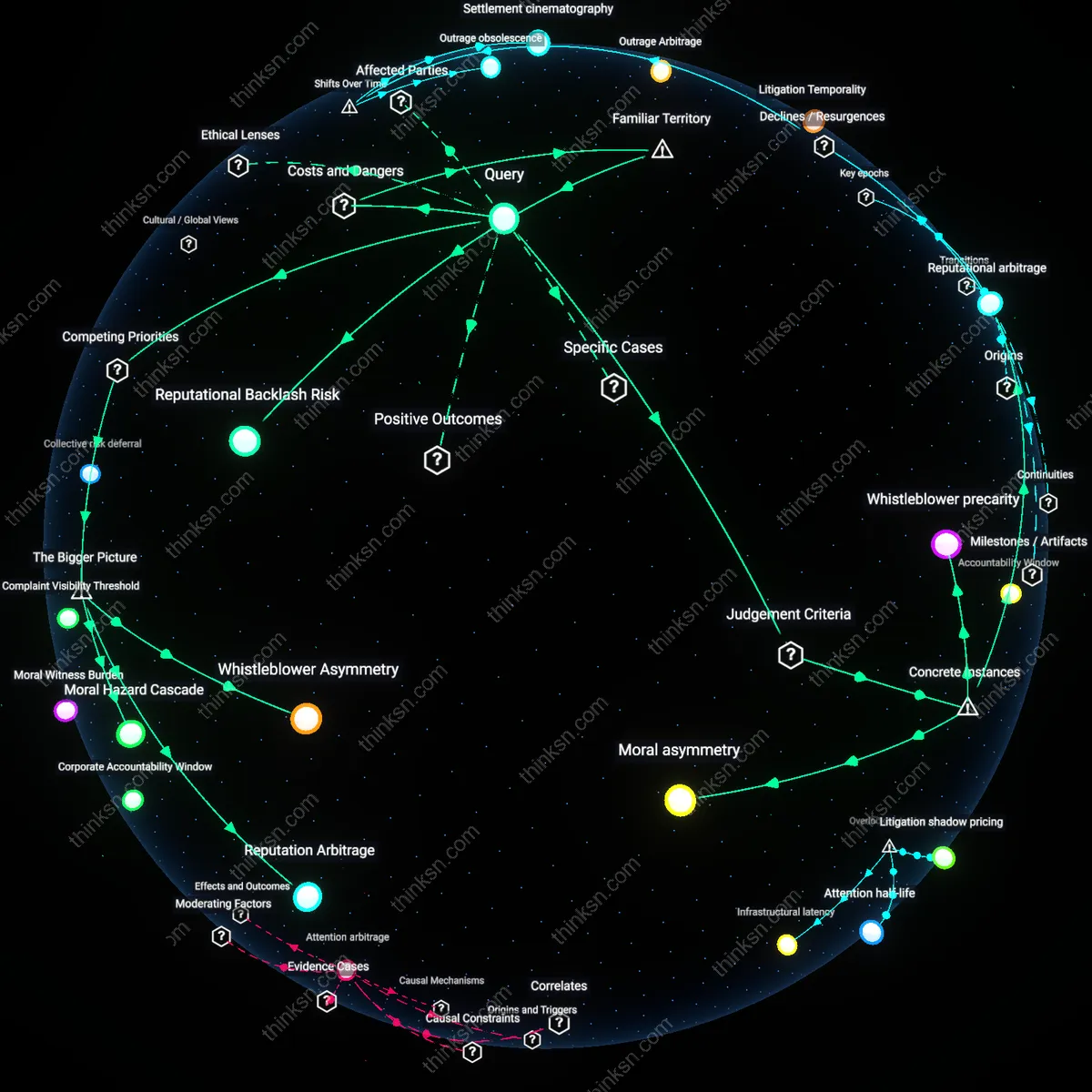
Publicly Confronting Sexism: Long-Term Relational Cost vs Personal Integrity?
Analysis reveals 8 key thematic connections.
Key Findings
Familial Reputation Economy
Confronting a sibling’s sexist remarks risks destabilizing an unspoken hierarchy where moral authority and social standing within the family are allocated not by ethical consistency but by perceived loyalty and emotional labor management; the sibling, parents, and extended kin implicitly participate in a reputation economy where calling out transgressions recalibrates affective debts, often penalizing the challenger for disrupting relational equilibrium. This system operates through annual gatherings, inheritance negotiations, and caregiving expectations, where silence functions as collateral for future support—revealing that the primary harm of confrontation is not emotional rupture but the long-term downgrading of one’s claim to collective belonging. The non-obvious insight is that resistance is filtered through status preservation, not moral clarity.
Gendered Silence Contract
Silently accepting sexist remarks reproduces a gendered silence contract in which female or nonbinary siblings are expected to absorb linguistic violence as part of their assigned role in maintaining familial harmony, a norm enforced not only by the offending sibling but also by neutral parties like parents who prioritize peace over accountability. This contract operates through differential emotional taxation—where speaking up triggers disproportionate backlash or dismissal—revealing that the personal harm of silence is not merely psychological but constitutive of a longer-term subjection to unacknowledged labor. The challenge lies in recognizing that inaction is not passive but an enforced compliance with a system that penalizes boundary-setting as betrayal.
Intergenerational Precedent Debt
Choosing to confront or remain silent accumulates intergenerational precedent debt, where the decision becomes a binding reference point for younger siblings and cousins navigating their own moral responses to oppression, with the original actor serving as a de facto institutional model within the kinship network. This mechanism functions through observation and implicit norm transmission during shared rituals like holidays or funerals, where the absence of challenge normalizes complicity more effectively than explicit endorsement; the underappreciated consequence is that personal risk is not individual but governance—each silence or confrontation sets policy for future conduct. This reframes the act as a form of informal jurisprudence rather than interpersonal conflict.
Relational accountability
One weighs the long-term relational impact of confronting a sibling's sexist remarks by prioritizing relational accountability over individual comfort, because sustained family dynamics normalize behaviors through unchallenged repetition. When a sibling voices sexist remarks and they go unaddressed, the silence functions as tacit endorsement within the kinship system, reinforcing hierarchical gender norms through what appears to be neutrality. The mechanism operates through family-as-institution, where private interactions reproduce broader patriarchal structures via low-stakes, high-frequency affirmations. The non-obvious insight is that refusing silence is not merely personal integrity but a deliberate act of institutional resistance within a microsocial domain structured by unspoken loyalties.
Emotional tax
One must weigh confrontation against the personal harm of silence by recognizing that unchallenged sexist remarks impose an ongoing emotional tax on marginalized kin, particularly women and gender-nonconforming family members. This tax accumulates through repeated exposure to demeaning speech, enforced by familial expectations of harmony and respect for hierarchy, which pressure targeted individuals to absorb harm to preserve peace. The system at work is the domestic economy of affect, where emotional labor is asymmetrically distributed to maintain relational stability in unequal systems. The insight often overlooked is that silence isn’t passive—it actively extracts a durable, compounding cost from those already disadvantaged within kinship networks.
Relational Debt
One must confront the sibling because failing to do so reproduces patriarchal bargain logics embedded in mid-20th century family systems, where women exchanged silence for domestic security, a mechanism now destabilized by post-1970s feminist consciousness that reframes silence as complicity; this shift reveals that withheld confrontation accumulates relational debt—unacknowledged harms that corrode kinship over time under liberal individualism’s demand for authentic expression.
Ethical Asymmetry
The obligation to confront emerges from a post-Civil Rights recalibration of moral responsibility in familial spaces, where private behavior is no longer exempt from public ethics—specifically, the late-20th century shift that redefined dignity as a non-derogable claim across all social domains; this transition produces ethical asymmetry, where the psychological cost of silence now outweighs relational risk due to expanded accountability norms once reserved for institutional settings.
Kinship Refraction
Confrontation must be weighed through the lens of neoliberal subjectivity that emerged in the 1990s, where self-actualization became a moral imperative and emotional labor was recast as personal responsibility rather than familial duty; this shift refracts kinship obligations through therapeutic discourse, producing kinship refraction—the splintering of collective family identity into individualized moral trajectories that make silence a form of self-betrayal.