Mediation or Disengagement: Tackling Parental Xenophobia Effectively?
Analysis reveals 5 key thematic connections.
Key Findings
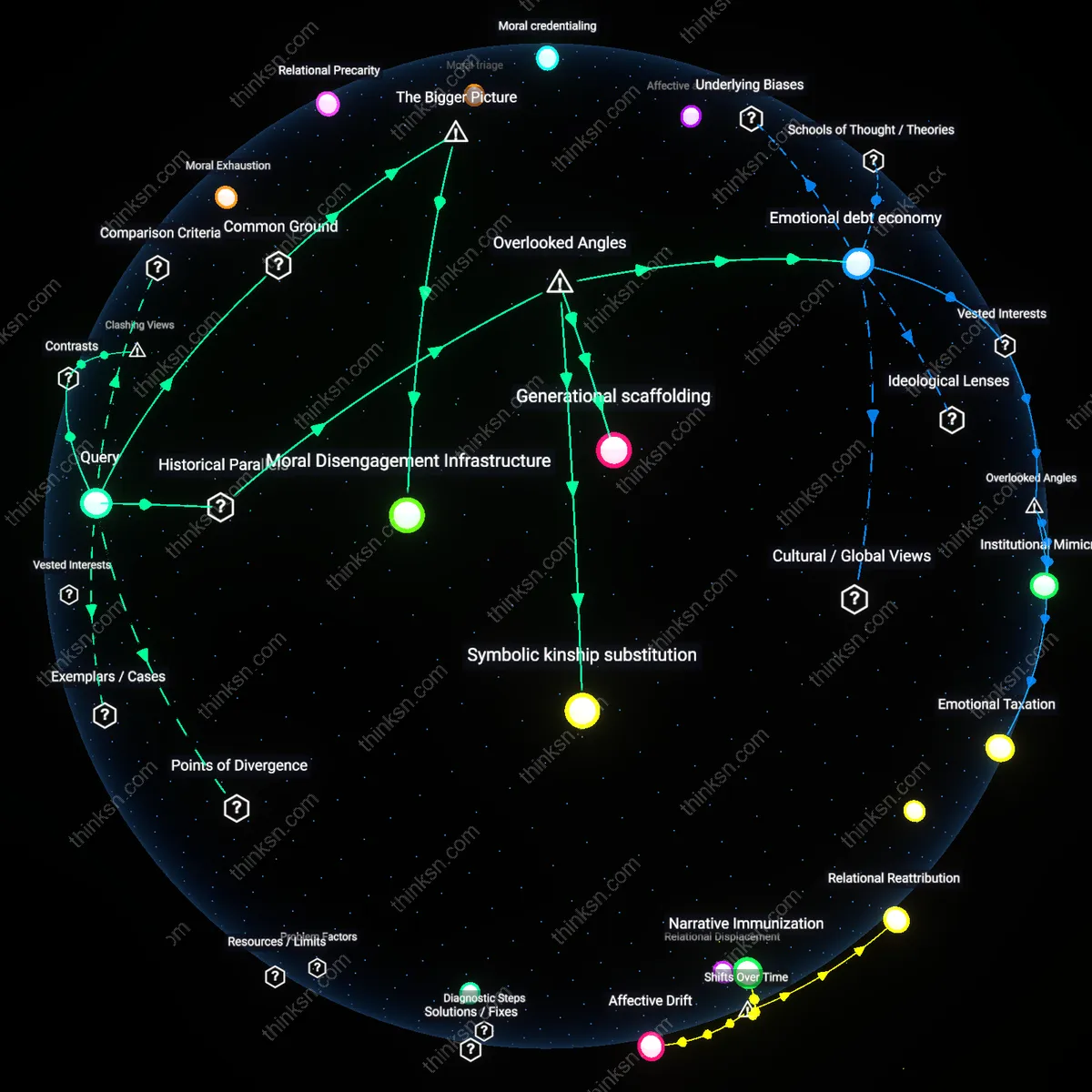
Generational scaffolding
Family mediation is more effective than unilateral disengagement in mitigating a parent's entrenched xenophobic beliefs when successive younger family members systematically model inclusive behaviors across repeated, low-stakes interactions—such as shared childcare or meal preparation—because these routine encounters create implicit normative pressure that bypasses ideological defense mechanisms; this dynamic mirrors how postwar German families gradually normalized democratic values through intergenerational exposure to Western media and school curricula, not through confrontation; what's overlooked is that mediation’s power lies not in dialogue but in the cumulative, invisible reinforcement of alternative social templates by those the parent is biologically or emotionally invested in protecting and pleasing.
Emotional debt economy
Unilateral disengagement can paradoxically strengthen a parent’s xenophobic beliefs by converting familial estrangement into a narrative of victimization that feeds into broader identity-based resentment, much like how politically isolated communities in 19th-century Ireland interpreted British withdrawal as confirmation of colonial betrayal; the unacknowledged mechanism is an emotional debt economy—where adult children’s physical or emotional absence is unconsciously registered as a moral default, triggering defensiveness rather than self-reflection; this reframes disengagement not as boundary-setting but as a form of relational foreclosure that may deepen ideological rigidity by removing access to corrective emotional feedback.
Symbolic kinship substitution
Family mediation gains traction over disengagement only when third-party figures—such as grandchildren, a trusted pastor, or a long-term neighbor—are symbolically recruited into the family’s moral circle and begin to embody countervailing values without triggering identity threat, a phenomenon observed in the gradual integration of Roma communities in post-dictatorship Portugal, where non-kin mediators softened ethnic boundaries by occupying roles traditionally associated with kinship duties; what's missed is that mediation works not through direct persuasion but through symbolic kinship substitution, where new relational nodes are anointed with ancestral authority, thereby allowing belief revision without perceived lineage betrayal.
Disengagement agency
Unilateral disengagement from a parent with entrenched xenophobic beliefs is not a surrender to familial fragmentation but a strategic assertion of moral boundary-making that reclaims agency in contexts where persuasion is structurally doomed. When adult children in urban centers like Toronto or Melbourne cut contact, they are not avoiding conflict but enacting a protective disengagement that prioritizes psychological sustainability over normative family cohesion, particularly when decades of exposure to far-right media have calcified the parent’s worldview into an epistemic closed loop. This contradicts the dominant narrative that disengagement is a failure of duty, exposing instead how silence and distance can constitute an operative form of resistance when dialogue only serves to legitimize abuse under the guise of 'healing'.
Moral Disengagement Infrastructure
Unilateral disengagement often amplifies entrenched xenophobic beliefs by activating a moral disengagement infrastructure that reinterprets isolation as persecution and confirms worldview coherence. When family severs contact, the parent enters a feedback-lean environment where beliefs face no immediate challenge, enabling cognitive realignment with ideologically congenial communities—online networks, partisan media, or peer enclaves—that validate exclusionary narratives. The non-obvious dynamic is that withdrawal, intended as moral boundary-setting, becomes a systemic trigger for belief entrenchment by removing the very conditions—proximate critique, emotional reciprocity—that disrupt ideological rigidity. The key actors are algorithmic platforms and affinity-based social circuits that fill the relational void, leveraging loneliness and grievance to naturalize xenophobia as defensive identity preservation.