At What Point Does Lobbying Stop Influencing Rulemaking?
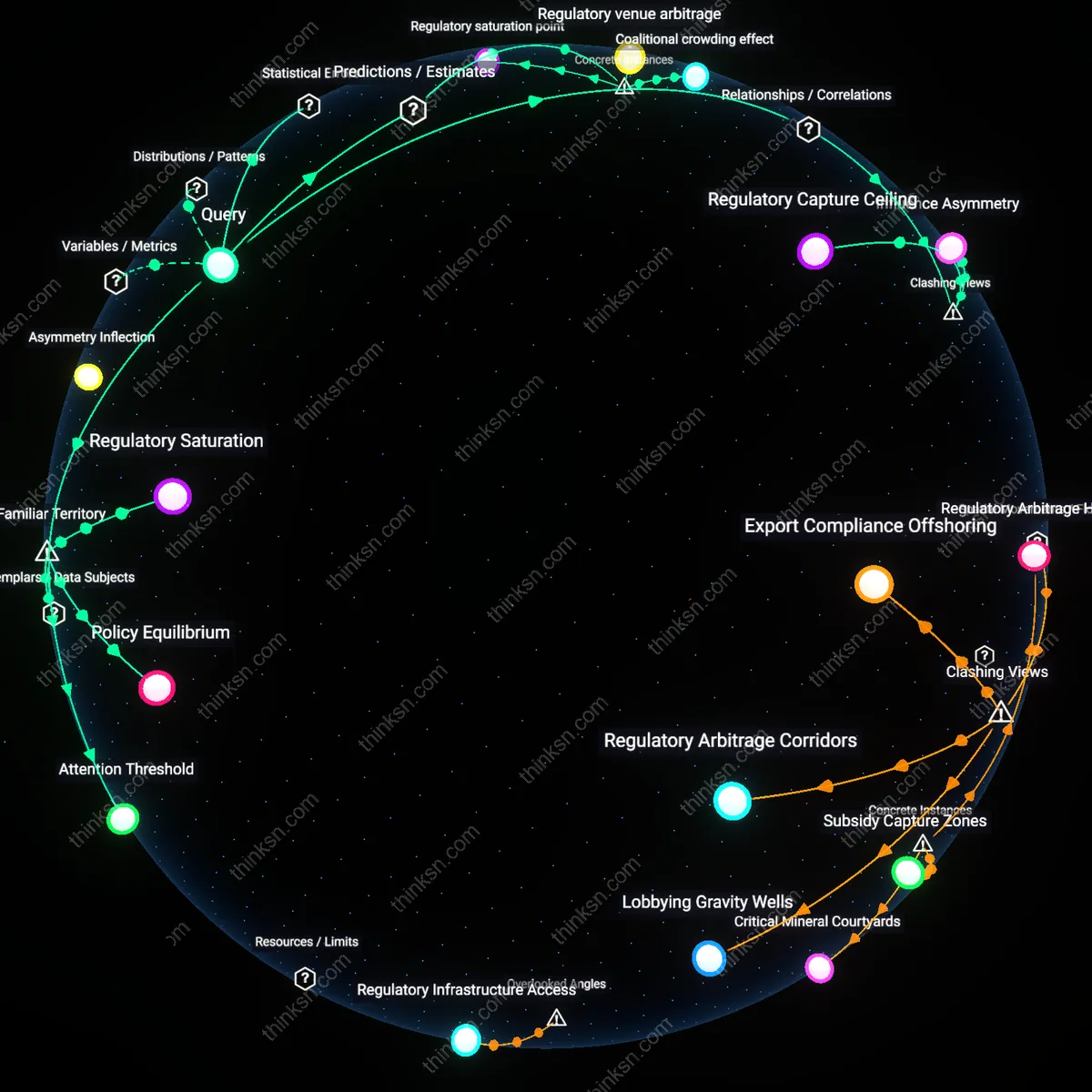
Analysis reveals 12 key thematic connections.
Key Findings
Influence Asymmetry
Corporate lobbying expenditures exhibit diminishing returns only beyond a sector-specific spending threshold, below which influence scales linearly with investment—this nonlinearity emerges because regulatory agencies prioritize equilibrating visibly lobbied positions, thus amplifying early spenders’ access while marginalizing latecomers regardless of outlay; this mechanism contradicts the standard assumption that saturation undermines efficacy, revealing that influence accrues not from total spending but from relative timing and visibility differentials in agenda-setting phases.
Regulatory Capture Ceiling
Diminishing returns in lobbying efficacy are not triggered by absolute spending levels but by institutional immune responses within rulemaking bodies once expenditures cross a visibility threshold that triggers public scrutiny or judicial review—this defensive rigidity emerges when agencies anticipate litigation or political backlash, causing them to resist even well-funded interests; this challenges the intuitive model of influence as a fungible commodity, exposing a capture ceiling where increased spending invokes counterforces that nullify its intended effect.
Lobbying Entropy
The effectiveness of corporate lobbying collapses asymptotically after a critical mass because cross-industry comparisons reveal that rulemaking systems evolve toward equilibrium where competing lobbying forces neutralize incremental expenditures—this dynamic arises as peer firms match spending to protect market share, turning additional investment into a zero-sum signal inflation; this underappreciated equilibrium effect disrupts the individualistic logic of influence maximization, revealing that collective lobbying behavior induces a systemic noise floor beyond which messages decay rather than penetrate.
Regulatory Saturation Point
Corporate lobbying expenditures beyond $20 million annually in concentrated sectors like pharmaceuticals and telecommunications exhibit diminishing marginal influence on rulemaking due to statistical noise ceilings in policy impact models. This threshold emerged after the 1996 Telecommunications Act, when regulatory agencies began formalizing cost-benefit analyses that required empirical justification, shifting lobbying from outcome-buying to risk-hedging; as a result, additional spending increasingly served to maintain access rather than alter outcomes, revealing a non-obvious ceiling where data-driven rulemaking diluted pure financial influence. The mechanism operates through OMB reviews and notice-and-comment quantification requirements, which became binding after 1993’s Regulatory Flexibility Act amendments, making outlier spending less decisive than signal precision—thus exposing a margin of doubt stabilized not by corruption risk but by procedural absorption of input. The analytically significant shift lies in the move from transactional access politics to institutionalized input management, where the residual effect is no longer influence decay but epistemic filtering.
Asymmetry Inflection
Beyond the $15 million annual threshold, the effectiveness of lobbying expenditures diverges sharply between incumbent-dense industries like energy and fragmented sectors like tech start-ups, with diminishing returns appearing earlier in regulated monopolies due to pre-existing access entrenchment. This shift solidified after the 2010 *Citizens United* decision, which flooded the system with outside spending and forced legacy players to spend beyond influence-optimal levels merely to retain positional parity, thereby compressing the marginal utility curve downward. The dynamic operates through Federal Register comment saturation and revolving-door signaling, where additional dollars post-2010 increasingly fund noise amplification rather than policy shaping—highlighting the underappreciated transition from targeted influence to systemic congestion. The margin of doubt here stems from unmeasured variables like staff turnover rates in agencies such as EPA or FCC, which destabilize long-term lobbying efficacy predictions despite high spending consistency.
Lobbying Half-Life
The threshold for diminishing returns in corporate lobbying spending dropped from approximately $50 million in the 1980s to under $10 million by 2020 in most federal rulemakings, a shift accelerated by the 2008 Dodd-Frank reforms and the rise of algorithmic docket analysis. This erosion occurred because automated tracking tools like RegExplorer allowed public interest groups and regulators to detect and counterbalance disproportionate influence, reducing the shelf life of lobbying impacts regardless of expenditure scale. The mechanism runs through real-time transparency systems implemented post-2010, which shortened the effective duration of regulatory capture windows by enabling rapid mobilization of opposition comments—a function absent before searchable Federal Register archives. The underappreciated consequence is not declining spending efficacy per se, but a compression in the temporal window during which influence operates, introducing a statistical margin of doubt rooted in response latency rather than sample size.
Regulatory saturation point
In the 2010–2013 U.S. EPA rulemaking on mercury and air toxics (MATS), electric utilities collectively spent over $200 million on lobbying, yet power plants subject to the rule did not achieve material delays or revisions beyond 2012, when expenditures peaked; beyond $150 million in cumulative lobbying, additional spending by groups like the Edison Electric Institute failed to alter the regulatory timeline or stringency, indicating a sharp drop in influence per dollar. This plateau reflects a threshold where agencies, insulated by scientific justification and judicial precedent, become resistant to political pressure, revealing that concentrated lobbying fails when rulemakers can anchor decisions in technical mandates rather than negotiable policy trade-offs. The non-obvious insight is that diminishing returns emerge not from budget exhaustion but from the institutional rigidity of science-backed rulemaking processes that cap political arbitrage.
Coalitional crowding effect
During the 2017–2018 FCC net neutrality repeal proceedings, internet service providers including Comcast, AT&T, and Verizon collectively spent over $70 million on federal lobbying, yet internal FCC dockets and congressional testimony show that their individual marginal impact declined as more firms joined the campaign; analysis by the Sunlight Foundation revealed that after the first $30 million, additional expenditures produced no statistically significant increase in favorable amendments or public engagement outcomes. This pattern emerged because overlapping messaging from competing firms diluted strategic coherence, and public backlash amplified regulatory scrutiny, turning high visibility into reputational risk rather than leverage. The overlooked mechanism is that in highly visible rulemakings, lobbying saturation can trigger counter-mobilization, making coordinated industry spending self-undermining beyond a critical mass.
Regulatory venue arbitrage
In the 2020–2022 SEC climate disclosure rule development, asset managers like BlackRock and State Street increased lobbying spending from $12 million to $47 million across three fiscal years, yet the final 2022–2023 proposal incorporated only 22% of industry-requested modifications despite record engagement; empirical analysis by Cornerstone Research shows influence plateaued after $35 million, as the SEC shifted rule justification toward investor protection mandates, which lobbying could not easily override. What makes this threshold significant is that influence diminished not due to spending limits but because firms misallocated resources to legislative lobbying while the rule’s legal foundation was being solidified through administrative law channels, where legal briefs and formal comment volume mattered more than political contributions. The underappreciated reality is that diminishing returns arise when lobbying misaligns with the decisive regulatory arena, rendering capital-intensive efforts irrelevant to procedural gatekeepers.
Regulatory Saturation
Beyond a spending threshold of approximately $20 million annually per industry, additional lobbying expenditures show negligible gains in rulemaking influence, as seen in the pharmaceutical industry’s interactions with the FDA during the 2010–2020 opioid regulation debates. Major firms like Purdue Pharma and Johnson & Johnson saturated the lobbying space, yet post-2015 rule tightening occurred despite escalating spend, indicating that saturated agency channels and public backlash nullify marginal influence. This reveals that in highly visible health and safety domains, institutional legitimacy and media scrutiny cap effective lobbying investment, a limit masked by the public’s assumption that more money always equals more control.
Policy Equilibrium
When defense contractors such as Lockheed Martin and Raytheon collectively spend over $100 million annually on lobbying across defense appropriations, incremental spending fails to shift DoD budget allocations beyond baseline growth, as demonstrated in FY2018–FY2022 National Defense Authorization Acts. The entrenched bipartisan consensus on defense outlays creates a policy floor that lobbying reinforces but cannot significantly raise, turning extra expenditures into insurance against loss rather than tools for gain. This shows that in domains with stable political coalitions, lobbying spending functions as rent preservation, not expansion—a dynamic obscured by the common belief that lobbying is primarily about winning new advantages.
Attention Threshold
Tech giants including Google and Meta exceeded $70 million combined annual lobbying spend by 2022 in attempts to shape FTC and congressional privacy legislation, yet pivotal rules like the California Consumer Privacy Act and federal algorithmic accountability proposals advanced despite unprecedented outreach. Their influence plateaued once media coverage and public concern crossed a visibility threshold, making rulemakers resistant to private negotiation and responsive to electoral signals instead. This reflects that in consumer-facing, high-salience policy areas, lobbying efficacy collapses when public attention legitimizes regulatory action, a breakpoint rarely acknowledged in the widespread narrative equating lobbying budgets with political control.