Is Online Mastery Worth the Cost When Hiring Doubts Loom?
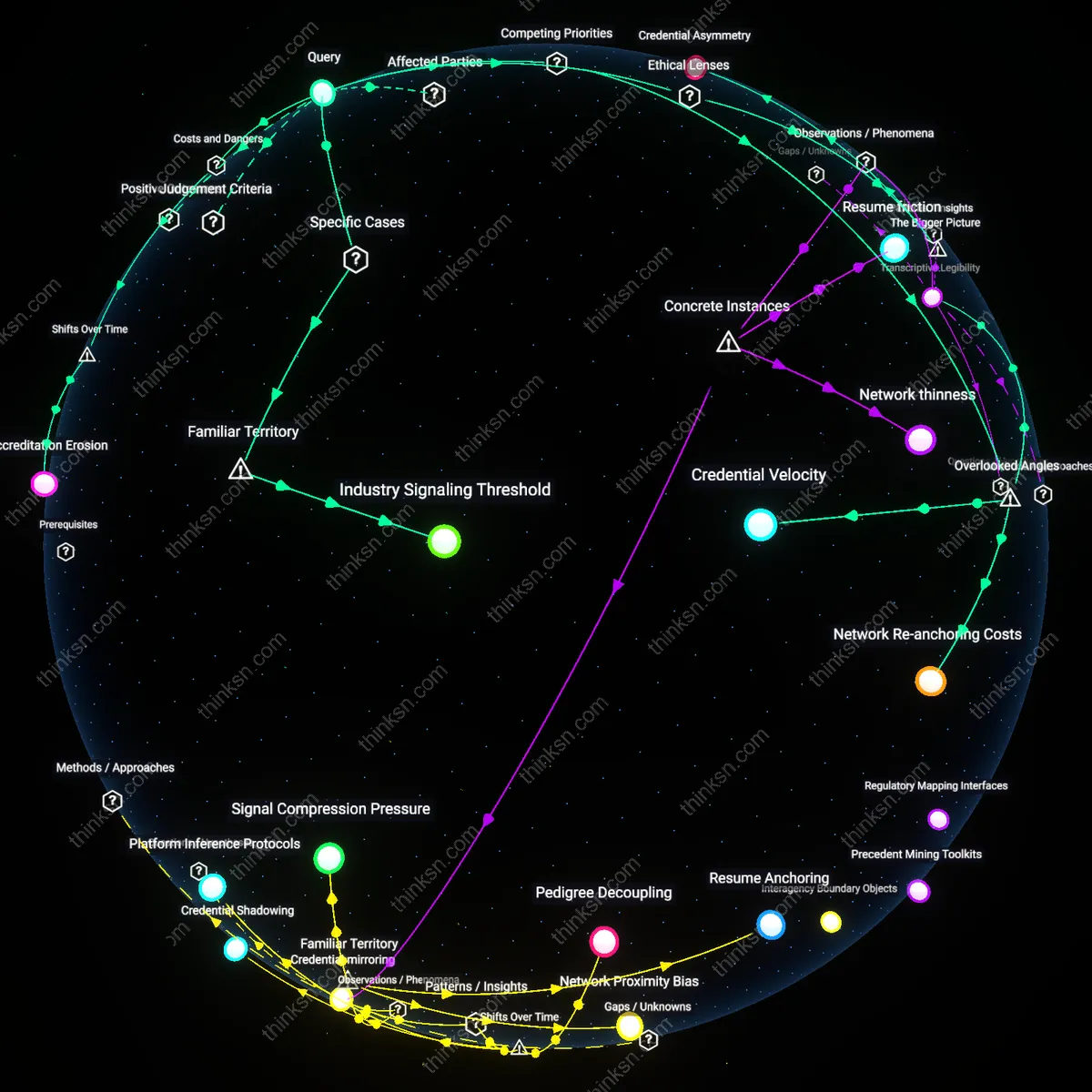
Analysis reveals 8 key thematic connections.
Key Findings
Accreditation Erosion
Pursuing an online master's to cut costs exposes mid-career professionals to employer skepticism that has intensified since the post-2010 expansion of for-profit online programs, which flooded the market with degrees of inconsistent rigor and triggered a defensive recalibration in hiring practices, particularly in regulated or prestige-sensitive industries like finance and law. This shift transformed employer perception from evaluating format-neutral credentials to silently filtering against online degrees by default, especially when applicants transition industries where pedigree signals trust and training. The non-obvious danger is not the degree’s quality but the institutionalized doubt now embedded in applicant tracking systems and recruiter heuristics—residually producing a credentialing penalty that disadvantages cost-conscious career changers despite identical curricula.
Credential Inflation Debt
Since the early 2020s, as online master’s programs became normalized during the pandemic, the very accessibility that makes them cost-effective has triggered a counter-response among employers in emerging sectors like AI governance and green energy, who now treat graduate degrees—especially online ones—as baseline filters rather than differentiators, forcing career changers into further upskilling or unpaid transitional roles. This marks a shift from the 2000s, when a single master’s, even online, conferred entry advantage; today, the devalued credential functions more as a toll than a ticket, particularly when switching industries with opaque hiring codes. The residual danger is not bias per se but systemic overproduction of credentials that traps cost-saving professionals in escalating investments, where savings on tuition yield long-term career debt through delayed placement and diminished returns.
Credential Velocity
Mid-career professionals should prioritize online degrees when the hiring velocity in a target industry favors rapid signal iteration over pedigree validation, because digital-native sectors like tech-enabled healthcare or climate fintech often evaluate candidates on demonstrable project velocity rather than institutional lineage. In these environments, the accelerated completion of an online degree—coupled with immediate application of coursework to public portfolios—creates a feedback loop where hiring managers update perceptions faster than bias can consolidate, effectively compressing the time between credential acquisition and legitimacy. This dynamic is overlooked because most analyses treat hiring bias as static, but in fast-evolving industries, the pace at which a credential enters and circulates within evaluative systems can matter more than its format—making the online degree’s temporal efficiency a covert advantage.
Network Re-anchoring Costs
The true cost of an online master’s is not tuition but the unseen effort required to re-anchor professional identity within a new industry’s social infrastructure, because physical campuses provide involuntary exposure to industry-specific rituals, unspoken norms, and spatialized networking that online programs cannot replicate through Zoom happy hours or LinkedIn groups. When transitioning into relationship-heavy fields like urban planning or luxury retail, mid-career professionals pay not in dollars but in access delay—meaning the online saver gains financial headroom but loses temporal leverage in building trust-based referrals, which are often triggered by analog co-presence. This is rarely accounted for in ROI calculations, yet it determines how quickly a candidate becomes ‘known’ in a new ecosystem, making bias not an employer trait but a network effect enforced through proximity.
Transcriptive Legibility
Professionals should weigh online degrees not by employer bias per se but by how organizational HR machinery ‘reads’ educational provenance through automated tracking systems, because in Fortune 500 firms and government contractors, applicant tracking systems (ATS) often parse degree legitimacy through domain affiliation—flagging regionally accredited but non-residential programs as requiring additional verification. This creates a hidden bottleneck where even if a hiring manager is neutral, the transcript’s metadata (e.g., delivery mode, campus zip code) triggers procedural delays or filtering thresholds invisible to the applicant. The overlooked reality is that institutional bias is increasingly algorithmic rather than intentional—shifting the risk from interpersonal prejudice to infrastructural illegibility, which undermines cost savings if the degree fails to generate interview conversions despite technical compliance.
Credential Asymmetry
Mid-career professionals should prioritize online degrees when transitioning industries because digital credentialing systems increasingly decouple skill signals from mode of acquisition, a shift accelerated by labor market platforms like LinkedIn and Coursera that normalize non-traditional credentials. This transition is sustained by algorithmic hiring tools that weight competencies over institution types, weakening historical employer bias—especially in tech and digital sectors—where verification of skills via portfolios or certifications supersedes pedigree. The underappreciated mechanism is that employers, under pressure to fill skill gaps quickly, are de facto standardizing on outcomes-based evaluation, which reduces the cost-benefit trade-off between online affordability and perceived legitimacy.
Institutional Lag
Professionals should discount employer bias in online degrees because regulatory accreditation frameworks—such as regional U.S. accreditors (e.g., Higher Learning Commission) and federal financial aid eligibility—already treat online and on-campus programs equivalently, legally neutralizing most formal grounds for discrimination. The persistence of bias reflects organizational inertia in traditional industries like law or finance, where HR practices have not adapted to accreditation parity, creating a misalignment between legal doctrine and internal hiring norms. The overlooked consequence is that cost savings from online programs become strategic advantages for career-changers entering sectors where regulatory alignment outpaces cultural adaptation, allowing early adopters to exploit this lag.
Industry Signaling Threshold
Professionals aiming to shift into regulated sectors like clinical psychology or structural engineering must treat online degrees as insufficient due to accreditation gatekeeping enforced by bodies like ABET or APA, where in-person clinical hours and residency components are non-transferable. In these fields, the employer bias isn't cultural but legally codified, making the mode of study a compliance requirement rather than a perception issue. This exposes that what people call 'employer bias' often conflates prejudice with statutory signaling thresholds that filter candidates before human judgment even applies.